Amazon Biotope Aquarium: Fish, Plants, and Setup Guide
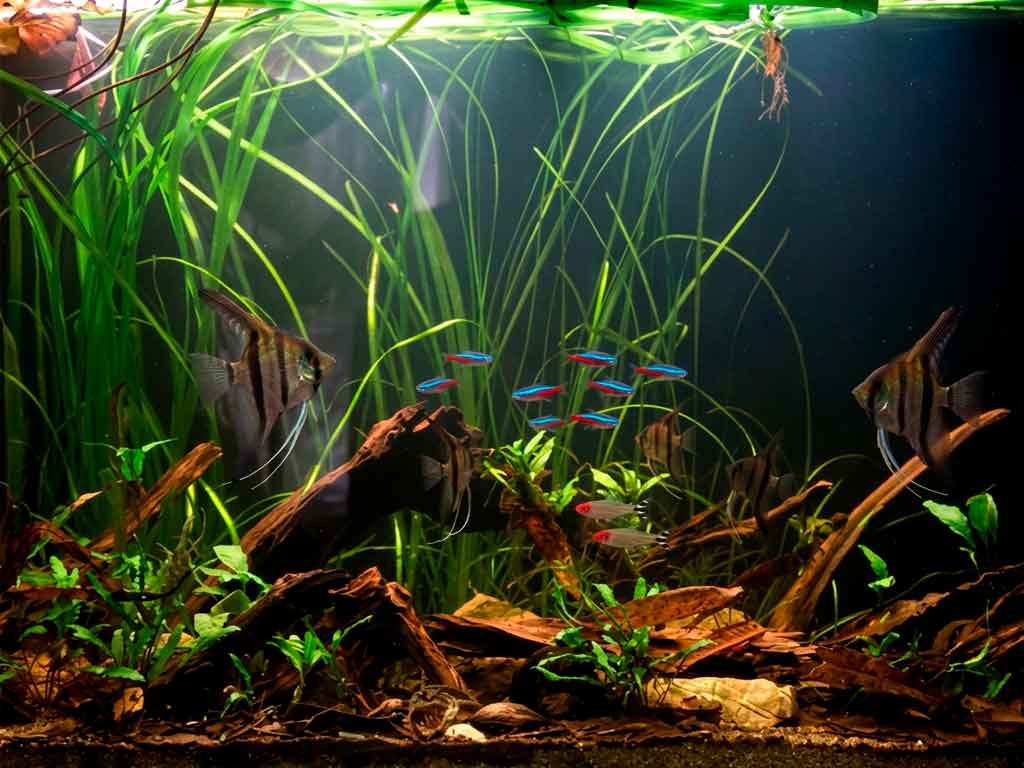
An Amazon biotope aquarium recreates a blackwater river: soft, acidic, tea-colored water. Those conditions decide the sand, the wood, the plants and almost every fish on the list.
Aim for pH 6.0 to 7.0, GH 1 to 5, KH 1 to 2 and 24 to 28 °C (75 to 82 °F). Get that stable, and the tank looks like the Rio Negro instead of a community tank with brown water.
What is an Amazon biotope aquarium?
A biotope tank copies one habitat from one region. For the Amazon that means the fish, plants and wood come from the same river system, and the water matches what they meet in the wild.
The Amazon basin is too large to copy as a whole. It covers blackwater rivers such as the Rio Negro, clearwater rivers such as the Tapajós, and whitewater rivers such as the Solimões. Most home builds follow one of the first two.
Many fish sold as Amazonian come from the Orinoco basin instead, which shares the same soft, acidic water. A tank built for one usually suits the other, which is why the two names appear together in hobby guides.
| Rule | What it means in practice |
|---|---|
| One region | Fish, plants and wood from the Amazon basin |
| Soft, acidic water | Low GH and KH, pH under 7 |
| Leaf litter and wood | Tannins, cover and food for microfauna |
| Dim light | Floating plants and a low-output LED |
A biotope is not a theme. Brown water and a plastic log do not make a tank Amazonian if the fish come from three continents.
Which Amazon habitat are you copying?
Three habitats cover most builds, and the choice sets the substrate, the flow and the fish.
| Habitat | What it looks like in a tank |
|---|---|
| Blackwater river | Tea-colored water, sand, drowned wood, leaf litter, very low hardness |
| Clearwater stream | Clear water, sand and rock, brighter light, more plants |
| Flooded forest | Roots and branches from top to bottom, dim light, deep leaf litter |
Blackwater river
Tea-colored water, white sand and drowned wood. The Rio Negro is the famous example, and the water is stained by tannins and humic acids from vegetation rotting in the forest.
Clearwater stream
Green-blue water rather than brown, sand and rock on the bottom, and enough light for plants. The Tapajós is the reference, and it suits Echinodorus better than a blackwater tank.
Flooded forest
The river rises into the trees for part of the year, so the tank is mostly roots and branches. Fish use the wood at every level, and the light is dim even at noon.
In parts of the basin, that water can fall near pH 3.5 (PortalPez).
That number is a warning, not a target. A tank at pH 3.5 has almost no carbonate buffer, and a small mistake moves the pH fast.
What water parameters does an Amazon biotope need?
The table is the short version, and the notes under it cover the number that causes most crashes.
| Parameter | Target |
|---|---|
| pH | 6.0 to 7.0 |
| GH (general hardness) | 1 to 5 dGH |
| KH (carbonate hardness) | 1 to 2 dKH |
| Temperature | 24 to 28 °C (75 to 82 °F) |
| Flow | Gentle, surface movement |
| Light | Low to moderate |
KH is the number to watch. At 0 dKH there is nothing to stop the pH falling when you add leaves or wood, and a swing of a full point overnight stresses fish.
Two ways to keep it stable:
- Test KH before and after every water change for the first month.
- If your tap water is hard, mix it with RO water rather than using pH-down chemicals.
Never chase a pH number with acid. A stable 6.5 beats a pH that drops to 5.5 every time you add catappa leaves.
Room temperature matters as much as the heater setting. A tank that holds 26 °C (79 °F) all year is safer than one that swings between 24 and 29 °C (75 and 84 °F) because a window is open.
How do you build the substrate and hardscape?
Build in layers, and let the wood and leaves do the work. Most of the habitat is wood and sand, not plants.
- Add a 4 to 6 cm (1.6 to 2.4 in) layer of fine silica sand, grain size under 2 mm.
- Test the sand and any rock with a drop of vinegar; if it fizzes, it contains carbonate and does not belong here.
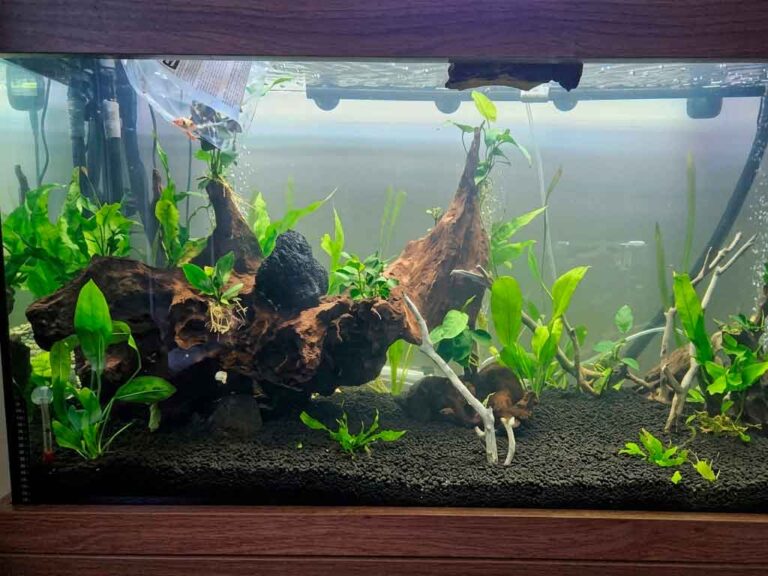
- Place driftwood or mangrove root across the tank, with branches reaching toward the surface.
- Add a few rounded stones around the wood base.
- Scatter dried leaves over part of the substrate, not the whole floor.
- Keep the front third open so bottom fish have sand to sift.
| Material | Why it belongs |
|---|---|
| Fine silica sand | Inert, safe for corydoras barbels, light enough to show fish color |
| Driftwood and roots | The structure of a flooded forest and cover for fish |
| Rounded stones | Clearwater streams and territories for dwarf cichlids |
| Catappa or oak leaves | Tannins, cover and food for microfauna |
| Alder cones | A slow, steady release of tannins |
Two details that separate a good Amazon tank from a brown one:
- Choose light sand. Dark gravel makes many Amazon fish darken and lose color, which is the opposite of what you want.
- Boil or soak wood before it goes in. Fresh wood leaches sap and tannins and clouds the water for weeks.
Which plants belong in an Amazon biotope?
The Amazon has thousands of plant species, but only a few reach the trade. That short list is normal.
| Plant | Where it goes |
|---|---|
| Echinodorus (Amazon sword) | Background, heavy root feeder |
| Cabomba | Background, fast grower |
| Ludwigia | Background or midground, red under good light |
| Heteranthera zosterifolia | Midground, bright light |
| Salvinia or Limnobium | Floating cover, dims the light below |
| Pistia | Floating, large, good for big tanks |
Echinodorus is the genus most associated with the region, and it does the heavy lifting in most Amazon layouts (NAscapers). It feeds through its roots, so give it a nutrient-rich base or root tabs.
The aquarium plants guide covers the species that tolerate low light, which suits a blackwater tank better than a high-tech planted setup.
None of these plants needs CO2 injection. A blackwater tank runs at low light, and CO2 does little for plants that are already limited by light. Root tabs for the Echinodorus are enough.
Which fish go in each zone?
Stock by layer. The community aquarium fish by zone guide explains the principle; this is the Amazon version.
| Zone | Amazon species |
|---|---|
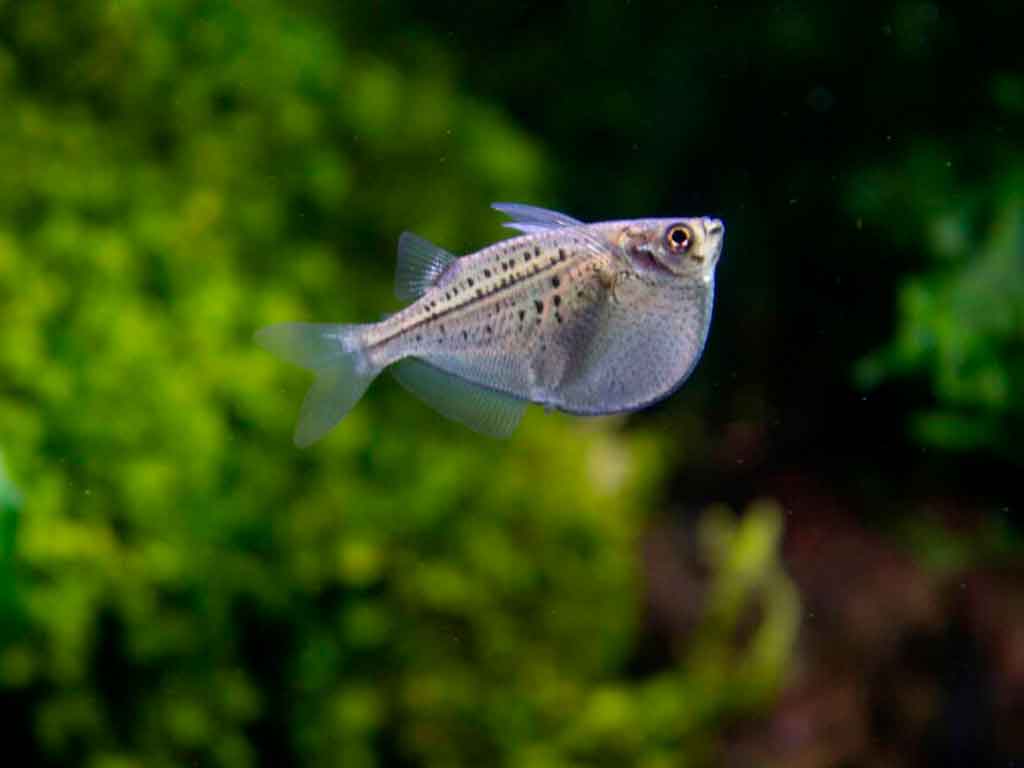
| Surface | Marbled hatchetfish, pencilfish |
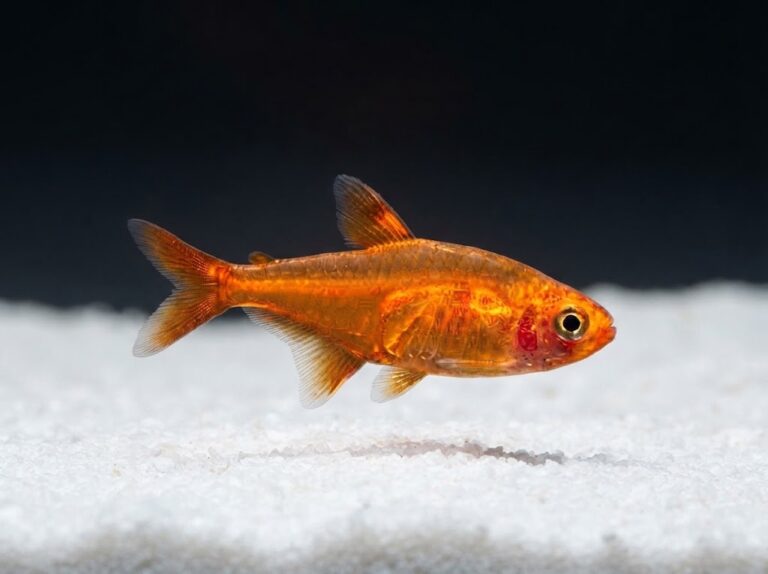
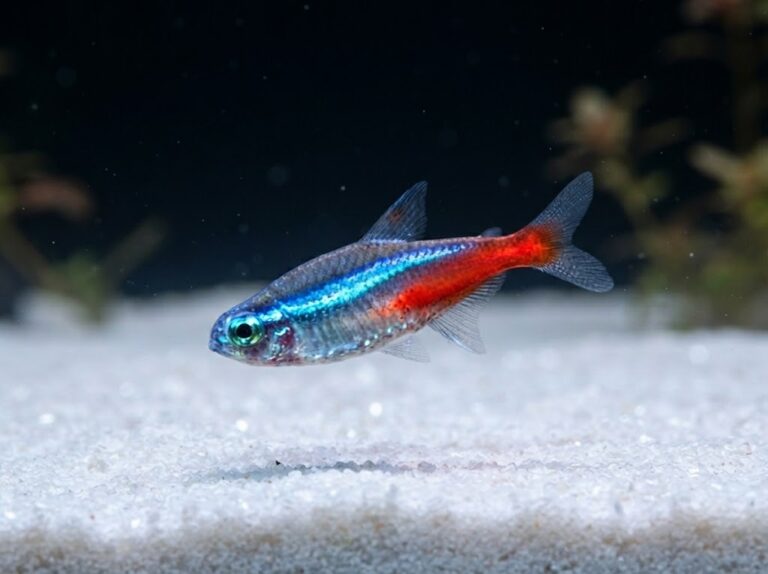
| Midwater | Neon tetra, cardinal tetra, rummy-nose tetra, ember tetra |
| Bottom | Panda cory, pygmy cory, Apistogramma |
| Algae crew | Otocinclus, bristlenose pleco |
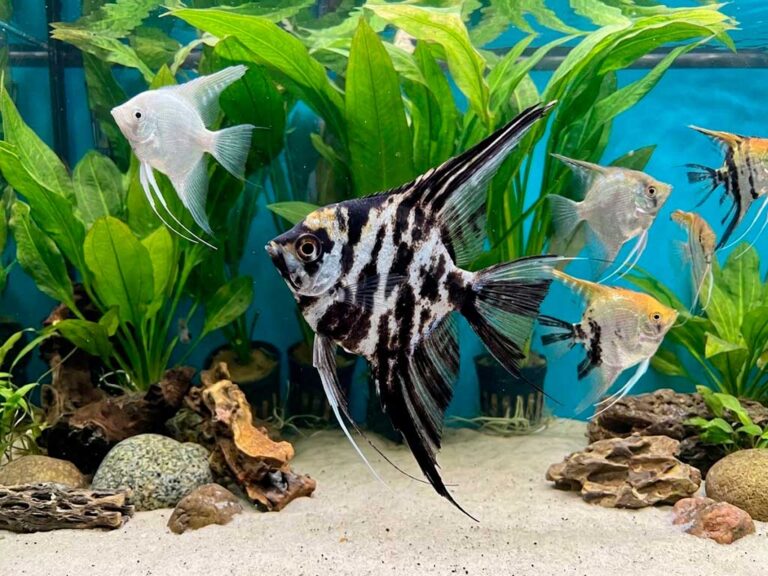
| Centerpiece | Angelfish, discus |
Rules that prevent most problems:
- Buy tetras in groups of 8 or more. Six is the floor, not the target.
- Keep one midwater school. Three schools compete for the same space.
- Skip discus until the tank is at least 200 L (53 US gal) and a year mature.
- Do not put adult angelfish with neon tetras; a 15 cm (6 in) angelfish can eat a 2.5 cm (1 in) tetra.
- Add Otocinclus to a tank with algae already growing, not to a new one.
The neon tetra care guide and the angelfish care guide cover the two species most builds start with. For the bottom layer, the panda cory care guide explains why sand matters.
Which Amazon fish should you avoid?
Several Amazon fish are sold as community fish and outgrow or out-eat the tank.
| Fish | Why it does not fit |
|---|---|
| Oscar | Reaches 30 cm (12 in) and eats anything that fits |
| Common pleco | Reaches 40 cm (16 in) and produces heavy waste |
| Pacu | Reaches 60 cm (24 in), far beyond any home tank |
| Silver dollar | Grows to 15 cm (6 in) and eats soft plants |
| Red-bellied piranha | Needs a species tank, not a community |
The pattern is adult size. A 5 cm juvenile in a shop tank can be 30 cm in two years, and the tank that looked large on day one becomes a problem by month eighteen.
How many fish fit your tank?
These are outlines, not rules. Filtration, water changes and adult size decide the real number.
| Tank | Stocking outline |
|---|---|
| 90 cm (36 in), 100 L (26 US gal) | 10 rummy-nose tetras, 1 pair Apistogramma, 6 panda corys |
| 120 cm (47 in), 200 L (53 US gal) | 15 cardinals, 1 pair angelfish, 8 panda corys, 6 Otocinclus |
| 150 cm (59 in), 300 L (79 US gal) | 20 cardinals, 5 discus, 10 corys, 1 bristlenose pleco |
A 100 L (26 US gal) tank is the practical floor for this biotope. Below that, the school sizes that keep tetras calm do not fit, and the water volume swings too fast.
What equipment does an Amazon biotope need?
- Filter rated at four to five times the tank volume per hour, with a gentle outlet.
- Heater sized for the room, because the tank runs at 24 to 28 °C (75 to 82 °F).
- Lid, because hatchetfish jump and the room air matters for surface fish.
- Low to moderate LED on a timer, 6 to 8 hours a day.
- RO unit or a source of soft water if your tap is hard.
- Test kit for pH, GH and KH, not just ammonia and nitrate.
- A spare bag of leaves, because they break down faster than most people expect.
- A small powerhead or air stone for surface movement when the room is warm.
The aquarium water guide covers the test routine, and a dim tank is easier to keep clean than a bright one.
What does a 200 L (53 US gal) build look like?
A parts list removes most of the guesswork. This is a blackwater build for a 120 cm (47 in) tank.
| Part | Choice |
|---|---|
| Tank | 120 cm (47 in), 200 L (53 US gal) |
| Filter | Canister rated at 800 to 1000 L/h, outlet near the surface |
| Heater | 200 W, set to 26 °C (79 °F) |
| Light | 30 W LED, 6 hours a day |
| Substrate | 5 cm (2 in) of fine silica sand |
| Wood | Three pieces of driftwood, one reaching the surface |
| Leaves | Catappa and oak, replaced monthly |
| Fish | 15 cardinals, 1 pair angelfish, 8 panda corys, 6 Otocinclus |
Two choices matter more than the rest: the sand is inert and light, so it does not raise hardness or dull the fish, and the wood gives the tank its structure and the tannins that define the habitat.
How do you introduce the fish?
Slow introduction protects both the fish and the filter.
- Quarantine every group for two to four weeks before it enters the display tank.
- Float the bag for 15 to 20 minutes to match temperature.
- Drip-acclimate for 30 to 45 minutes, especially if the shop water is harder than yours.
- Net the fish into the tank and never pour shop water in.
- Add the school first, the bottom group second and the centerpiece last.
- Test ammonia and nitrite every day for the first week after each addition.
How long before you add fish?
Six to eight weeks for a new filter, and the calendar is not the test.
| Week | What to do |
|---|---|
| 1 | Set up sand, wood and filter, add an ammonia source, test daily |
| 2 to 3 | Ammonia falls, nitrite rises, keep testing |
| 4 to 5 | Nitrite falls, nitrate appears, the filter is nearly ready |
| 6 | Water change, add leaves, check KH and pH |
| 7 to 8 | Add the first school, then test daily for a week |
A tank that reads zero ammonia and zero nitrite for a week is ready. A tank that has been running for a week is not.
How do you keep blackwater stable?
Stability beats a perfect color, and the routine is short and mostly about water.
- Change 20% to 25% of the water weekly, at tank temperature.
- Top up evaporation with RO water, because minerals stay behind.
- Replace half the leaves every 4 to 6 weeks as they break down.
- Test KH weekly; if it reads 0, add a small amount of tap water or a KH buffer.
- Rinse filter media in removed tank water, never under the tap.
- Keep the lid on and the room free of drafts.
Tannins fade between water changes. That is normal, and it is also a useful gauge: when the water clears, the leaves are spent.
What mistakes ruin an Amazon biotope?
| Mistake | Fix |
|---|---|
| Dark gravel | Use light silica sand so fish keep their color |
| Calcareous sand or rock | Acid-test every material before it goes in |
| KH at 0 with heavy leaf litter | Test KH and keep it at 1 to 2 |
| Bright light over slow plants | Dim the light and add floating plants |
| Discus in a new 100 L tank | Wait for 200 L and a mature filter |
| No lid | Fit one, especially with hatchetfish |
Most of these mistakes cost money rather than fish. Test the sand before the tank is full, and the rest is patience.
Frequently Asked Questions
Build the water first, then the wood
Amazon biotope tanks fail at the water, not at the decoration. An Amazon biotope is a water project first, and the sand, wood and fish follow from it in that order, before anything else. Set the sand, test for carbonates, get KH to 1 or 2 and let the wood and leaves stain the tank before you buy fish.
Then stock one school, one bottom group and one centerpiece, and give the filter eight weeks to mature. The tank will look better with fewer species and a stable pH than with a long list and brown water that swings every week.
Keep a notebook for the first three months. Write down pH, KH, temperature and what you changed, and the tank stops being a mystery and becomes a system you can repeat on the next build.