Freshwater Angelfish (Pterophyllum Scalare): Care Guide & Varieties
Freshwater angelfish sit in an odd spot in the hobby: hardy enough for a beginner tank, yet closely related to a genuine blackwater specialist that gets confused with it constantly, sometimes deliberately. In practice, Pterophyllum scalare is the angelfish species behind the overwhelming majority of what’s sold as “angelfish” worldwide, and understanding where it ends and its rarer relative begins matters for anyone shopping by name alone.
This guide covers real tank requirements, the color varieties worth knowing, and one honest warning about mixing angelfish with smaller community fish.
Quick Identity Card
| Trait | Detail |
| Scientific name | Pterophyllum scalare (Schultze in Lichtenstein, 1823) |
| Common names | Angelfish, Freshwater Angelfish, Scalare |
| Family / Order | Cichlidae, Cichliformes |
| Origin | Amazon Basin: Peru, Colombia, Brazil; also French Guiana and Guyana |
| Adult size | Up to 15 cm (6 in) |
| Diet | Omnivore leaning predatory, small fish, prawns, worms |
| Temperament | Semi-aggressive, monogamous pairs |
| Water temperature | 26 to 30°C (75 to 86°F) |
| pH | 6.0 to 7.0 |
| GH (hardness) | 3 to 10 dGH |
| Minimum tank | 91 cm (35 in), roughly 132 L (35 US gal) for adults |
| Lifespan | Around 12 years captivity, up to 15 in the wild |
| IUCN status | Least Concern |
Origin and Natural Habitat
Pterophyllum scalare covers a genuinely wide stretch of the Amazon Basin, native to Peru (notably the Ucayali river), Colombia, and Brazil, with populations also documented in French Guiana’s Oyapock river and Guyana’s Essequibo river. It favors swamps and flooded grounds thick with vegetation, tolerating both clear and silty water depending on location.
A related form from the Orinoco basin exists too, distinguished by thinner, doubled stripes compared to the single stripes typical of Amazon-basin scalare. The two can interbreed, which blurs the line between them further in wild-collected stock.
Identification
The body runs strongly laterally compressed and disc-shaped, with elongated, triangular dorsal and anal fins that give the fish its distinctive silhouette and its “angel” name. That body shape lets angelfish tuck vertically among roots and plant stems, a genuine camouflage advantage in dense, cluttered water.
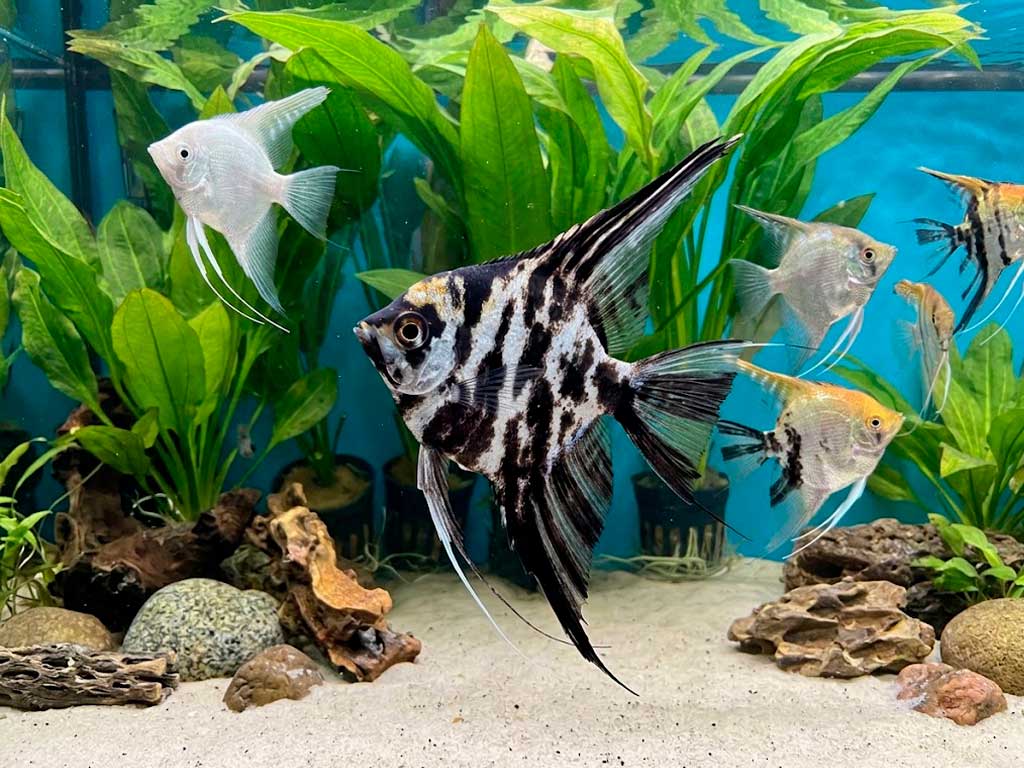
Wild-type coloration runs silver with dark vertical bars, providing additional cover against a striped, shadowy backdrop. The iris often shows red, and coloration varies considerably across the many domesticated strains bred from this base pattern.
Color and Fin Varieties
Selective breeding has produced an enormous range of forms from this single species. Koi angelfish combine orange, white, and black patterning reminiscent of koi carp. Marble angelfish carry a mottled black-and-white or black-and-silver pattern, while black lace and zebra varieties lean into bold striping and dark finnage.
Veiltail angelfish carry dramatically elongated, flowing fins, and platinum and gold forms shift the base color entirely. Blushing, pearlscale, and albino strains round out a genuinely huge range of options, all of which trace back to Pterophyllum scalare rather than separate species.
Behavior and Temperament
Angelfish get classified as semi-aggressive in the trade, and that label earns its place. In the wild, this species works as an ambush predator, taking small fish and invertebrates whenever the opportunity arises, and that instinct doesn’t disappear in captivity.
Pairs form monogamous bonds, and sexing individual fish reliably isn’t realistic until they’re close to breeding age. Generous, consistent feeding helps keep angelfish from turning that predatory instinct on smaller tankmates out of simple hunger.
Diet and Feeding
In the wild, this species takes juvenile fish, prawns, and a range of worms, with tubifex worms in particular linked to strong growth and better reproductive performance in captive studies. Mosquito larvae also make a nutritious addition when available.
A rotation of quality flake or pellet food alongside live or frozen bloodworm and tubifex covers most angelfish well. The feeding guide for ornamental fish covers the broader principles of building that kind of varied diet.
Tank Requirements and Water Parameters
An adult angelfish needs a tank around 91 cm (35 in) long, roughly 132 liters (35 US gallons), given how quickly this species outgrows a small starter tank. Juveniles under about 2 inches can start smaller, but that window closes fast.
Water chemistry stays comfortably moderate: temperature between 26 and 30°C (75 to 86°F), pH from 6.0 to 7.0, and general hardness anywhere from 3 to 10 dGH. A well-planted tank with roots, rocks, or bogwood for cover, alongside open swimming space, suits this species’ natural habitat well. The water chemistry guide covers holding those parameters steady.
Tankmates and Compatibility
Here’s the honest warning worth knowing before stocking a mixed tank: angelfish will eat anything small enough to fit in their mouth once they reach adult size. Platy fish and molly fish, both genuinely popular pairing choices online, carry real risk here, especially as fry or smaller adults, since a full-grown angelfish can and often will treat them as a meal rather than a companion.
Larger, faster tetras and barbs generally fare better, provided they’re sized to avoid becoming an easy target and the angelfish are kept well fed to reduce predatory motivation.
Breeding
Angelfish breed relatively easily in the aquarium, and pairs form genuine monogamous bonds. That said, generations of selective breeding for color and finnage have left many domesticated strains with weakened parental instincts, and it’s common for parents to eat their own eggs or fry rather than guard them.
Reliable sexing remains difficult until fish approach breeding age, so building a breeding group usually means raising several juveniles together and letting natural pairs form on their own.
How It Differs From the Altum Angelfish
Here’s what actually matters for anyone tempted by an “altum” label: Pterophyllum altum is a genuinely distinct species, not a taller variety of scalare, and it comes from a completely different, much stricter native habitat. True altums come from the upper Orinoco basin and Rio Negro watershed in Venezuela, Colombia, and Brazil, restricted to soft, strongly acidic blackwater with a pH often as low as 4.5 to 6.0 and near-zero hardness, conditions scalare doesn’t require at all.
Physically, altum runs taller, with a deeper notch above the eye and a more pronounced forehead indentation, reaching up to 45 cm fin-to-fin in height. It also needs a considerably larger, taller tank, often 350 liters and 60 cm of height at minimum. Misidentified or deliberately mislabeled scalare color forms, sometimes marketed under names like “Peru altum,” show up in the trade regularly. Buying true altum reliably means going through a specialist source with confirmed collection locality, not a generic listing.
Conservation Status
The IUCN Red List classifies Pterophyllum scalare as Least Concern, reflecting its wide native range across the Amazon Basin and its long history of successful captive breeding, which has taken significant pressure off wild-collected stock.