Salvinia Care Guide: Growing, Control & Water Spangles
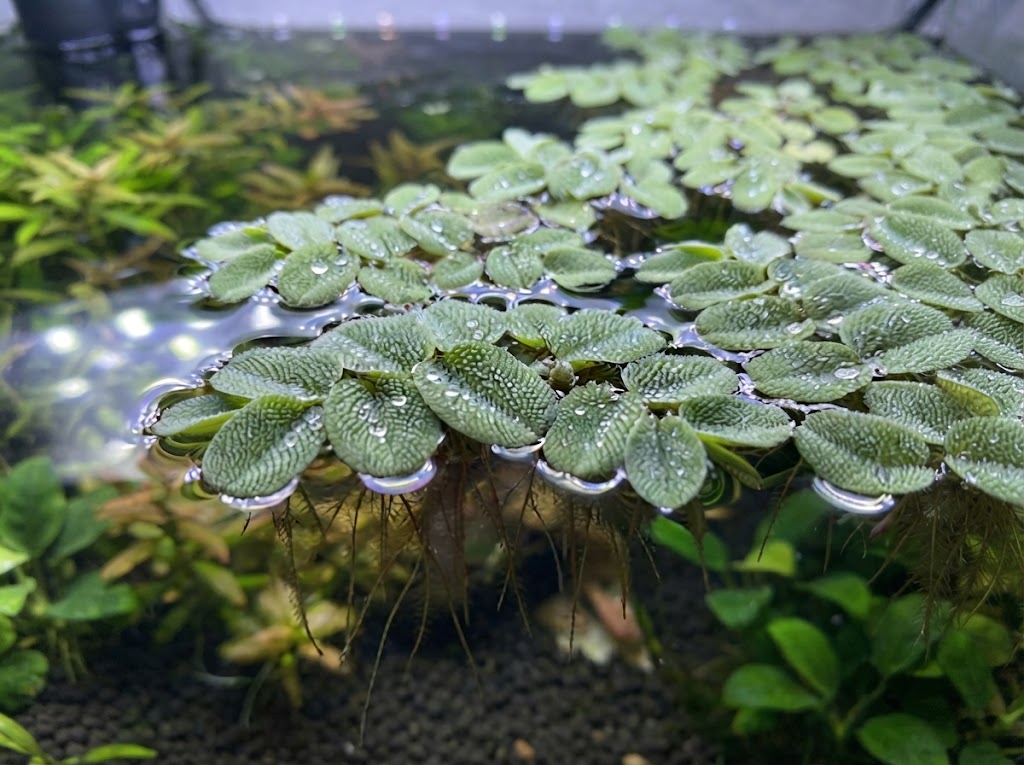
A small portion of salvinia can cover a surprising amount of aquarium surface in a short time.
This floating fern needs no substrate, no injected CO2, and relatively little equipment, but its fast growth makes surface management the part that deserves the most attention.
For most aquarium keepers, the appeal is obvious. Salvinia provides overhead shade, consumes nutrients directly from the water column, and creates cover around the surface without requiring you to plant anything in the substrate.
The important detail is identification. Aquarium stores may use names such as Salvinia minima, Salvinia natans, or “water spangles” somewhat loosely, while Salvinia molesta, commonly called giant salvinia, is a serious invasive species in several regions.
Salvinia Quick Facts
| Care factor | Salvinia |
| Plant type | Floating fern |
| Difficulty | Beginner |
| Light | Low to moderate |
| CO2 | Not required |
| Placement | Floating |
| Substrate | Not required |
| Growth | Fast |
| Propagation | Fragmentation |
| Temperature | About 18–30°C (64–86°F) |
| pH | About 6.0–8.0 |
| Nutrition | Water column |
| Main maintenance issue | Controlling surface coverage |
Salvinia is unusual because the structures hanging below the surface are not true roots. They are modified leaves that perform a root-like function while the plant remains completely free-floating.
That distinction matters when you are planning fertilization. There is nothing to bury.
What Is Salvinia?
Salvinia is a genus of floating ferns found naturally in different parts of the Americas and elsewhere. In the aquarium trade, Salvinia minima is one of the names most commonly associated with the small floating plants sold as water spangles.
Tropica describes Salvinia minima as a floating plant that can reach roughly 1–3 cm and grow quickly when light and nutrients are available. Its leaves have small hairs that help make the surface water resistant.
Those hairs are one of the easiest visual clues when identifying the plant.
The upper leaves sit directly on the water surface, while the submerged modified leaf hangs below. Because salvinia feeds from the water column, it can grow without any connection to gravel, sand, aquasoil, or other substrate.
That also makes adding it to an aquarium extremely simple.
Salvinia Minima vs. Salvinia Natans vs. Giant Salvinia
The name “salvinia” covers several species, and aquarium labeling is not always consistent.
Salvinia minima is particularly relevant to aquarium keeping. It tends to have relatively small leaves and is commonly sold as water spangles.
Salvinia natans also appears frequently in aquarium searches and product listings. However, trade names can be unreliable, so a photograph alone should not be treated as definitive species identification.
Then there is Salvinia molesta, commonly called giant salvinia.
That plant deserves a completely different level of caution. Queensland Government identifies S. molesta as a restricted invasive plant because it can form dense mats and spread through waterways.
So if you are buying salvinia from an unfamiliar source, check the scientific name rather than relying only on “salvinia” printed on the label.
Does Salvinia Need CO2?
No. Salvinia does not require injected CO2 to grow in a normal freshwater aquarium.
As a floating plant, its leaves have direct access to atmospheric carbon dioxide. That gives it an advantage over submerged plants that depend entirely on dissolved CO2.
Tropica rates Salvinia minima as having a low CO2 demand, while AquariumStocking lists CO2 as unnecessary for its aquarium care profile.
This makes salvinia particularly useful in low-tech aquariums.
Adding CO2 may still influence the overall planted-tank environment, but it should not be treated as a requirement for keeping salvinia healthy.
Salvinia Lighting Requirements
Salvinia is generally comfortable under low to moderate aquarium lighting.
Because it floats directly below the light fixture, it has immediate access to whatever light reaches the water surface. A fixture that looks relatively weak for a heavily planted substrate can still provide plenty of illumination for a floating plant.
The bigger problem is excessive coverage.
As salvinia multiplies, individual plants begin shading one another. A thick mat can also reduce the amount of light reaching submerged plants below it.
That creates a simple rule for mixed planted aquariums: manage salvinia according to the light requirements of the plants underneath it, not just according to the needs of the floater itself.
Water Parameters and Temperature
Salvinia is tolerant of a reasonably broad range of freshwater conditions.
A practical target is:
Temperature: 18–30°C (64–86°F)
pH: approximately 6.0–8.0
Hardness: soft to moderately hard water
AquariumStocking gives S. minima a range of 18–30°C and pH 6.0–8.0, while other aquarium sources use somewhat narrower ranges. The important point is that salvinia does not require unusually specialized water chemistry.
Stable conditions matter more than chasing a single perfect number.
If you already maintain appropriate water parameters for your fish and other plants, salvinia will usually adapt without demanding a separate chemistry regime.
For broader planted-aquarium water management, see our Aquarium Water Guide and Aquarium Water Chemistry Guide.
How Salvinia Gets Its Nutrients
Salvinia feeds primarily from the water column.
That makes liquid fertilization much more relevant than root fertilization. Fish waste, feeding, water changes, and the existing nutrient load of the aquarium all influence how quickly the plant grows.
If the tank is lightly stocked and aggressively filtered, nutrient availability may be relatively low. A fast-growing floating plant can consume those nutrients quickly.
One practical option is a complete liquid micronutrient supplement.
FROM AMAZON.COM
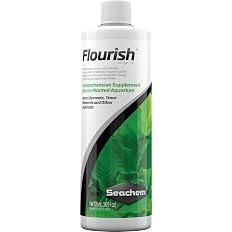
Seachem Flourish Freshwater Plant Supplement
A comprehensive plant supplement with minerals, trace elements, and vitamins to support healthy growth in freshwater planted tanks.
Buy on Amazon.comHappy Pet Zone may earn a commission when you click through to Amazon.com, at no extra cost to you. As an Amazon Associate, we earn from qualifying purchases.
Your Seachem reference describes Flourish Comprehensive as a general micronutrient supplement providing elements including calcium, magnesium, iron, vitamins, and amino acids. It does not supply nitrogen or phosphorus.
For that reason, it can make sense when the aquarium’s existing nutrient profile calls for additional micronutrients. It should not be treated as a complete replacement for nitrogen or phosphorus when those nutrients are actually deficient.
Do Salvinia Need Root Tabs?
Generally, no.
Root tabs are designed for plants that obtain a substantial portion of their nutrition through roots in the substrate. Salvinia is floating and has no conventional root system planted into the substrate.
Adding root tabs underneath a Salvinia mat does not target the plant’s primary feeding mechanism.
How to Add Salvinia to an Aquarium
Introducing salvinia is one of the easiest plant additions you can make.
First, inspect the plants carefully and remove obvious debris or unwanted hitchhikers. Floating plants are particularly good at carrying tiny pieces of other plants, including duckweed.
Then place the salvinia directly on the water surface.
There is no planting depth to get right. There is no rhizome to expose. There is no root system to anchor.
Give the plant enough open surface area to spread, then begin controlling the population before it becomes a solid mat.
Starting with roughly 25–40% surface coverage gives you room to see how quickly the plant grows in your specific aquarium.
Does Salvinia Tolerate Water Flow?
This is one area where salvinia deserves careful explanation.
Aquatic Arts recommends gentle flow for Water Spangles, while AquariumStocking specifically highlights salvinia’s unusual tolerance of surface movement.
The safest approach is to distinguish between surface movement and violent turbulence.
A normal filter return that moves the plants around is usually manageable. A return that repeatedly submerges, flips, or traps the plants against the glass is a different situation.
Salvinia’s hairy leaf surface helps it remain buoyant and shed water, but that does not mean it benefits from being constantly battered by the filter.
If the plants repeatedly collect in one corner, use a floating corral or airline barrier to keep a defined growing area.
How Fast Does Salvinia Grow?
Fast.
Under favorable conditions, a small starting portion can become a substantial surface population surprisingly quickly. AquariumStocking describes a small portion covering a surface within roughly two to three weeks under ordinary conditions.
Your actual growth rate will depend on light, temperature, nutrients, surface area, and competition from other plants.
The important part is to remove excess plants regularly.
Waiting until the entire surface is covered creates more work later because the lower layers receive less light and can begin deteriorating.
How to Control Salvinia Growth
The easiest maintenance method is simply removal.
Use a net, cup, or your fingers to remove excess plants during routine water changes. Focus on the thickest areas rather than trimming only the visible edges.
A useful target is to keep roughly 25–50% of the water surface open, adjusting that percentage according to the plants and fish below.
There is no universal perfect coverage number.
If your submerged plants are becoming shaded, reduce the floating layer. If your fish benefit from more overhead cover and the plants underneath tolerate lower light, you can allow more coverage.
The mistake is allowing salvinia to occupy the entire surface without monitoring what happens underneath.
Propagation: Why Salvinia Spreads So Easily
Salvinia can spread through fragmentation.
That means pieces can separate from an established group and continue growing. You do not need to deliberately plant seeds or divide a rooted crown.
This is convenient when you want more plants.
It is also why salvinia can become a maintenance problem.
Fragments can remain attached to aquarium nets, buckets, filter equipment, tubing, or hardscape. If you move equipment between aquariums, small pieces can travel with it.
Salvinia and Shrimp
Salvinia can work very well in shrimp aquariums.
The submerged structures provide additional surface area where microorganisms and biofilm can develop, while the floating canopy can create a more sheltered environment.
The plant also helps create visual separation between the bright open water and the surface.
For breeding setups, moderate floating coverage can be useful because it provides additional cover for young fish and creates a more complex upper layer in the aquarium.
Just keep enough open surface area for proper gas exchange and observation.
Salvinia With Bettas and Other Fish
Salvinia is generally compatible with peaceful freshwater community aquariums.
Bettas can appreciate floating cover, especially when the plant creates shaded areas near the surface. Small tetras, livebearers, gouramis, and many shrimp can also coexist with it.
The main issue is not toxicity or compatibility. It is coverage.
A completely covered surface changes the amount of light reaching the aquarium and can interfere with your ability to observe fish behavior. Keep clear areas where you can easily feed and inspect the aquarium.
Large herbivorous fish may also consume or damage floating plants.
Salvinia vs. Amazon Frogbit
Both are beginner-friendly floating plants, but their growth habits are different.
Amazon Frogbit develops a more recognizable root curtain beneath each plant, while salvinia remains smaller and forms a different type of surface cover.
Salvinia is particularly interesting when you want a compact floating fern that can spread across the surface without producing the very long roots associated with some frogbit specimens.
If you want longer roots that create shelter beneath the surface, compare it with our Amazon Frogbit Care Guide.
Salvinia vs. Water Lettuce
Water lettuce tends to produce larger rosettes and a more substantial visual presence.
Salvinia has a finer texture and can create a lighter-looking surface layer, especially when maintained as a loose patch rather than a solid mat.
Water lettuce can also become large enough to dominate the surface of smaller aquariums. Salvinia gives you smaller individual plants, although its fast reproduction still demands regular removal.
Our Water Lettuce Care Guide covers the other major floating-plant option in more detail.
Common Salvinia Problems
Salvinia Turning Brown in the Middle
When the center of a floating mat starts deteriorating, look at the structure of the mat first.
Plants may have piled into several layers, causing the lower plants to receive less light and remain trapped against other vegetation.
Remove some of the population and spread the remaining plants across the surface.
Salvinia Becoming Pale
Pale growth can indicate insufficient nutrients, particularly when growth is otherwise slow.
Check the aquarium’s overall nutrient availability before adding supplements. A complete micronutrient product can help when micronutrients are actually lacking, but adding fertilizer blindly can create a different problem.
Salvinia Not Growing
Check temperature, lighting, nutrient availability, and plant density.
A crowded mat can appear to stop growing because new growth is hidden among older plants. Remove some of the population and watch what happens over the following week.
Salvinia Keeps Collecting in One Corner
That is usually a flow problem.
The filter return is pushing the floating plants toward one area where they accumulate. A floating ring or airline barrier can create a controlled growing zone and prevent the plants from forming a thick pile.
Is Salvinia Invasive?
Some Salvinia species are invasive and heavily regulated.
This is one of the most important parts of responsible Salvinia care.
Queensland Government lists Salvinia molesta, or giant salvinia, as a restricted invasive plant. It can form dense mats, spread rapidly, degrade water quality, and interfere with native aquatic ecosystems. The government also identifies aquarium dumping as one pathway for its spread.
Regulations differ by location.
For that reason, check the rules where you live before purchasing, selling, trading, or releasing any Salvinia. Do not assume that because a plant is sold by an aquarium retailer it is legal everywhere.
And never release unwanted aquarium plants into ponds, streams, lakes, drainage channels, or other natural waterways.
How to Dispose of Excess Salvinia
Never pour unwanted salvinia into a drain or outdoor water source.
Remove the plants from the aquarium and dispose of them in a way that prevents fragments from reaching natural waterways.
This matters even more with a plant that spreads through fragmentation.
If you maintain multiple aquariums, clean nets and other equipment after working with Salvinia before using them in another system. One small fragment can be enough to start a new population.
Salvinia is an excellent floating plant when you want fast growth, simple care, and surface cover without planting anything into the substrate.
The maintenance commitment is small, but it is regular. Keep the floating layer controlled, give your submerged plants enough light, and remove excess growth before the mat becomes several layers thick.
For a typical community aquarium, I would start around 25–40% surface coverage, then adjust toward 50% or less depending on how the plants underneath respond.
The other number worth remembering is growth speed. Check the surface at least once a week. If salvinia is expanding rapidly, remove some before it becomes a problem.