Fish Tank Electricity Cost: How Much Your Aquarium Adds to the Bill, Especially in Winter

Working out fish tank electricity cost takes one formula: the wattage of each device multiplied by the hours it actually runs, divided by 1,000, and multiplied by your price per kilowatt-hour.
Run that arithmetic on a 208 L (55 US gal) heated freshwater tank in winter and you get about 68 kWh a month, which costs roughly $12 at the US average residential rate of 18.17 cents per kWh in September 2026 (EIA).
The same tank comes to about £22 a month at the UK price cap of 32.69 pence per kWh, which applies from 1 January 2027 (Ofgem). The method travels to any country and tariff.
What winter changes is the share of time the heater spends switched on, and that one number explains most of the seasonal jump in fish tank electricity cost.
How much does a fish tank cost to run per month?
The table below compares five setups on one basis: a heater cycling between 30% and 45% of the time in a room at 20 °C – 68 °F, a filter running around the clock, and a light on for 8 hours a day. Smaller tanks sit at the top of that duty range, because they lose heat faster per liter of water.
| Setup | Estimated winter use |
|---|---|
| 19 L (5 US gal) | 21.7 kWh a month |
| 76 L (20 US gal) | 39.6 kWh a month |
| 208 L (55 US gal) | 68.4 kWh a month |
| 284 L (75 US gal) | 88.8 kWh a month |
| 300 L reef | 172.8 kWh a month |
Those figures are estimates built from the equipment described here, not meter readings from your tank. Fish tank electricity cost scales with volume, though not in a straight line, and a 208 L tank at that rate for a full year would use about 820 kWh. That is why the winter months deserve their own calculation rather than an annual average.
How do you calculate fish tank electricity cost?
Five steps, and a calculator is enough.
- Find the wattage on the device label, the plug, or the manual. Write down the number printed there rather than the number in the product name.
- Estimate the hours per day each device runs. Heaters and pumps cycle, so use the fraction of the day the device is actually on.
- Daily kWh = (watts × hours per day) ÷ 1,000.
- Monthly kWh = daily kWh × the number of days in the month.
- Monthly cost = monthly kWh × your price per kWh.
Here is the whole method on one device.
A 100 W heater that runs 40% of the time uses 100 × 0.40 × 24 ÷ 1,000 = 0.96 kWh a day.
Over 30 days that is 28.8 kWh, or $5.23 at 18.17 cents and £9.41 at 32.69 pence.
Why the wattage on the box is not your real number
A 300 W heater does not draw 300 W hour after hour. It draws 300 W while the element is on and nothing while the thermostat rests, so the label states a maximum rather than an average.
Pumps behave the same way once a controller is involved. A DC return pump at half speed draws well under its rated wattage, and a dimmable LED at 60% draws less than its full output. Nameplate numbers are a ceiling, so they start the calculation rather than answer it.
Does a fish tank heater use a lot of electricity?
Usually more than any other single device in a heated freshwater tank, and less than most owners expect. In the 208 L example the heater accounts for 1.68 of the 2.28 kWh used each day, about 74% of the total. That duty cycle is the biggest single lever on fish tank electricity cost. In my own tanks, the heater is also the device I notice first when the weather turns.
The formula for the heater alone is:
heater kWh per day = watts × duty cycle × 24 ÷ 1,000.
The duty cycle is the fraction of the day the element is on, and it is the number worth measuring rather than guessing.
What changes the duty cycle?
Six things move that number, and most of them are under your control.
- Room temperature. A tank at 25 °C – 77 °F in an 18 °C – 64 °F room loses heat faster than the same tank at 23 °C – 73 °F, so the heater runs longer.
- A lid or cover. Evaporation carries heat away with the vapor, so an open tank loses water and energy.
- The set point. Every degree above the species’ range adds to the gap the heater must close.
- Tank size. A small tank has more surface and glass per liter, so it sheds heat faster and cycles more.
- Drafts and cold surfaces. A tank beside a window, a door, or an uninsulated exterior wall sits in colder air.
- Insulation and flow. Foam behind the tank cuts loss through the glass, and good circulation stops the thermostat reading a warm pocket.
The aquarium heater and thermometer guide covers sizing and placement, and it is the page to read before buying a replacement.
If you are replacing a heater and want a known quantity, the Fluval E100 100 W electronic heater is rated by Fluval for tanks up to 120 L (30 US gal). That ceiling assumes a covered tank in a normal room, so a 120 L tank in a cold room needs more wattage. The honest limitation is printed on the rating: it is a small heater, and small heaters work hardest in the conditions this article is about.
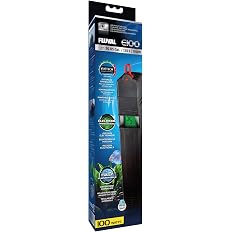
Fluval E 100 Watt Electronic Heater
Continuously monitors and displays aquarium water temperature in real time. Intelligent digital microprocessor monitoring system with dual temperature sensors.
Shop on AmazonHappy Pet Zone may earn a commission when you click through to Amazon.com, at no extra cost to you.
Which equipment uses the most power in a fish tank?
The table compares example draws for common equipment. These are figures used in the arithmetic here, not measured averages, so check the label on your own device before replacing it.
| Equipment | Example draw used here |
|---|---|
| 100 W heater | 100 W while on |
| Canister filter | 15 W |
| Hang-on-back filter | 10 W |
| Standard LED | 30 W |
| High-output planted light | 80 W |
| Return pump | 40 W |
| Protein skimmer | 15 W |
| Chiller | 300 W while running |
| Wavemaker | 10 W |
Manufacturer specifications describe what a device can draw, and nothing about how well it heats or moves water. Two filters rated at 15 W can perform very differently, which is why fish tank electricity cost is only half the equipment decision. The aquarium filtration guide explains what those watts buy.
What runs up your electric bill the most?
In a heated freshwater tank, the heater usually leads. In a reef tank, lighting and circulation can overtake it, and a chiller in summer can lead by a wide margin.
The reef example shows the pattern: 1.8 kWh a day for a 200 W light, 0.96 kWh for the return pump, 0.48 kWh for wavemakers, and 2.16 kWh for the heater at 30% duty. Add the skimmer and the tank passes 5.7 kWh a day, almost twice the 284 L freshwater setup beside it.
Should you turn the filter off at night to save electricity?
No, in almost every case. The filter is not where fish tank electricity cost comes from, and 8 hours off saves 0.12 kWh, about 2 cents a day at the US average rate. The risk sits on the other side of the ledger.
Biological filtration depends on oxygen and moving water. The bacteria that process ammonia live in the filter media, and a canister that sits switched off becomes a stagnant chamber with falling oxygen. Restarting it then pushes that water back into the tank.
If noise is the real problem, move the filter outlet or set the pump to a lower speed instead of switching it off at night.
Do aquarium lights add much to the electric bill?
Less than the heater in most freshwater tanks, and a lot more in a reef or high-tech planted setup. The arithmetic is simple: light kWh per day = watts × hours on ÷ 1,000.
A 30 W LED on for 8 hours uses 0.24 kWh a day, or 7.2 kWh a month.
That costs $1.31 in the US and £2.35 in the UK at the rates used here.
An 80 W planted light on the same schedule uses 19.2 kWh a month, and a 200 W reef fixture on for 9 hours uses 54 kWh a month, which is $9.81 or £17.65.
Lighting also heats the water. A 200 W reef light running 9 hours delivers 1.8 kWh of heat a day, the same energy a 75 W heater would release running nonstop. Winter reduces heater runtime as a result, and summer turns the same heat into a load the tank has to shed.
The aquarium lighting guide covers spectrum and duration, while a timer and a dimmer do more for the bill than a new fixture.
How much does a heated fish tank cost in winter?
More than in summer, for one reason: the gap between water temperature and room temperature grows. Heat loss through glass, surface, and equipment rises roughly in proportion to that gap.
Why winter raises the bill
A tank held at 25 °C – 77 °F in a 24 °C – 75 °F room has a 1 °C – 33 °F gap to close. The same tank in an 18 °C – 64 °F room has a 7 °C – 44 °F gap, and all else being equal it loses heat about seven times as fast. That is why the winter duty cycle in the table is two to three times the summer figure, and why winter fish tank electricity cost rises faster than the tariff does.
Evaporation adds to the loss: moving air carries vapor away, and every liter that evaporates takes heat with it. A lid cuts that path, which is why covered tanks hold temperature with less heater time. Drafts do the same job faster.
The winter formula
Use the same heater formula with a winter duty cycle: watts × winter duty × 24 ÷ 1,000. The table shows the planning assumptions used for the five setups above.
| Season | Duty cycle used in the examples |
|---|---|
| Winter, room near 18 to 20 °C | 35% to 45% |
| Spring and autumn | 25% |
| Summer, room near 24 to 26 °C | 15% |
Those are planning figures, not measurements. The only way to know your own duty cycle is to log the heater for a week with a meter or a monitoring plug.
Reheating water after a water change
Match the new water to the tank within 1 to 2 °C – 33 °F / 35 °F, because a sudden drop stresses fish and can trigger an outbreak in a tank that is already under pressure. The energy cost of doing that is small, and it should never be the reason to skip the match.
Water needs about 4,186 J per kilogram per degree Celsius (OpenStax College Physics, Table 14.1), which is 1.16 Wh to raise one liter by 1 °C – 33 °F. A 140 L water change with a 5 °C – 41 °F difference therefore needs 140 × 5 × 1.16 = 812 Wh, or about 0.81 kWh. That is $0.15 in the US and £0.27 in the UK.
Treat 0.81 kWh as a floor, because the heater delivers that energy over hours and the tank keeps losing heat while it works.
Monthly Electricity Cost by Tank Size (US vs. UK)
The chart compares the monthly electricity cost of five aquarium setups at the US average rate (18.17 cents per kWh) versus the UK price cap (32.69 pence per kWh).
Comparison Table by Setup
| Aquarium Setup | US Monthly Cost (USD) | UK Monthly Cost (GBP) |
| 19 L | $3.95 | £7.10 |
| 76 L | $7.20 | £12.94 |
| 208 L | $12.43 | £22.36 |
| 284 L | $16.14 | £29.03 |
| 300 L reef | $31.40 | £56.49 |
Breakdown by Region
- United States (18.17 cents per kWh)
- 19 L: $3.95 per month
- 76 L: $7.20 per month
- 208 L: $12.43 per month
- 284 L: $16.14 per month
- 300 L reef: $31.40 per month
- United Kingdom (32.69 pence per kWh)
- 19 L: £7.10 per month
- 76 L: £12.94 per month
- 208 L: £22.36 per month
- 284 L: £29.03 per month
- 300 L reef: £56.49 per month
Chart Notes
- Rate sources: The US figure reflects the September 2026 residential average (EIA); the UK figure reflects the price cap from January 1, 2027, excluding VAT (Ofgem).
- Standing charges excluded: Standing charges are not included because having a tank does not change them.
Electricity cost by biotope and setup type
The equipment mix decides fish tank electricity cost, so the same volume can run at very different prices.
Tropical community tank
A heater carries most of the load, with a filter and a modest LED behind it. This is the pattern in the 208 L example, where the heater is about three quarters of the total.
Planted high-tech tank
High-output light, CO2 injection, and a heater share the bill, and a 200 L planted tank can run 80 W to 120 W of light for 8 hours before the heater is counted.
African cichlid and discus tanks
Large volume and a warm set point push the heater harder than a community tank of the same size. A discus tank near 29 °C – 684 °F in a 20 °C – 68 °F room leaves a 9 °C – 48 °F gap, and insulation matters more there than anywhere else on this list.
Betta, nano, and shrimp tanks
Wattage is low, but the cost per liter is often higher because a small tank loses heat faster. A 19 L tank with a 50 W heater can use more energy per liter than a 284 L tank with a 300 W unit, and shrimp react badly enough to swings that a controller earns its place.
Coldwater and goldfish tanks
No heater in most setups, which leaves lighting and filtration as the main loads. Cooling only becomes an issue in warm climates, where a fan or chiller can add more than a heater would.
Marine reef tank
Lighting, return pump, wavemakers, skimmer, and heater together, plus a chiller in summer. This is the most expensive setup here at about 173 kWh a month in winter, and the only one where the heater is not the leading device.
How can you reduce your fish tank’s electricity cost?
The fastest way to cut fish tank electricity cost is to reduce the heat the tank loses before touching any equipment. The measures below are ordered by expected impact.
- Fit a lid or cover. Less evaporation means less heat lost and less top-off water to replace.
- Move the tank away from drafts, windows, doors, and exterior walls. Colder surrounding air raises the duty cycle for as long as the tank stays there.
- Insulate the back and base. Foam board or a cabinet panel reduces loss through the glass, provided it does not cover the heater, filter, or ventilation.
- Set the temperature inside the species’ range. Every degree above the range adds to the gap and to the bill, and it does not help the fish.
- Use a precise controller. A controller with its own probe cuts power at a set point, which also protects against a stuck heater.
- Put the light on a timer or a dimmer. Eight hours at 60% is cheaper than ten hours at 100%, and plants rarely need the extra.
- Size the heater for the room, then measure. An undersized heater runs constantly and never catches up, and one week with a meter shows whether the change worked.
The table compares two versions of the same 208 L tank to show what the first four measures are worth in energy.
| Setup | Heater energy per month |
|---|---|
| No lid, near a draft, set to 27 °C | 72 kWh |
| Lid fitted, interior wall, set to 25 °C | 47.5 kWh |
The difference is 24.5 kWh a month, or $4.45 in the US and £8.00 in the UK. Those savings rest on duty cycle assumptions, so treat them as a direction rather than a promise.
How can you measure your real electricity use?
A plug-in energy meter answers the question in a week. Plug the tank’s power strip into it, leave everything running as normal, and read the total after seven days. Daily kWh = total kWh ÷ 7, and multiplying that by 30 turns an estimate into your own fish tank electricity cost.
A smart plug with energy monitoring does the same job and keeps a history. The Tapo P115 two-pack is rated at 15 A and 1800 W, reports consumption in the app, and works with Alexa, Google Home, and SmartThings. The limitation is worth knowing first: it connects on 2.4 GHz Wi-Fi only, it needs the app to report anything, and it occupies a socket. For one tank it is a practical way to separate the heater’s share from the rest.
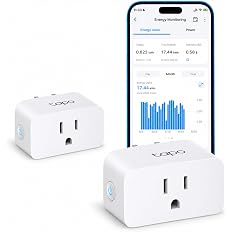
Tapo Smart Plug Wi-Fi, Energy Monitoring, P115(2-Pack), 15A
Works with Alexa & Google Home & Samsung SmartThings, Timer, 1800W Max, ETL Certified, 2.4G Wi-Fi Only.
Shop on AmazonHappy Pet Zone may earn a commission when you click through to Amazon.com, at no extra cost to you.
The heater’s indicator light is the cheapest method and the least accurate. Count the minutes it stays on over an hour, and you get a rough duty cycle for that hour. It tells you whether the heater is working hard, not what the tank uses in a month.
Frequently Asked Questions
Measure for one week, then fix the biggest number
Fish tank electricity cost comes down to two numbers: the duty cycle and your price per kWh. The formula gives you an estimate, and one week with a meter gives you the truth, which is why the meter comes first.
Then change one thing at a time. Fit the lid, move the tank off the cold wall, set the heater to the middle of the species’ range, and log another week. That sequence costs almost nothing, and it beats guessing at the Aquariums section level, where every setup has a different answer. The water pump guide is the next read if circulation turns out to be your second-largest load.