Cardinal Tetra (Paracheirodon Axelrodi): Care Guide & Neon Tetra Differences
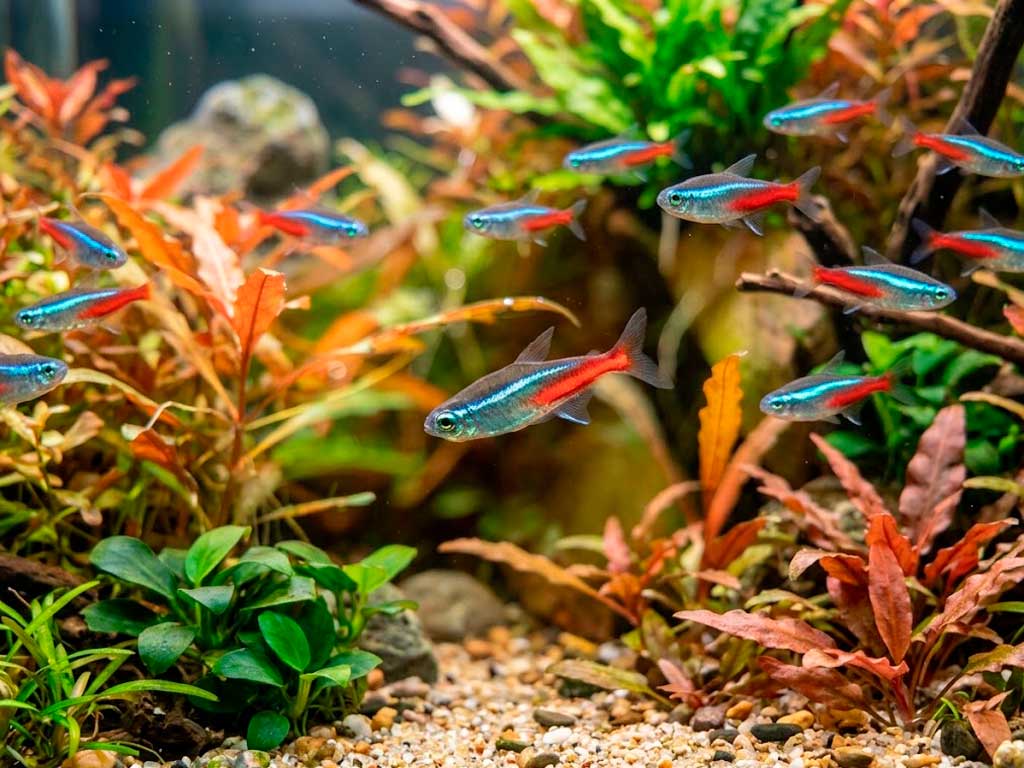
Cardinal tetras get mistaken for neon tetras constantly, close enough in size and coloring that most shoppers never bother checking the difference. In practice, one detail settles the confusion instantly, and it matters for anyone trying to buy the fish they actually want.
This guide covers real tank setup, how to tell the two species apart at a glance, and an honest, more complicated take on wild-caught sourcing than the usual “always buy captive-bred” advice.
Quick Identity Card
| Trait | Detail |
| Scientific name | Paracheirodon axelrodi (Schultz, 1956) |
| Common names | Cardinal Tetra |
| Family / Order | Acestrorhamphidae (subfamily Megalamphodinae), Characiformes |
| Origin | Upper Orinoco and Rio Negro rivers, South America |
| Adult size | About 3 cm (1.2 in), up to 5 cm (2 in) reported |
| Diet | Omnivore, flake, freeze-dried, and live foods |
| Temperament | Peaceful, shoaling |
| Water temperature | 21 to 28°C (70 to 82°F) |
| pH | 5.0 to 7.0, prefers soft and acidic |
| GH (hardness) | 1 to 5 dGH |
| Minimum tank | 38 L (10 US gal), 76 L (20 gal) preferred for larger schools |
| Breeding | Historically difficult in captivity, improving with modern breeders |
| IUCN status | Least Concern |
Origin and Natural Habitat
Paracheirodon axelrodi is native to the upper Orinoco and Rio Negro river systems, spanning parts of Venezuela, Colombia, and Brazil. It inhabits both blackwater and clearwater streams, warm and slow-moving, characterized by acidic pH, low mineral content, and the tannin-rich humic acids that give blackwater its distinctive tea color.
Two recognizable phenotypes exist across this range. The Rio Negro form carries a blue stripe extending all the way to the adipose fin, while the Orinoco form shows a stripe that stops short of it, a difference detailed enough that some researchers consider the Orinoco population a possible subspecies. Rare “gold” and “silver-blonde” color forms, carrying noticeably less blue in the stripe, also turn up specifically within Rio Negro populations.
Identification and the Neon Tetra Mix-Up
Here’s what actually matters for telling these two apart: check how far the red stripe extends. On a cardinal tetra, the vivid red coloring runs the full length of the body, from nose to tail. On a neon tetra, that red stripe covers only about the back half of the body, stopping around the midpoint. The neon’s blue stripe also reads as noticeably less vibrant and iridescent compared to the cardinal’s.
That iridescence itself comes from a genuinely interesting structural source rather than pigment: light refracting through guanine crystals in specialized cells called iridocytes, sitting just under the skin. The exact shade shifts with viewing angle, appearing more deeply sapphire or indigo when viewed from below rather than straight on.
Behavior and Temperament
Cardinal tetras read as calm, active, and genuinely peaceful, doing best in shoals of five or more individuals. They occupy the middle of the water column, making them a natural fit for a well-aquascaped community tank rather than the bottom or surface layers.
Despite their delicate appearance, cardinal tetras belong to the same broader order as piranhas, Characiformes, and share a surprisingly similar tooth structure, though obviously nothing like piranha-level bite behavior in practice.
Diet and Feeding
This species feeds readily on flake, freeze-dried, and live foods without much fuss, making it a genuinely easy fish to keep fed well. The feeding guide for ornamental fish covers building a varied rotation, though cardinal tetras aren’t a demanding species in this regard.
Tank Requirements and Water Parameters
A tank of at least 38 liters (10 US gallons) works for a small shoal, with 76 liters (20 gallons) preferred for a larger school given how much better this species shows off in numbers. A well-planted setup with subdued lighting and floating plants matches its natural blackwater habitat closely.
Water chemistry should lean soft and acidic: temperature between 21 and 28°C (70 to 82°F), pH from 5.0 to 7.0, and general hardness kept low, around 1 to 5 dGH. Deviating meaningfully from that soft, acidic profile won’t necessarily harm an adult fish day to day, but it does affect breeding success and fecundity significantly. The water chemistry guide covers achieving and holding those parameters, and strong biological filtration matters here to keep ammonia, nitrite, and nitrate under control.
Breeding
Cardinal tetras have historically been genuinely difficult to breed in captivity, which is part of why this species remained less widespread in the hobby than the more easily bred neon tetra for decades. That’s changed considerably in recent years, with more breeders now successfully producing captive-bred stock at scale.
One practical way to tell bred fish from wild-caught: wild-caught specimens frequently show some fin damage from capture and transport, while captive-bred fish typically arrive with fins in better condition.
An Honest Note on Wild-Caught Sourcing
Here’s a genuine complication worth sitting with rather than glossing over: buying wild-caught cardinal tetras isn’t automatically the worse choice conservation-wise, which runs counter to the usual advice given elsewhere in this series. A sustainable wild fishery for cardinal tetras and other ornamental species operates across the Amazon Basin, employing thousands of local people.
Some ichthyologists argue this fishery gives those workers a genuine economic incentive to protect the forest and rivers they depend on, since losing that income could push them toward more destructive alternatives like deforestation instead. That’s not a blanket endorsement of wild-caught fish over captive-bred ones in every case, but it’s a real, documented argument worth knowing rather than assuming captive-bred is always the more responsible choice by default.
Conservation Status
The IUCN Red List classifies Paracheirodon axelrodi as Least Concern. Its wide native range and the ongoing sustainable fishery model discussed above both support that assessment, without evidence of the population facing significant decline.