Yellow Watchman Goby Care Guide: Pistol Shrimp Pairing
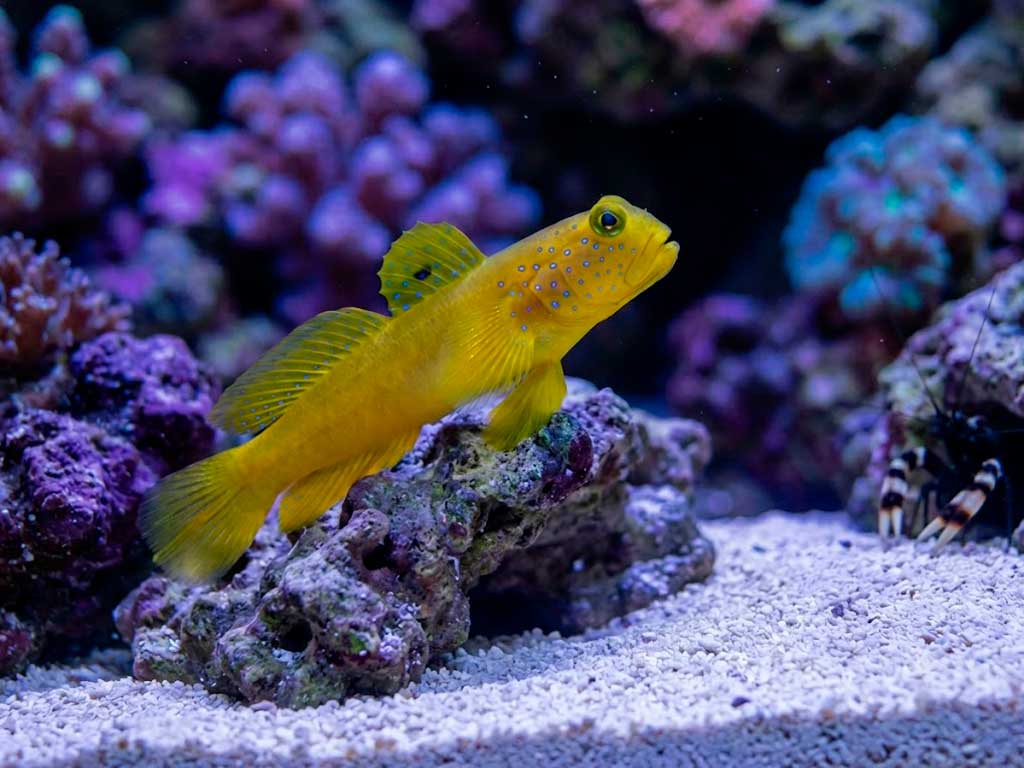
Our best saltwater fish for beginners guide mentions the yellow watchman goby mainly for one reason: its partnership with a pistol shrimp is one of the most genuinely fascinating relationships you can watch unfold in a home aquarium.
This guide covers full care for the goby itself, plus everything worth knowing before you add the shrimp half of that partnership.
Quick answer: The yellow watchman goby (Cryptocentrus cinctus) is a hardy, peaceful burrowing fish suited to tanks 20 gallons and up with a fine sand bed. It forms a genuine mutualistic partnership with pistol shrimp, sharing a burrow the shrimp digs in exchange for acting as its lookout. The pairing is optional, the goby does fine alone, but adding a pistol shrimp is best done only after your tank has been stable for a few months.
Quick Facts: Yellow Watchman Goby
- Scientific name: Cryptocentrus cinctus
- Also called: Yellow prawn goby, yellow shrimp goby
- Size: Up to 4 inches (10 cm)
- Minimum tank size: 20 gallons
- Substrate: Fine sand, essential for burrowing
- Diet: Carnivore, small meaty foods
- Reef safe: Yes
- Temperament: Peaceful, territorial over its burrow
The Goby and Pistol Shrimp Partnership, Explained
This is genuinely one of the most interesting mutualisms in the reef aquarium hobby. Pistol shrimp, most commonly Randall’s pistol shrimp or the tiger pistol shrimp in the trade, are excellent diggers but have very poor eyesight, which leaves them vulnerable while working outside their burrow. The yellow watchman goby has the opposite problem: sharp eyesight but no ability to dig a proper burrow of its own.
Together, they solve both problems at once. The shrimp digs and maintains a shared burrow in the sand, and the goby moves in alongside it. While the shrimp works outside the entrance, it keeps an antenna resting on the goby’s body or tail at nearly all times, since it can’t see danger coming but can feel the goby’s body language instantly. A sudden flick from the goby signals a threat, and both animals dart back into the burrow together within a fraction of a second.
You don’t need the shrimp for the goby to thrive, it will happily use existing rockwork crevices or dig a shallow depression on its own instead. But if you want to see this behavior firsthand, wait until your tank has run stable for at least a few months before adding the shrimp, since it’s more sensitive to new-tank conditions than the goby is.
Tank Requirements
A single yellow watchman goby does well in a tank as small as 20 gallons. Fine sand is non-negotiable, since both the goby’s natural digging behavior and any future pistol shrimp partnership depend on a substrate soft enough to burrow through. Coarse crushed coral or large-grain sand won’t work nearly as well.
Provide a mix of open sand near live rock, covered in our live rock and sand guide, so the goby has both material to dig into and a stable rock structure to anchor its burrow against. Keep water parameters stable, detailed in our water chemistry guide, and use a tight-fitting lid. Like many gobies, this species jumps readily when startled.
Setting Up the Perfect Burrow Site
Where you place rockwork matters more for this species than for most reef fish. A good burrow site sits at the base of a stable rock formation, ideally with at least one larger rock or piece of rubble the goby and shrimp can use as a structural anchor for the tunnel entrance. Loose sand alone tends to collapse without something solid nearby to brace against.
Leave a reasonably open, flat sand area near the rock base rather than crowding it with decor, since both animals excavate and redistribute sand as they work, sometimes moving surprising amounts of it overnight. Position this spot somewhere you can actually watch it, low, front-facing sand areas make for far better viewing than a burrow tucked behind rockwork toward the back of the tank. Once established, expect the entrance to shift slightly over time as the pair renovates; this is normal maintenance behavior, not a sign anything is wrong.
Diet and Feeding
Yellow watchman gobies are carnivores that feed on small invertebrates and crustaceans in the wild, and they adapt well to prepared foods in captivity.
- Frozen mysis and brine shrimp
- Small marine meaty preparations
- Sinking pellets, since this fish rarely feeds at the surface
Feed once or twice daily, and if paired with a pistol shrimp, make sure food actually reaches the burrow entrance, since the shrimp benefits from the same feeding as its goby partner.
Other Watchman Goby Species
Several close relatives share the same burrowing, shrimp-partnering lifestyle, sold under similar names.
- Blue Watchman Goby: Similar size and care, with a blue-grey body and orange spotting.
- Red Watchman Goby: A deep red-orange coloration, otherwise nearly identical care to the yellow variety.
- Black and Indigo Watchman Gobies: Less common in the trade but follow the same burrowing behavior and shrimp partnership.
Care requirements stay essentially the same across all of them, so pick based on color preference rather than expecting meaningfully different husbandry. A few lookalikes cause genuine confusion at the store: the diamond watchman goby and orange-spotted prawn goby belong to a related but distinct group with slightly different care needs, so confirm the species name before assuming identical husbandry across every fish labeled a “watchman goby.”
Compatibility and Tank Mates
Yellow watchman gobies are peaceful and reef safe, ignoring corals and most invertebrates entirely. They coexist well with clownfish, chromis, and other calm community fish that occupy different parts of the tank. They can be territorial toward other bottom-dwelling or burrowing fish competing for the same real estate, so avoid stocking multiple burrowing species in a smaller tank.
Frequently Asked Questions
Do I need a pistol shrimp for my yellow watchman goby?
No. The goby thrives with or without one, using rockwork crevices or a self-dug depression instead. The shrimp is a genuinely interesting addition to watch, not a requirement for the goby’s health.
What pistol shrimp pairs best with a yellow watchman goby?
Randall’s pistol shrimp and the tiger pistol shrimp are the two most commonly paired species in the trade, and both form the same burrow-sharing partnership readily.
When should I add the pistol shrimp?
Wait until your tank has been stable for a few months. Pistol shrimp are more sensitive to new-tank water quality swings than the goby, so rushing this pairing risks losing the shrimp.
Why does the pistol shrimp keep its antenna on the goby?
The shrimp has poor eyesight and relies on touch to sense the goby’s movement. A sudden flick from the goby signals danger, and both animals retreat into the burrow together almost instantly.
What substrate does a watchman goby need?
Fine sand. Coarse or large-grain substrate makes burrowing difficult for both the goby and any future pistol shrimp partner.
Is the yellow watchman goby reef safe?
Yes. It ignores corals and most invertebrates entirely and poses no threat to a reef tank.
What size tank does a yellow watchman goby need?
A single fish does well in 20 gallons or more, with fine sand for burrowing and rockwork nearby to anchor its territory.
Can I keep two watchman gobies together?
It’s risky in a smaller tank, since they can be territorial toward their own kind over burrow space. A larger tank with well-separated territory gives better odds of success.
Does a yellow watchman goby jump out of tanks?
It can, particularly when startled. A tight-fitting lid is a simple, essential precaution for this species.
Whether or not you add the pistol shrimp half of the equation, the yellow watchman goby earns its place on any beginner stocking list: hardy, peaceful, endlessly watchable, and one of the easiest ways to see genuine animal partnership play out in your own living room.