Labidochromis Caeruleus: Care Guide for the Electric Yellow Lab
Labidochromis caeruleus carries a scientific name that means “blue” in Latin, despite being one of the most famous solid-yellow fish in the entire aquarium hobby. In practice, that mismatch traces back to real history: the species was described decades before its now-iconic yellow morph was ever discovered.
This guide covers where the “Electric Yellow” actually comes from, real tank requirements for this notably peaceful mbuna, and why the wild population behind such a common aquarium fish is genuinely harder to find than the trade suggests.
Quick Identity Card
| Trait | Detail |
| Scientific name | Labidochromis caeruleus (Fryer, 1956) |
| Common names | Yellow Lab, Electric Yellow, Blue Streak Hap, Canary Cichlid |
| Family | Cichlidae (mbuna, Lake Malawi) |
| Origin | Endemic to the northwestern coast of Lake Malawi, East Africa |
| Adult size | Formally recorded to 8.1 cm SL; commonly cited up to 13 to 15 cm in aquarium literature |
| Diet | Opportunistic omnivore, mostly invertebrates in the wild |
| Temperament | Notably peaceful for a mbuna, still territorial when spawning |
| Water temperature | 23 to 28°C (73 to 82°F) |
| pH | 7.0 to 8.9, hard and alkaline |
| GH (hardness) | 7+ dGH, tolerates soft to hard |
| Minimum tank | Around 150 to 190 L (40 to 50 US gal) |
| Lifespan | 6 to 10 years |
| Breeding | Maternal mouthbrooder, not difficult |
| IUCN status | Least Concern, but genuinely uncommon in the wild |
Origin and the Real Story Behind “Electric Yellow”
Here’s what actually matters before anything else: this species was named for a color it doesn’t usually display anymore in the hobby. Geoffrey Fryer formally described Labidochromis caeruleus in 1956 based on specimens, likely from the Nkhata Bay population, showing a pale blue cast in breeding males. That’s why “caeruleus,” Latin for blue, ended up as the species name.
The now-famous solid yellow morph wasn’t discovered until around 1980, when diver Stuart Grant located a small wild population at Lion’s Cove, Malawi. Grant deliberately limited collection of these fish, worried that mass export could push the small population toward extinction. Around the same time, exporter Pierre Brichard sold captive-bred specimens under the puzzling name “Labidochromis tanganicae,” mistakenly implying a Lake Tanganyika origin before the confusion got sorted out.
Origin and Natural Habitat
This species is endemic to the northwestern coast of Lake Malawi, known only from that specific region within the lake’s vast rift system. At least a dozen distinct color morphs exist across different reef locations, including forms recorded at Chilucha Reef, Jalo Reef, and Lupingu, most of which go essentially unnoticed by hobbyists in favor of the one variant that made this species famous.
Identification
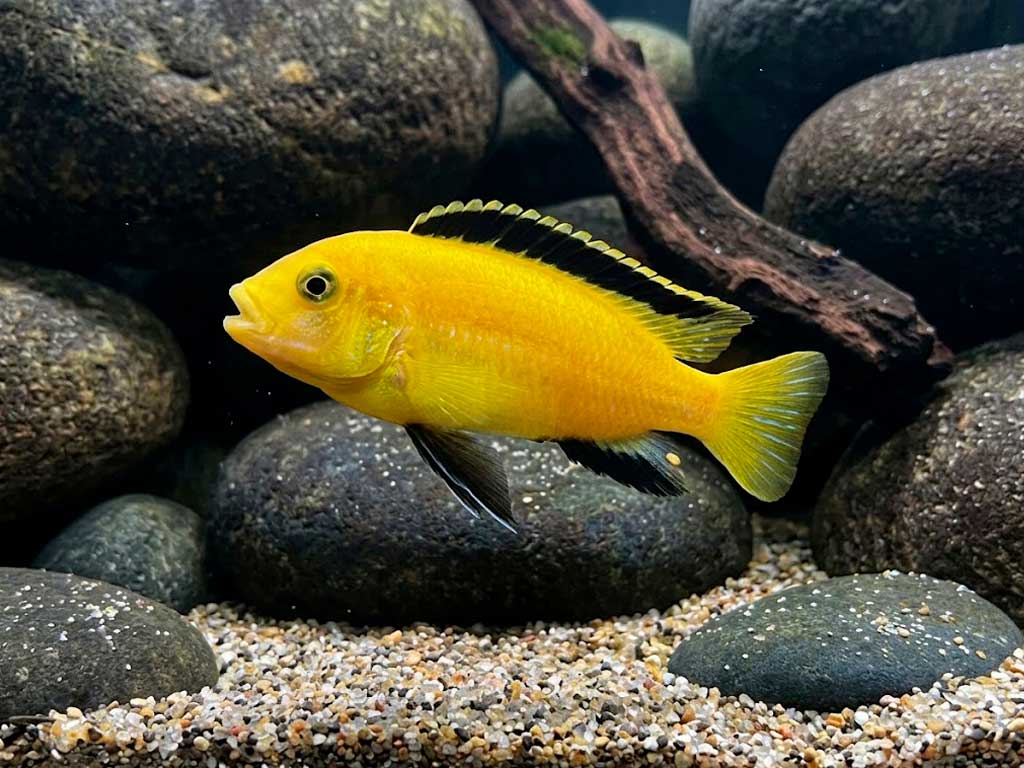
The “Electric Yellow” morph carries a bright, solid yellow body with black-edged dorsal, anal, and pelvic fins, a color combination genuinely uncommon among mbuna, most of which run in blue and black tones. Sexing isn’t straightforward from color alone. Males typically show more black on the fins, particularly the ventral and pectoral fins, and dominant males tend toward a brighter yellow than females or subordinate males.
Behavior and Temperament
This ranks among the most peaceful mbuna commonly kept, a genuine relief from the more combative reputation the group carries overall. Intraspecific aggression rarely escalates seriously, and a large enough tank can support more than one breeding male without constant conflict.
That peaceful reputation opens up real tankmate flexibility. This species pairs well with other mbuna, peacocks, featherfins, and even some non-cichlid community fish in the right setup, though it still shows genuine territorial behavior around spawning time.
Diet and Feeding
In the wild, this species works as an opportunistic omnivore, feeding largely on invertebrates picked from the rocky substrate. Captive diets should include both meaty foods and a genuine vegetable component, since this species runs more omnivorous than many of its mbuna relatives.
A rotation of cichlid pellets or flake, brine shrimp, and spirulina-based foods covers this species well. The feeding guide for ornamental fish covers building that kind of balanced diet in more depth.
Tank Requirements and Water Parameters
A tank in the 150 to 190 liter range (40 to 50 US gallons) gives this species the room it needs, with plenty of rockwork essential for hiding spots and territory boundaries. A sandy or fine gravel substrate matches the natural Malawi rift lake habitat closely, and the African cichlid tank setup guide covers building that kind of system from the ground up.
Water needs to stay firmly hard and alkaline, matching every Lake Malawi cichlid covered on this site: temperature between 23 and 28°C (73 to 82°F), pH anywhere from 7.0 to 8.9, and general hardness on the harder side, generally 7 dGH or above. That profile lines up closely with the requirements covered in the Abactochromis labrosus guide, another Lake Malawi mbuna from this series, since the entire lake shares this same fundamental water chemistry.
Breeding
This species is a maternal mouthbrooder, and reproduction is genuinely straightforward compared to many cichlids. The male excavates a pit in the sand within his territory, and the female lays eggs there before taking them into her mouth for fertilization by the male.
Eggs and fry stay in the female’s mouth for roughly three weeks before release, a brooding period consistent across most Lake Malawi mouthbrooders. Breeding difficulty is rated genuinely low, making this a reasonable species for a first attempt at cichlid breeding.
Conservation Status
The IUCN Red List classifies Labidochromis caeruleus as Least Concern, assessed in 2018. That rating comes with a real asterisk worth knowing: specialist sources describe the species as genuinely uncommon underwater even where it does occur, and renewed export collection specifically targeting the yellow variant has made encountering it in the wild even less likely than before.
Given how vastly the captive-bred population now outnumbers the wild one, sourcing captive-bred stock isn’t just the easier option here. It’s also the one putting essentially zero additional pressure on an already genuinely rare wild population.