Acanthocobitis Botia: Care Guide for the Mottled Zipper Loach
Acanthocobitis botia gets sold under a name that, strictly speaking, belongs to fish from one river system in Assam, India, while most of what actually ships under that label comes from somewhere else entirely. In practice, that naming mess doesn’t make the fish any less worth keeping, but it does change what “authentic” even means here.
This guide covers the real taxonomy behind the name, what a proper setup looks like, and how to avoid confusing it with an unrelated loach that shares its nickname.
Quick Identity Card
| Trait | Detail |
| Scientific name | Acanthocobitis botia (Hamilton, 1822), now Paracanthocobitis botia |
| Common names | Mottled Loach, Zipper Loach, Sand Loach, Spot Loach, Eye-Spot Loach |
| Family / Order | Nemacheilidae, Cypriniformes |
| Origin (true range) | Mainstem of the Brahmaputra River, Assam, India |
| Origin (trade range) | Historically assumed across Pakistan to Thailand; now known to cover several distinct species |
| Adult size | Normally 8 to 10 cm SL; some sources report up to 14.9 cm |
| Diet | Omnivore, bottom feeder |
| Temperament | Peaceful, adaptable, occasionally nips long-finned fish |
| Water temperature | 16 to 26°C depending on source, adaptable |
| pH | Up to 7.2 |
| GH (hardness) | Up to 25 dGH |
| Minimum tank | 75 x 30 cm base |
| Breeding | No confirmed home aquarium breeding reports |
| IUCN status | Least Concern |
Origin and the Name Behind the Name
Here’s what actually matters before buying this fish: the scientific name on the label is more complicated than it looks. Acanthocobitis botia was described from “northeastern Bengal” and, for decades, assumed to range across an enormous stretch of Asia, from the Indus basin in Pakistan through India, Nepal, Myanmar, Yunnan province in China, and into western Thailand.
A 2015 taxonomic revision by Singer and Page changed that picture completely. True Paracanthocobitis botia, the currently valid name, is now restricted to the mainstem (and possibly tributaries) of the Brahmaputra River in Assam, India.
Populations from Peninsular India, Sri Lanka, and Myanmar that were once lumped under the same name turned out to be distinct species entirely, and specimens from the Mae Klong drainage in Thailand are now recognized as a different species as well. In practice, most fish sold today as “Acanthocobitis botia” almost certainly come from outside its true, narrow native range.
Identification
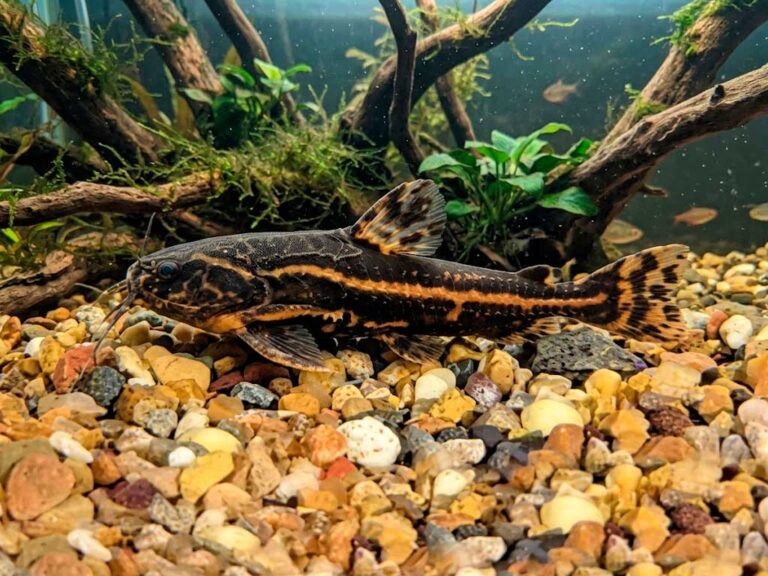
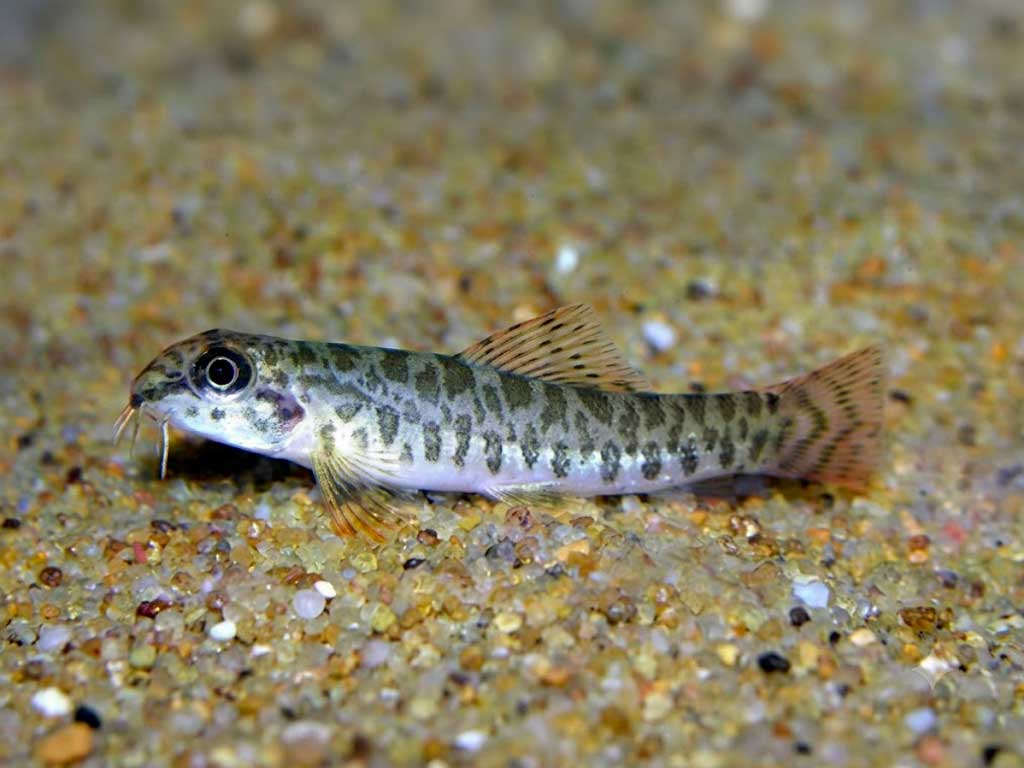
The juvenile “zipper” pattern gives this species its most popular nickname: a series of connected dark markings running down the sides that genuinely resembles a zipper when the fish is young.
That pattern diffuses and spreads as the fish matures, eventually reading as more of a mottled or striped effect.
A distinctive ocellus, a dark eye-spot, sits at the top of the caudal peduncle near the base of the tail, a reliable field mark even after the zipper pattern fades. Males lack a suborbital flap present in some related species, showing a suborbital groove in its place instead, and the lateral line typically runs complete or reaches at least to the anus.
The Botia Striata Confusion
This is worth calling out directly: Acanthocobitis botia gets mislabeled interchangeably with Botia striata, the zebra loach, constantly in the trade. The two aren’t closely related at all. Botia striata belongs to the family Botiidae, while Acanthocobitis botia sits in Nemacheilidae, an entirely different lineage of loaches.
The eye-spot at the top of the caudal peduncle is the fastest way to tell them apart. Acanthocobitis botia carries it clearly, and Botia striata doesn’t show the same marking. Anyone shopping for either fish should check for that ocellus before trusting the label alone.
Behavior and Temperament
Multiple independent sources, including wholesale importers who handle this species regularly, describe it the same way: adaptable, undemanding, and genuinely peaceful.
That reputation holds up better than most loach species, many of which carry at least some territorial or nippy tendencies.
The species will occasionally nip long-finned tankmates like angelfish or gouramis, though this stays the exception rather than the rule. It runs nocturnal and can be shy at first, settling in and becoming more visible once acclimated to a tank.
Diet and Feeding
As a bottom feeder, this species appreciates a varied diet: sinking algae wafers, shrimp pellets, bloodworm, and tubifex all get readily accepted. Given time, it will also learn to take food from the middle and even the top of the water column, though bottom feeding stays its natural preference.
The feeding guide for ornamental fish covers the broader principles of rotating food types, which applies directly here given how willingly this species adapts its feeding habits.
Tank Requirements and Water Parameters
A base of 75 x 30 cm covers this species comfortably, a genuinely manageable footprint compared to some of the larger loaches and catfish covered elsewhere on this site. Sand or fine gravel substrate matters for burrowing behavior, and subdued lighting alongside rocks or driftwood for cover suits this species well.
Water parameters show real variation depending on the source, which is worth knowing rather than picking one number and moving on. Formal ecological records list a temperature range of 24 to 26°C, tropical territory, while wholesale importers who handle live specimens regularly report success at a notably cooler 16 to 22°C. pH stays manageable up to 7.2, and general hardness tolerates up to 25 dGH, making this a genuinely adaptable species across a range of tap water conditions.
The water chemistry guide covers how to test and hold parameters steady regardless of which end of that range gets chosen.
Tankmates and Compatibility
This species pairs well with other fish from the same general region: zebra danios, rosy barbs, and dwarf gouramis all get mentioned specifically as compatible tankmates by keepers with direct experience. Community tanks of 20 gallons or more work comfortably.
Unlike many hillstream-associated loaches that tend toward solitary keeping, this species has reportedly been kept successfully alongside others of its own kind, a genuine point of flexibility compared to close relatives like the fast-current Aborichthys loaches covered elsewhere on this site.
Breeding
Reproduction follows the standard pattern for the family: external fertilization with no parental guarding of eggs, and a typical spawn size around 100 to 150 eggs. That said, no confirmed breeding reports exist specifically from home aquaria.
Anyone attempting it would be working from natural history data rather than an established hobbyist protocol, since this remains one of the less-documented aspects of an otherwise well-understood species.
Conservation Status
The IUCN Red List classifies this species as Least Concern, last formally assessed in 2007. Given the taxonomic uncertainty surrounding exactly which populations belong to the true species versus its now-separated relatives, that assessment likely reflects the broader species complex rather than the narrowly defined Assam population alone.