German Blue Ram (Mikrogeophagus Ramirezi): Care Guide & Buying Tips
German blue rams carry a name that misleads on two fronts at once: they aren’t from Germany, and the scientific name attached to them spent over sixty years genuinely unsettled.
In practice, this dwarf cichlid rewards careful, informed keepers with some of the most striking iridescent coloration in the freshwater hobby, but it also gets sold constantly as an easy community fish when it’s genuinely anything but.
This guide covers real water requirements, honest tankmate advice, and why the fish sold under a fancy color-strain name might not be the healthiest option available.
Quick Identity Card
| Trait | Detail |
| Scientific name | Mikrogeophagus ramirezi (Myers & Harry, 1948) |
| Common names | Ram Cichlid, Blue Ram, German Blue Ram, Butterfly Cichlid |
| Family / Order | Cichlidae, Cichliformes |
| Origin | Orinoco River basin llanos, Venezuela and Colombia |
| Adult size | Around 4 cm SL (1.6 in), commonly cited up to 6 cm |
| Diet | Benthophagous omnivore, sifts substrate for food |
| Temperament | Not a true community fish; poor competitor |
| Water temperature | 27 to 30°C (81 to 86°F), unusually warm |
| pH | 4.0 to 7.0 |
| GH (hardness) | 1 to 10 dGH |
| Minimum tank | 60 x 30 cm, roughly 54 L (14 US gal) for a pair |
| Lifespan | 3 to 4 years |
| Breeding | Biparental substrate spawner |
| IUCN status | Least Concern |
Origin and a Name That Misleads Twice Over
Here’s what actually matters before anything else: despite the common name, this species has nothing to do with Germany. It’s native exclusively to the Orinoco River basin llanos, the vast tropical savanna grasslands spanning Venezuela and Colombia. The “German” label traces back to early German breeding lines that popularized and refined the classic blue color form, not the fish’s actual origin.
The scientific name carries its own tangled history. Originally described as Apistogramma ramirezi in 1948, this species spent decades bouncing between competing genus names, Microgeophagus, Papiliochromis, and eventually Mikrogeophagus, argued over by multiple taxonomists across more than sixty years. Sven Kullander’s definitive 2011 analysis finally settled the dispute in favor of Mikrogeophagus, though older aquarium literature still commonly uses the earlier names.
Origin and Natural Habitat
The llanos is a vast, highly biodiverse system covering nearly 600,000 square kilometers across Venezuela and Colombia, characterized by well-defined wet and dry seasons and consistently warm year-round temperatures. This species inhabits the seasonally flooded plains and tributaries draining into the Orinoco from the north and west.
Identification
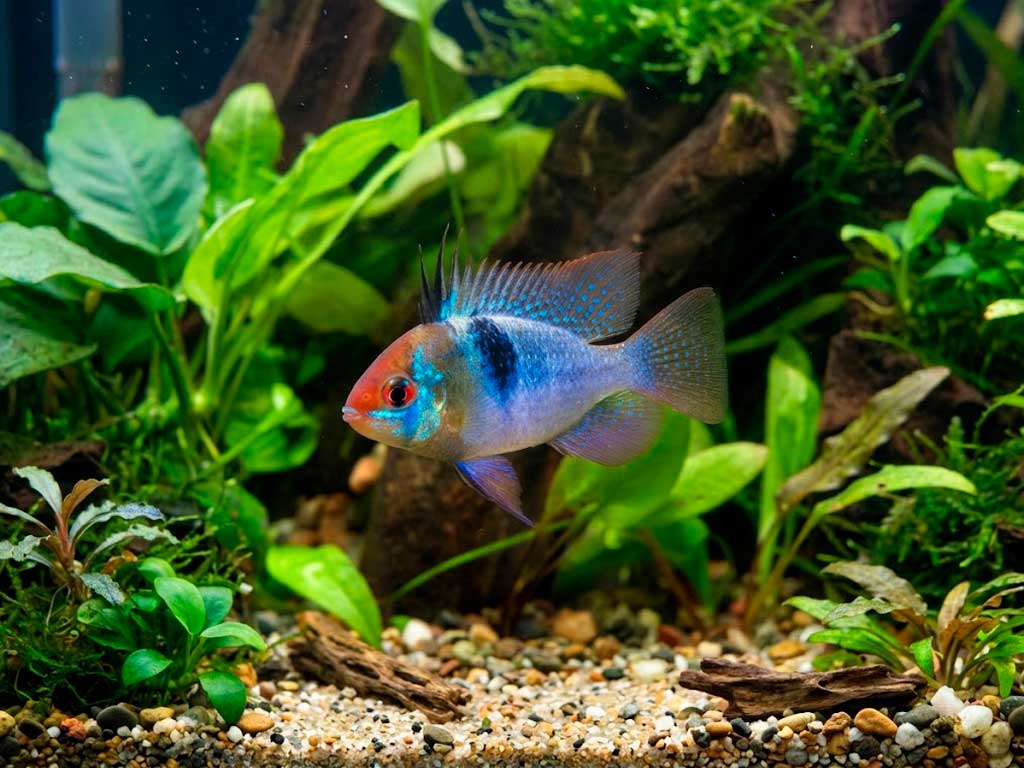
The body runs compressed and disc-shaped, with wild-type males showing genuinely striking iridescent blue markings across the fins, body, and head, set against yellow and orange base coloration. Females typically carry a pinkish patch on the belly absent in males, though this marker doesn’t always hold true in commercial ornamental strains.
Behavior and Compatibility: An Honest Warning
This is the section that matters most before buying this fish: despite being sold constantly as a community species, Mikrogeophagus ramirezi genuinely isn’t one. It requires pristine water quality and competes poorly for food against more assertive tankmates.
Juveniles stay gregarious, but adults pair off and defend a territory roughly a couple of feet across once sexually mature.
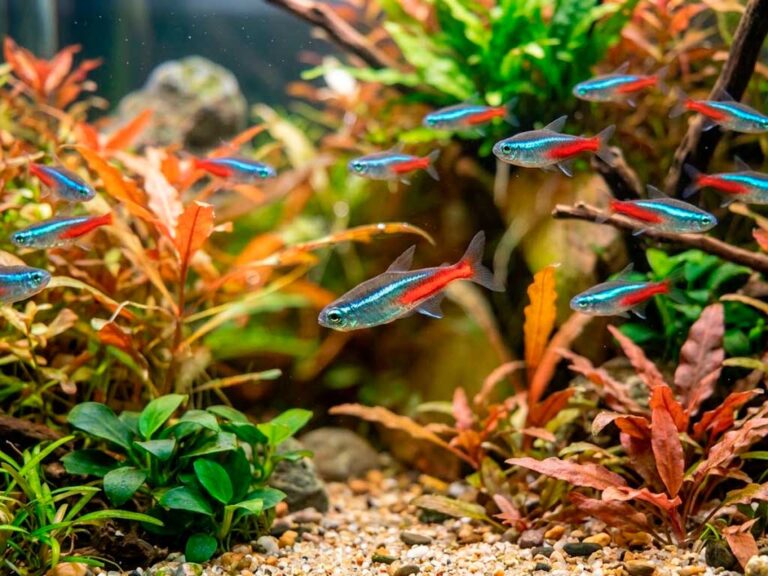
The best tankmates are peaceful, open-water schooling fish that share this species’ need for warm water, since their presence signals safety and reduces shyness. Cardinal tetras are specifically recommended for exactly this reason, sharing both temperament and water chemistry closely enough to make a genuinely compatible pairing. Avoid territorial or aggressive fish, most other cichlids, and anything requiring harder water than this species tolerates.
Diet and Feeding
In the wild, this species works as a benthophagous forager, taking mouthfuls of substrate and sifting out edible material through the gills and mouth, while also snatching food directly from the water column.
That natural feeding style translates into a genuine need for live and frozen foods like bloodworm, artemia, daphnia, and grindal worm, supplemented with quality small sinking dried food.
Wild-caught fish specifically may refuse dry food at first, though most learn to accept it over time. The feeding guide for ornamental fish covers building that kind of varied rotation in more depth.
Tank Requirements and Water Parameters
A base of 60 x 30 cm, roughly 54 liters (14 US gallons), suits a single pair. Soft sandy substrate, wood roots and branches creating shady spots and caves, plus a flat rock or two for potential spawning sites, all suit this species’ natural preferences well.
Dried leaf litter adds a natural touch and supports beneficial microbe growth that can serve as a secondary food source for fry.
Water needs to run genuinely warm for a tropical fish: temperature between 27 and 30°C (81 to 86°F), pH anywhere from 4.0 to 7.0, and general hardness kept low, 1 to 10 dGH. Filtration and flow should stay gentle, and large water changes are best avoided in favor of smaller, more frequent ones, around 10 to 15%.
Critically, this species should never go into a new or biologically immature tank, since deteriorating water quality can trigger a condition similar to hole-in-the-head disease, starting as small pits around the head and lateral line. The water chemistry guide covers holding these demanding parameters steady.
Breeding
This species is a biparental substrate spawner, best bred in a dedicated setup with no other fish present. No specific trigger reliably starts spawning beyond good diet and a stringent maintenance routine. Eggs are laid on a flat rock, driftwood, a broad leaf, or directly on the aquarium glass, with both parents sharing brood care equally afterward.
Eggs hatch in 2 to 3 days, and fry stay largely immobile for another 5 days before becoming free-swimming and ready for microworm or infusoria, followed by brine shrimp nauplii. Inexperienced pairs sometimes eat their first few broods but often improve with practice, though this depends heavily on starting with genuinely healthy, well-bred stock.
A Critical Buying Warning
Here’s what actually matters most for anyone shopping for this species: the commercial ornamental strains dominating the trade, including gold, long-finned, electric or neon blue, and especially the balloon form, tend to be genetically weak, hormone-treated to intensify coloration, disease-prone, short-lived, and poor breeders.
The balloon strain in particular is considered a genuinely deformed body shape by specialist sources, not a natural variation worth seeking out.
Wild-caught fish or stock from a reputable private breeder carry superior genetics but demand more precise water conditions and diet, arguably making this species suitable mainly for experienced keepers regardless of which route gets chosen.
Given how differently these two sourcing paths perform, it’s worth researching a specific seller’s breeding practices rather than assuming any “German blue ram” for sale is equivalent to another.
How It Differs From the Bolivian Ram
The genus Mikrogeophagus contains exactly two species, geographically separated by a wide gap. The Bolivian ram, Mikrogeophagus altispinosus, occurs in Bolivia and western Brazil, well outside the Orinoco range of true ramirezi. It grows larger, shows noticeably less color overall, and entirely lacks the iridescent blue markings that define its more famous relative.
In practice, the Bolivian ram has a reputation as the hardier, more forgiving of the two species, a real consideration for anyone drawn to the ram cichlid look but wary of the water-quality demands covered above.
Conservation Status
The IUCN Red List classifies Mikrogeophagus ramirezi as Least Concern, reflecting a stable population within its native Orinoco basin range.