Blue-Green Chromis Care Guide: The Schooling Truth
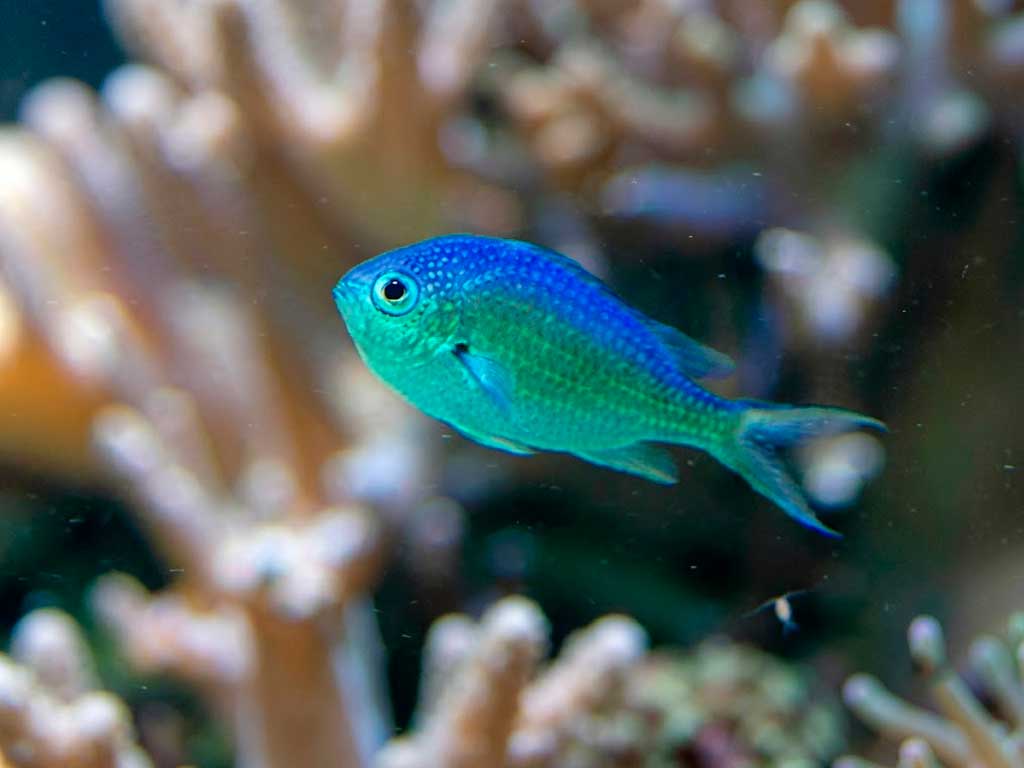
Blue-green chromis show up on nearly every beginner stocking list, ours included in our best saltwater fish for beginners guide, usually described as an easy schooling fish that adds color and movement.
That description isn’t wrong exactly, but it skips something important: what actually happens when you put a group of chromis in a home aquarium rarely looks like schooling at all.
This guide covers the real behavioral picture, how many to buy, tank sizing, feeding, and the species you might be confusing blue-green chromis with at your local fish store.
Quick answer: Blue-green chromis (Chromis viridis) are hardy, reef-safe, iridescent damselfish relatives that rarely school the way people expect in home aquariums. Small groups in modest tanks often develop a dominance hierarchy that thins the group over time. A single chromis in a 30 to 40 gallon tank, or a large group of 8 or more in a 100+ gallon tank, both produce far more stable long-term results than the popular middle-ground group of 4 to 6.
Quick Facts: Blue-Green Chromis
- Scientific name: Chromis viridis
- Size: 3 to 4 inches (7.5 to 10 cm)
- Minimum tank size: 30 gallons for one fish, 100+ for a stable group
- Temperature: 75-82°F (24-28°C)
- Lifespan: 8 to 15 years with proper care
- Diet: Planktivore, needs frequent small feedings
- Reef safe: Yes
The Schooling Myth: What Actually Happens in Your Tank
In the wild, blue-green chromis hover in loose, shifting clouds above branching coral, sometimes hundreds or thousands strong. That aggregation isn’t social bonding, it’s a survival strategy. Massive open water, constant predator pressure, and drifting plankton all push chromis to stay loosely grouped, since scattered fish are easier for predators to pick off and a crowd improves everyone’s odds of intercepting food.
Remove those pressures, which is exactly what a home aquarium does, and the behavior changes. Chromis are technically members of the damselfish family, and within days of being introduced to a tank, they start sorting into a dominance hierarchy instead of maintaining a loose, peaceful aggregation. One fish claims the best feeding position and territory. The rest fall into a pecking order beneath it, and the fish at the bottom get pushed toward the edges, eat less, and grow increasingly stressed.
Reef hobbyists have a name for the predictable result: group attrition. You buy six chromis, and months later you’re down to two or three. It isn’t bad luck or poor husbandry necessarily, it’s the hierarchy working exactly as social pressure would predict in a confined space. Understanding this upfront changes how you should actually stock this fish.
How Many Should You Keep?
Counterintuitively, the popular middle-ground group size is the riskiest choice.
- A single fish: Eliminates hierarchy problems entirely. One chromis in a 30 to 40 gallon reef community tank can live a full, active, colorful life for a decade or more with none of the group dynamics headaches.
- A small group (3 to 7): The most commonly recommended approach, and unfortunately the one most likely to end in attrition. A medium tank gives hierarchy enough room to form but not enough room to dilute it, so a dominant fish often picks off the rest over the following months.
- A large group (8 or more): With enough fish, no single individual can realistically dominate everyone, which spreads the aggression thin enough that it stops being lethal. This requires real space, generally 100+ gallons with substantial open swimming water.
| Tank Size | Recommended Approach |
| 30-40 gallons | Single specimen |
| 55-75 gallons | Small group (expect some attrition) |
| 100+ gallons | Large group of 8-12 |
If you do go with a group, buy every fish at the same time as juveniles and add them together. Introducing a new chromis to an already-established group invites immediate aggression toward the newcomer, since the hierarchy is already set.
Tank Requirements and Aquascaping
Keep parameters stable within the ranges above, covered in more depth in our water chemistry guide. Chromis tolerate moderate nitrate better than many reef fish, but that tolerance is a buffer against mistakes, not a reason to skip regular testing.
Aquascape with genuine open swimming lanes through the mid and upper water column, not a wall of rock. Chromis need room to spread out and establish separate territories, and dense, maze-like rockwork just traps subordinate fish in dead ends where a dominant fish can corner them. Leave meaningful gaps between rock formations, covered in our live rock and sand guide, and strong, varied circulation from a wavemaker or powerhead, detailed in our water pump and circulation guide, helps replicate the drifting current chromis use to intercept food in the wild.
Diet and Feeding
Chromis are constant grazers by nature, picking plankton out of the water column all day rather than eating a couple of large meals. Matching that pattern in your tank supports both their health and their coloration.
- Frozen mysis shrimp: A solid protein-rich staple.
- Small marine pellets: Easy to portion for routine feeding.
- Enriched or vitamin-boosted foods: Noticeably intensify their iridescent blue-green coloration over time compared to a basic diet.
Feed two to three small portions daily rather than one large one, only what the group finishes in a few minutes. If you’re keeping several chromis, scatter food across multiple spots in the tank rather than one feeding point, since a dominant fish will otherwise monopolize a single feeding zone and starve out the rest of the group faster than hierarchy alone would.
Blue-Green Chromis vs. Other Chromis Species
A few similar-looking species show up in the trade, and mixing them up leads to stocking mistakes.
- Green Chromis (Chromis viridis): The fish most people mean by “blue-green chromis,” named for its shifting iridescent color. Indo-Pacific origin, the most common and affordable chromis in the trade.
- Blue Reef Chromis (Chromis cyanea): A Caribbean species with a deeper, more uniform blue rather than shifting iridescence. Runs slightly larger, tends toward a more assertive temperament, and generally needs a bigger system. Don’t mix this species with green chromis in the same tank.
- Black Axil Chromis (Chromis atripectoralis): Easily confused with green chromis at a glance, distinguished by a dark marking near the base of the pectoral fin. Tends to tolerate smaller groups reasonably well, but can show more pronounced territorial behavior individually.
Compatibility and Tank Mates
Chromis are peaceful toward other species and fully reef safe, ignoring corals, shrimp, and snails entirely. They occupy the open water column, which keeps them out of conflict with bottom-dwelling gobies or rock-claiming clownfish, covered in our ocellaris clownfish care guide. Blennies, firefish, and peaceful wrasses all make solid tankmates too.
Avoid pairing chromis with genuinely aggressive damselfish, which will harass them relentlessly, and skip anything large enough to treat a 3-inch fish as a snack. Anthias occupy a similar water-column niche and compete for the same drifting food, so adding both to the same tank can disrupt feeding hierarchies for either species.
If Your Group Is Already Shrinking
If attrition has already started, a few responses genuinely help. Identify and remove the most aggressive individual if one stands out, though be aware the next-most-dominant fish sometimes simply takes over the role. Rearranging rockwork resets territorial claims and can interrupt an established pecking order. Increasing feeding frequency and spreading food across multiple points reduces the competition driving the aggression in the first place.
If you’re down to two or three fish and the group has stabilized, that’s often a reasonable stopping point. If aggression keeps cycling through whichever fish becomes dominant, the honest fix is usually accepting a single specimen rather than continuing to replace losses.
Frequently Asked Questions
Do blue-green chromis actually school in aquariums?
Usually not in the tight, synchronized way people expect. Most home aquariums produce loose groupings that shift into a dominance hierarchy rather than true schooling behavior, which only really approximates wild schooling in very large systems with 10 or more fish.
Why does my chromis group keep shrinking?
This is called group attrition, and it happens when a dominance hierarchy forms in a tank too small to dilute the aggression. A dominant fish monopolizes food and territory, and subordinate fish grow stressed, stop eating well, and eventually die or get killed outright.
Is it better to keep one chromis or a group?
For most home aquariums, yes, a single fish is the more reliable choice. It removes hierarchy problems entirely and still gives you the active swimming and color that makes chromis appealing. Groups only tend to stabilize well in tanks of 100 gallons or more with 8 or more fish.
What is the difference between green chromis and blue reef chromis?
Green chromis (Chromis viridis) come from the Indo-Pacific and show shifting iridescent color, while blue reef chromis (Chromis cyanea) come from the Caribbean, run a bit larger, and show a deeper, more uniform blue. They shouldn’t be mixed in the same tank.
Are blue-green chromis reef safe?
Yes, completely. They don’t bother corals, shrimp, or snails, and their mid-water swimming keeps them out of conflict with bottom-dwelling or rock-claiming tankmates.
How often should I feed chromis?
Two to three small feedings a day works better than one large meal, matching their natural grazing behavior. Groups benefit from food scattered across multiple points in the tank to reduce competition.
Can chromis live with clownfish?
Yes, they pair well in most community reef tanks. Clownfish claim rock or coral territory while chromis occupy open water, so the two species rarely come into direct conflict.
What tank size do I need for a group of chromis?
Plan on 100 gallons or more for a group of 8 to 12 fish to have the best chance at long-term stability. Smaller tanks with smaller groups often see the group shrink over the first year.
Why does my chromis look pale or washed out?
Stress from hierarchy pressure is a common cause, along with a basic, unenriched diet. Vitamin-enriched foods noticeably intensify their iridescent coloration compared to plain flakes or pellets.
How long do blue-green chromis live?
With stable water quality and appropriate stocking, 8 to 15 years is a realistic lifespan, whether kept singly or in a well-planned group.
Blue-green chromis earn their popularity honestly, hardy, colorful, and genuinely reef safe, but the fish store advice to “grab six for a school” sets a lot of tanks up for disappointment. Match your stocking plan to your actual tank size, not the picture in your head of a synchronized cloud of fish, and you’ll get years of enjoyment out of this species either way.