Abramites Hypselonotus: Care Guide for the Marbled Headstander
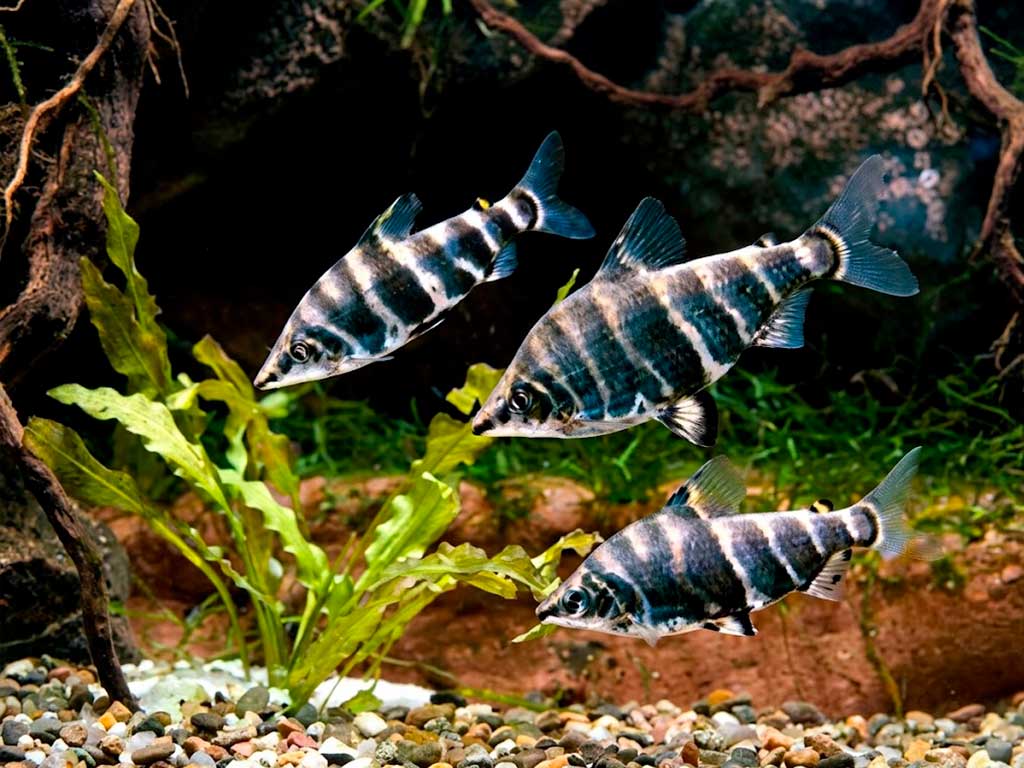
Abramites hypselonotus rests at a steep head-down angle in the water, a posture so distinctive it gave the entire headstander group its name. In practice, this South American characin brings genuine personality to a planted tank, provided the tank is large enough and the plants tough enough to survive it.
This guide covers the tank size this species actually needs, why it eats plants for breakfast, and how to avoid the one common misidentification that trips up even experienced keepers.
Quick Identity Card
| Trait | Detail |
| Scientific name | Abramites hypselonotus (Günther, 1868) |
| Common names | Marbled Headstander, High-Backed Headstander |
| Family / Order | Anostomidae, Characiformes |
| Synonyms | Leporinus hypselonotus, Abramites microcephalus, Abramites ternetzi |
| Origin | Amazon, Orinoco, and Paraguay-Paraná river systems, South America |
| Adult size | 12 to 14 cm standard length, up to 20 cm reported in some sources |
| Diet | Omnivore, strongly herbivore-leaning |
| Temperament | Peaceful when young, increasingly solitary and territorial with age |
| Water temperature | 23 to 27°C (73 to 81°F) |
| pH | 6.0 to 7.5 |
| GH (hardness) | 2 to 18 dGH |
| Minimum tank | 120 x 30 cm base, even for a single specimen |
| Lifespan | Around 15 years |
| IUCN status | Least Concern |
Origin and Natural Habitat
Abramites hypselonotus covers an enormous range across South America east of the Andes, found throughout the Amazon and Orinoco basins plus the Paraguay-Paraná system, spanning Bolivia, Brazil, Colombia, Ecuador, Guyana, Peru, Venezuela, Paraguay, and Argentina. Few aquarium fish sold today occupy this much natural territory.
The species reads as an ecological generalist, turning up in everything from turbid main river channels to quiet backwaters and minor tributaries. It also moves into temporarily flooded zones during the annual high-water season, following the food that expands with the flood.
Identification
The body runs deep and laterally compressed, giving mature fish a genuinely high-backed, almost diamond-shaped profile that makes the species hard to confuse with most other characins. A distinctive post-pelvic median keel, unique to the genus Abramites, adds to that unmistakable silhouette.
Coloration reads beige to light brown with seven to nine dark vertical bands running down the body, a yellow forehead, and a matching yellow adipose fin. Here’s what actually matters for wild-caught specimens: each individual carries a genuinely unique striping pattern, so no two fish from the wild look quite identical.
Behavior and Temperament
Young Abramites hypselonotus behave peacefully enough to join almost any community tank. That changes with age. Adults grow steadily more solitary and can turn genuinely territorial toward their own species, and occasionally nippy toward tankmates as well.
The headstanding posture itself ties directly to feeding behavior. In the wild, this species is often found face-down in narrow vertical rock fissures, and that same head-down angle shows up constantly in aquarium tanks even though the body shape would suggest a surface-dwelling fish. Trust me on this one: cover the tank well.
This species jumps readily, using that ability naturally to change territory or escape predators in the wild, and an uncovered tank at home turns that instinct into a real risk.
Diet and Feeding
This species leans heavily herbivore, and “leans” undersells it. Wholesale suppliers who handle this fish regularly describe it as an extreme herbivore, and tender or soft-leaved aquarium plants rarely survive contact with a hungry Abramites hypselonotus.
A workable diet combines algae wafers and vegetable-based flake or pellet food as the daily base, supplemented with fresh vegetables like lettuce, spinach, or peas.
Occasional live or frozen fare such as bloodworm rounds things out, though the vegetable component stays essential rather than optional. Anyone planting the tank should stick to genuinely tough species like Java fern, since anything soft-leaved becomes a snack.
Tank Requirements and Water Parameters
A base of 120 x 30 cm marks the real minimum, and that number applies even to a single fish, not just a group. Given how large this species reads visually with its deep body, undersized tanks make the fish look cramped fast.
Water chemistry stays fairly forgiving within a tropical range: temperature between 23 and 27°C (73 to 81°F), pH from 6.0 to 7.5, and general hardness anywhere from 2 up to 18 dGH.
The water chemistry guide covers how to hold those parameters steady, and given the tank size this species needs, the filtration systems guide is worth reading before stocking a system this large.
Tankmates and Compatibility
This is not a beginner community fish once it matures. Compatibility runs closer to “non-community” territory, and successful keepers generally pair it with boisterous, similarly-sized tankmates rather than small or delicate species.
Keeping a proper group helps dilute aggression, since Abramites species interact constantly with each other and too few individuals in too little space becomes a genuine nuisance. Larger groups in larger aquariums smooth that behavior out considerably compared to a pair or trio squeezed into a small tank.
Diet and feeding advice on this site generally follows the same core principles across species. The guide to feeding ornamental fish covers the fundamentals of building a varied, balanced diet, which pairs naturally with the vegetable-heavy approach this species needs.
Breeding
Reproduction in the aquarium has historically been rare and inconsistently documented. Older aquarium references list breeding as essentially unaccomplished in captivity, and even current sources describe it as moderately difficult at best.
Sexual dimorphism offers little help for anyone attempting it. Mature females run somewhat deeper-bodied than males, but the difference stays subtle enough that reliable sexing from external features alone isn’t realistic.
How It Differs From Abramites Eques
The genus Abramites contains exactly two species, and the second one, Abramites eques, comes with a genuinely unusual footnote: wholesale suppliers who’ve handled this genus for decades report it has essentially never been imported alive. Every photo claiming to show A. eques in the trade turns out, on closer inspection, to be a color variant of A. hypselonotus instead.
A. eques lives only in the Rio Magdalena drainage of Colombia, a single river system, compared to the vast multi-basin range of A. hypselonotus. The two species differ measurably: A. hypselonotus carries 10 to 12 branched anal-fin rays against 13 to 14 in A. eques, and shows 8 transverse bars distributed across the whole body rather than the 5 bars of A. eques, whose first band sits under the dorsal fin instead of starting behind the head.
In practice, anyone shopping for a headstander in this genus is buying Abramites hypselonotus, whatever the label says.
Conservation Status
The IUCN Red List classifies Abramites hypselonotus as Least Concern, a reasonable rating given how widely distributed the species is across South America. Its enormous natural range and generalist habitat preferences give it real resilience that many narrower-range aquarium fish simply don’t have.