Swordtail Fish (Xiphophorus Hellerii): Care Guide, Types & Breeding
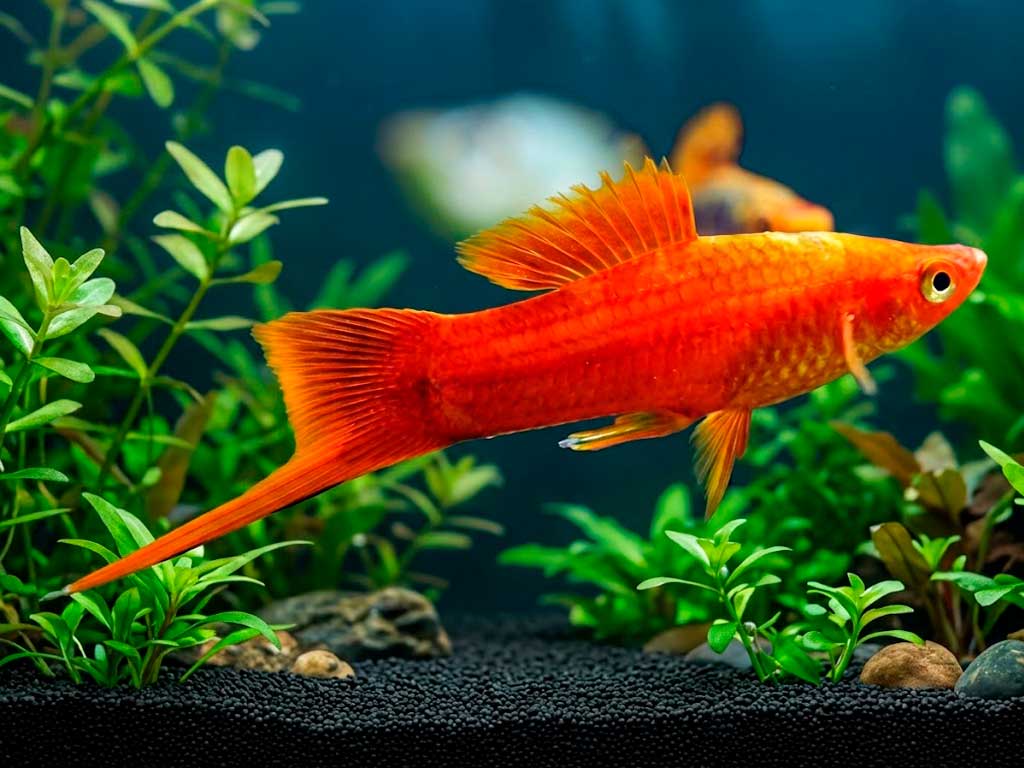
Swordtail fish get their name from a feature only the males have: an elongated lower tail lobe that can stretch out a third of the body’s total length. In practice, this livebearer shares almost everything else with the platy, its closest relative, right down to overlapping color varieties and near-identical water needs.
This guide covers real tank requirements, the traits that make males genuinely unusual among livebearers, and exactly how a swordtail differs from the platy it constantly gets grouped with.
Quick Identity Card
| Trait | Detail |
| Scientific name | Xiphophorus hellerii (Heckel, 1848) |
| Common names | Swordtail, Green Swordtail |
| Family / Order | Poeciliidae, Cyprinodontiformes |
| Origin | Atlantic coast of Central America, Veracruz (Mexico) to northwestern Honduras |
| Adult size | Males around 10 cm plus the sword; females up to 12 cm |
| Diet | Omnivore, worms, crustaceans, insects, plant matter |
| Temperament | Peaceful toward other species; males aggressive toward each other |
| Water temperature | 20 to 28°C (68 to 82°F) |
| pH | 7.0 to 8.5 |
| GH (hardness) | 10 to 30 dGH |
| Minimum tank | Around 76 to 100 L (20 to 26 US gal) for adults |
| Lifespan | Around 5 years |
| Breeding | Livebearer, 20 to 200 fry per brood |
| IUCN status | Least Concern, but invasive in 30+ countries |
Origin and Natural Habitat
Xiphophorus hellerii comes from the Atlantic slope of Central America, ranging from Veracruz, Mexico, down to northwestern Honduras, with populations also documented in Guatemala and Belize. It’s a genuinely adaptable species, turning up in habitats as different as stagnant swamps and swift mountain streams.
Wild swordtails favor fast-flowing, heavily vegetated rivers and streams, though they also colonize warm springs, weedy canals, and ponds. That habitat flexibility is a big part of why this species has established itself so easily wherever people have introduced it outside its native range.
Identification
The wild, natural coloration of this species is what most people actually mean by “green swordtail”: an olive-green back, greenish-yellow flanks, and a reddish stripe bordered by green running from snout to tail. This isn’t a bred color variety. It’s the original, default look the species carries in the wild.
Males carry the defining feature: a long, sword-like extension of the lower caudal fin lobe, often edged in black. Females lack the sword entirely and run translucent grey-beige by comparison, with a rounded rather than elongated tail.
Two Kinds of Males
Here’s a genuinely unusual trait worth knowing before buying a group: male swordtails develop along one of two distinct timelines. Early-maturing males grow their sword and gonopodium (a modified anal fin used for reproduction) relatively young, sometimes starting around 1 to 1.5 inches in length.
Late-maturing males take far longer, and in the meantime, they’re commonly mistaken for females, sometimes staying female-looking even at 4 inches long.
On top of that, this species has a documented tendency toward sex reversal, switching from female to male under certain environmental conditions. Between the two male types and the reversal potential, sexing a group of young swordtails with total confidence isn’t always realistic.
Behavior and Temperament
Toward other species, swordtails read as genuinely peaceful and adaptable, fitting well into a community tank alongside barbs, gouramis, corydoras, loricariid catfish, and other livebearers. Toward each other, males tell a different story: they compete aggressively, and cramped conditions make that worse.
The standard fix is stocking ratio: keep one male to two or three females, minimum, to spread out that aggression and avoid excessive harassment of any single female.
Diet and Feeding
Swordtails are easy, adaptable omnivores. In the wild they take worms, crustaceans, insects, and plant matter, and that same variety translates directly into aquarium care.
A rotation of flake, small pellets, and live or frozen foods covers their needs well. The feeding guide for ornamental fish covers the broader principles of building that kind of balanced diet, and swordtails aren’t a species that demands anything beyond the basics.
Tank Requirements and Water Parameters
A tank in the 76 to 100 liter range (20 to 26 US gallons) suits adult swordtails well. Smaller setups around 38 liters can work temporarily for juveniles under about 7 cm, but adults in a tank that size are likely to show real aggressive tension, especially between males.
Water chemistry runs on the harder, more alkaline side, closely matching the platy: temperature between 20 and 28°C (68 to 82°F), pH from 7.0 to 8.5, and general hardness anywhere from 10 to 30 dGH. Open swimming space in the middle to upper water column matters too, alongside planting along the back and edges rather than densely throughout.
The water chemistry guide covers testing and adjusting toward that harder end of the range.
Tankmates and Compatibility
Beyond the barbs, gouramis, and bottom-dwelling catfish already mentioned, swordtails pair especially naturally with other livebearers that share their hard-water preferences.
Platy fish top that list, given how closely the two species overlap in origin, temperament, and water requirements, and mixed platy-swordtail community tanks are genuinely common in the hobby.
Small or delicate fish don’t belong in the same tank. Swordtails aren’t aggressive toward other species by nature, but their size and activity level can still stress out anything too fragile to keep pace.
Breeding
Like the platy, swordtails are livebearers, giving birth to free-swimming fry rather than laying eggs. Gestation runs 24 to 30 days, and a single brood can range anywhere from 20 to 200 fry, a notably wider range than what’s typical for platies.
The bigger difference sits in timing: swordtails reach sexual maturity at 8 to 12 months old, considerably later than the platy’s roughly 4-month timeline. Floating or dense planting gives fry somewhere to hide immediately after birth, since adults, swordtails included, will eat their own young without that cover.
Swordtail vs. Platy: How They Compare
Given how often these two get shopped for together, a direct comparison is worth laying out plainly. Both belong to the genus Xiphophorus, share the same native Central American region, and can even crossbreed with each other under the right conditions.
The clearest visual difference is the sword itself: male swordtails carry it, male platies never do. Size differs too, with swordtails generally running larger, up to 12 cm compared to the platy’s 6 to 7 cm ceiling. Behaviorally, swordtail males show real aggression toward each other in a way platies typically don’t, which is why the stricter male-to-female ratio matters more here.
Breeding timelines diverge as well: platies mature and reproduce noticeably faster than swordtails do.
What the two species share matters just as much: nearly identical water chemistry preferences, similar omnivorous diets, and genuinely compatible temperaments toward other community fish, which is exactly why keeping both together works so well in practice.
Conservation Status
The IUCN Red List classifies Xiphophorus hellerii as Least Concern, reflecting a wide native range across Central America. That said, this species carries a documented history as a successful invasive outside its native range, established in more than 30 countries.
Confirmed invasive populations exist in Israel (since the early 20th century), Iran, southern India, South Africa, and Australia, and the species has even taken hold in geothermally warmed waters in Hungary and Bulgaria, well outside its natural tropical range.
Given that track record, releasing any swordtail into local waterways, regardless of location, carries real ecological risk. Excess fry or unwanted adults should go back to a shop or another keeper, never into a pond, canal, or stream.