Banggai Cardinalfish Care Guide: Tank, Diet & Breeding
Our best saltwater fish for beginners guide lists the banggai cardinalfish as an easy, striking beginner choice, and it genuinely is.
But this species carries a story most care guides skip past: it comes from one of the smallest natural ranges of any marine aquarium fish, breeds in a way almost no other reef fish does, and the choice to buy captive-bred here matters more than it does for almost anything else in the hobby.
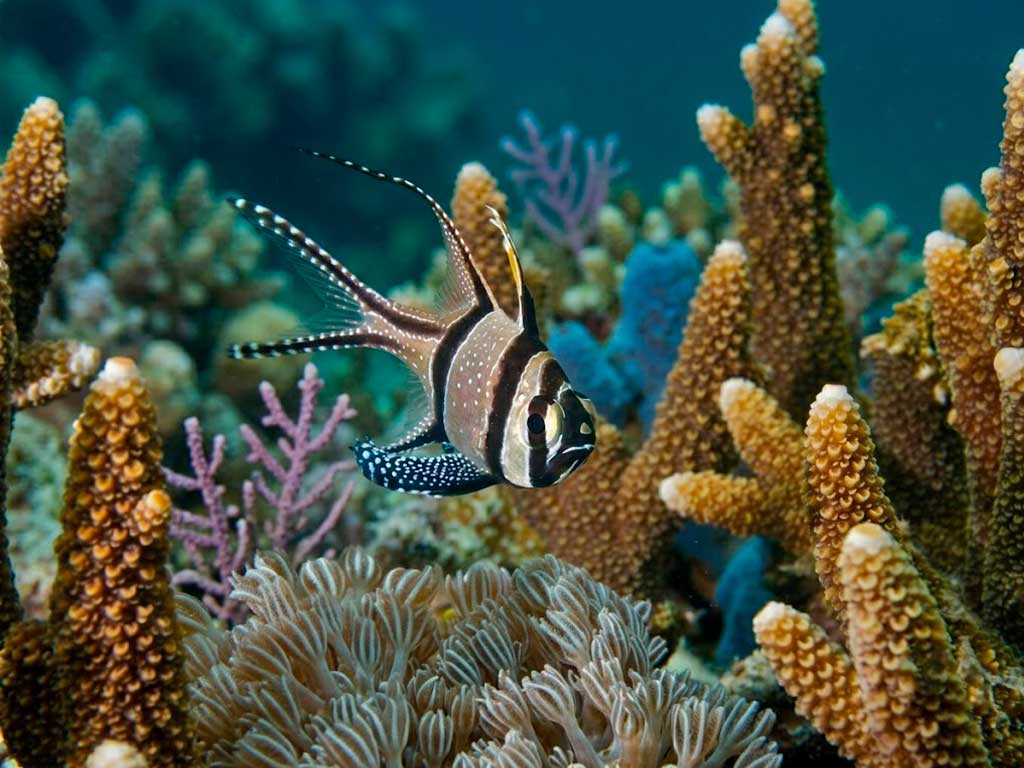
Quick answer: The banggai cardinalfish (Pterapogon kauderni) is a peaceful, slow-moving, silver-and-black striped fish suited to tanks 20 gallons and up. It’s easy to feed, easy to breed, and widely available captive-bred, which matters because the wild population is IUCN-listed as endangered due to its extremely limited natural range and heavy collection pressure for the aquarium trade.
Quick Facts: Banggai Cardinalfish
- Scientific name: Pterapogon kauderni
- Also called: Kaudern’s cardinalfish, often misspelled bangai or banggi cardinal
- Size: About 3 inches (7.5 cm)
- Minimum tank size: 20 gallons
- Lifespan: 2.5 to 3 years typically, up to 5 with excellent care
- Diet: Carnivore, mainly small crustaceans
- Conservation status: IUCN Endangered in the wild
- Temperament: Peaceful, slow-moving, somewhat shy
Why Captive-Bred Matters More With This Species
Most reef fish on a beginner stocking list range across huge swaths of ocean. The banggai cardinalfish doesn’t. Its entire natural population is confined to the Banggai Archipelago in Indonesia, a genuinely tiny range for a species that became enormously popular in the aquarium trade after its “discovery” by hobbyists in the late 1990s. That combination, a naturally restricted range plus heavy collection pressure, is exactly what pushed the wild population to an IUCN Endangered listing.
The good news is this species breeds easily in captivity, covered below, which means captive-bred stock is genuinely abundant and often no more expensive than wild-caught individuals. There’s no meaningful tradeoff here: captive-bred banggai cardinalfish also tend to handle shipping and new tank conditions better than wild fish. Buying captive-bred isn’t a compromise for this species, it’s simply the better choice on every front.
Appearance and Identification
Banggai cardinalfish are unmistakable once you’ve seen one: a silver body marked with bold black bars, elongated trailing fins, and a scattering of white spots across the body and fins. That spot pattern is genuinely unique to each individual fish, similar to a fingerprint, so no two banggai cardinalfish look exactly alike if you look closely.
Males and females look nearly identical outside of breeding season. During breeding, a male’s mouth visibly enlarges to accommodate the eggs and fry he’ll be carrying, covered in more detail below.
Tank Requirements
A single banggai cardinalfish, or a bonded pair, does well in a tank as small as 20 gallons. Unlike active swimmers that patrol the whole tank, this species is naturally sedentary: in the wild, it stays close to a single shelter, a sea urchin, anemone, or coral branch, rather than roaming widely. That translates directly to aquarium behavior. It won’t need the swimming room some other reef fish demand, but it does need a secure spot to call home.
Provide an overhang or shaded ledge where it can retreat if reef lighting feels too bright, covered in our live rock and sand guide. Keep water parameters stable, detailed in our water chemistry guide, since this species handles stress poorly and may refuse food for days if conditions swing.
Natural Habitat: A Fish That Doesn’t Wander
In the wild, banggai cardinalfish live in shallow, sheltered bays and harbors around seagrass beds and coral reefs, typically at depths of less than 6 meters. Rather than ranging widely, individuals and small groups stay closely associated with a single host shelter, most often the long spines of a sea urchin, but sometimes an anemone or a branching coral colony, retreating into that shelter whenever a predator passes.
This site-attached lifestyle is unusual for a reef fish, and it is also part of what made the species so vulnerable to overcollection: a population tucked into a small number of shallow, easily accessible bays is far easier to net out entirely than a species spread across open reef. Replicating this behavior in your tank is straightforward. A stable shelter, whether that is dense rockwork, a coral branch, or even a large decorative urchin-like ornament, gives the fish the same sense of security it would have on a natural reef, and you will often see it hover in the same general spot day after day rather than exploring the whole aquarium.
Diet and Feeding
In the wild, banggai cardinalfish feed mainly on copepods and other small crustaceans, picking opportunistically at whatever drifts by. In captivity, they’re generally easy eaters once settled, though their relatively small mouth means food size matters.
- Frozen mysis and brine shrimp, appropriately sized
- Finely chopped marine meaty foods
- Small marine pellets
Feed once or twice daily. A newly introduced fish sometimes takes a few days to start eating confidently in an unfamiliar tank; this is normal, not necessarily a health problem, though prolonged refusal is worth investigating.
Compatibility and Tank Mates
Banggai cardinalfish are peaceful and reef safe, ignoring corals and invertebrates entirely. They coexist well with other calm community fish, including clownfish, gobies, and royal grammas, since none of these species compete directly for the same territory or feeding style. Avoid fast, aggressive feeders that might consistently out-compete this slower, more deliberate eater at mealtime.
Small groups can work in a large enough tank, but pairs are the most reliable and commonly recommended stocking approach for hobbyists specifically interested in breeding.
Breeding: One of the Easiest Marine Fish to Breed at Home
This is where the banggai cardinalfish genuinely stands apart from almost every other reef fish, and it’s a big part of why captive-bred stock is so widely available. Like several other cardinalfish species, banggai cardinalfish are paternal mouthbrooders: after the female releases a sac of eggs and the male fertilizes them, he carries the entire clutch in his mouth for roughly 20 to 30 days, through fertilization, hatching, and early development, without eating during much of that period.
Here’s the detail that makes this species so uniquely beginner-friendly for breeding: unlike most reef fish, which release larvae into open water for weeks as vulnerable, hard-to-feed plankton, banggai cardinalfish skip that stage entirely. The male releases fully formed, miniature juveniles that already look like tiny adults and can eat appropriately sized foods right away. That single trait removes the single hardest part of breeding most marine fish at home.
If you want to try breeding, a stable, low-stress pair in a tank with minimal competition for food is usually all it takes. Watch for the male’s mouth to visibly enlarge, a sign he’s holding a clutch, and expect juveniles to appear on their own timeline without any special rearing tank required, though separating them from more assertive tankmates improves survival odds.
Frequently Asked Questions
Is the banggai cardinalfish endangered?
Yes, the wild population is IUCN-listed as endangered, driven by its extremely limited natural range in Indonesia’s Banggai Archipelago and heavy collection for the aquarium trade. Captive-bred stock is widely available and doesn’t contribute to that pressure.
Why should I buy captive-bred banggai cardinalfish specifically?
This species breeds easily in captivity, so captive-bred individuals are genuinely abundant, often no pricier than wild-caught fish, and tend to adapt to aquarium life more readily. There’s essentially no downside to choosing captive-bred here.
What size tank does a banggai cardinalfish need?
A single fish or bonded pair does fine in a tank as small as 20 gallons, since this species stays close to a chosen shelter rather than actively patrolling open water.
How do banggai cardinalfish breed?
The male mouthbroods the eggs for roughly 20 to 30 days after fertilization, and releases fully formed juveniles rather than free-swimming larvae. This makes them one of the easier marine fish to breed successfully at home.
Is bangai cardinal the same fish as banggai cardinalfish?
Yes. Bangai, banggi, and several other spellings are common misspellings of the same species, Pterapogon kauderni, also called Kaudern’s cardinalfish.
Are banggai cardinalfish reef safe?
Yes, completely. They ignore corals and invertebrates and pose no threat to a reef tank.
How can you tell male and female banggai cardinalfish apart?
Outside of breeding, they look nearly identical. During breeding, a male’s mouth visibly enlarges to hold the developing eggs and fry, which is the clearest way to identify sex at that stage.
How long do banggai cardinalfish live?
Typically 2.5 to 3 years, though well-cared-for individuals in stable systems can live up to 5 years.
Why won’t my new banggai cardinalfish eat?
A few days of hesitation after introduction is common while it settles into a new environment. If it refuses food well beyond that, check water parameters and make sure faster tankmates aren’t out-competing it at mealtime.
Can I keep more than one banggai cardinalfish together?
Yes, pairs are commonly and successfully kept together, and small groups can work in a larger tank. Pairs are the most straightforward approach if breeding is part of your goal.
Few beginner-friendly reef fish combine easy care with a genuinely interesting natural history the way the banggai cardinalfish does. Choose captive-bred, give it a secure shelter to call home, and you’re keeping a species whose entire wild future benefits, in a small way, from your fish never having come from that fragile Indonesian population at all.