Ocellaris Clownfish Care Guide: Types, Tank Setup & Breeding
Ask ten reefers what their first fish was, and a striking number will say the same thing: an ocellaris clownfish. There’s a reason this species anchors our best saltwater fish for beginners guide, but a single mention there barely scratches the surface.
This is the deep dive: tank requirements, feeding, breeding biology, and a genuinely comprehensive breakdown of the color morphs, Black Ice, Snowflake, Storm, Picasso, Misbar, and dozens more, that most care guides never bother explaining.
Quick answer: The ocellaris clownfish (Amphiprion ocellaris), also called the false clownfish or false percula, is a hardy, captive-bred-friendly reef fish suited to tanks 15 gallons and up. It needs no host anemone to thrive, eats a wide variety of foods, and comes in dozens of selectively bred color morphs beyond the classic orange, white, and black pattern.
Quick Facts: Ocellaris Clownfish
- Scientific name: Amphiprion ocellaris
- Also called: False clownfish, false percula clownfish
- Size: Up to 3.3 inches (8.5 cm)
- Minimum tank size: 15 gallons
- Temperature: 75-82°F (24-28°C)
- pH: 8.1-8.4
- Diet: Omnivore
- Care level: Easy, excellent for beginners
- Temperament: Peaceful, mildly territorial around a chosen host
Ocellaris vs. Percula: Which “Clownfish” Do You Actually Have?
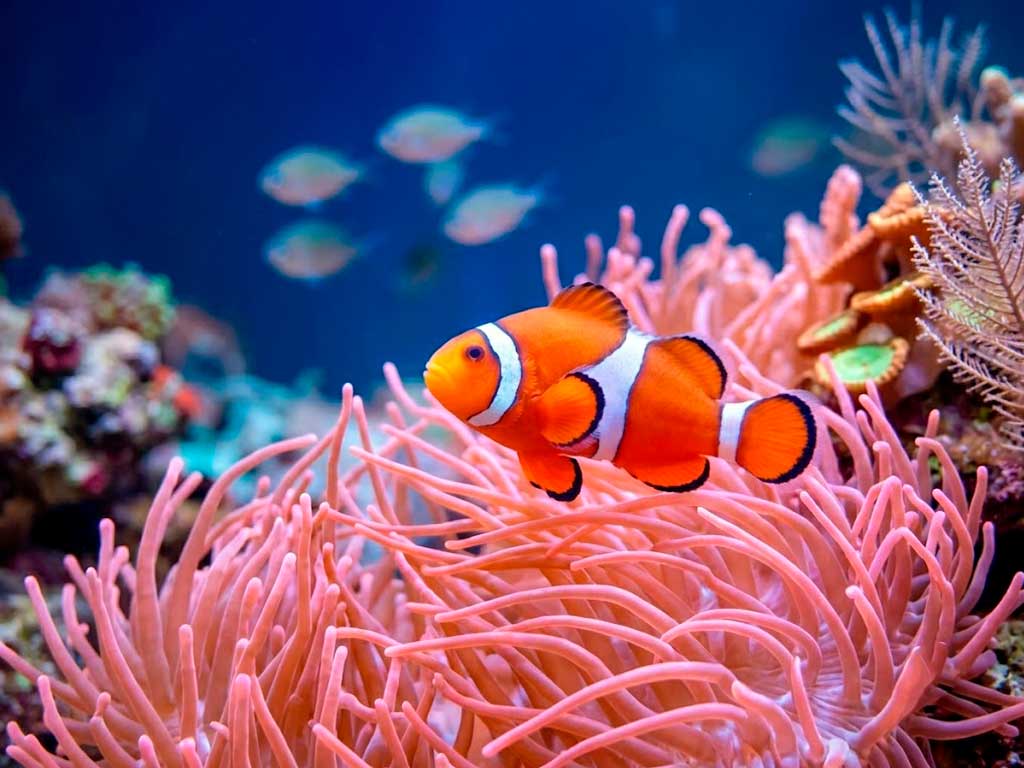
Ocellaris clownfish are commonly called “false clownfish” or “false percula” because they look almost identical to their close relative, the true percula clownfish (Amphiprion percula). Both are orange with three white bars outlined in black, and both are beloved, beginner-friendly staples of the hobby, so the confusion is understandable.
A few details separate them. Ocellaris typically have thinner black outlining around their white bars compared to the noticeably thicker black edging on true perculas. Perculas also tend to run slightly smaller and are generally considered a touch more aggressive.
For practical purposes, care requirements are nearly identical between the two, so this distinction matters more for identification than for how you’ll actually keep the fish.
Tank Requirements
A single ocellaris or a bonded pair does well in a tank as small as 15 gallons, though sizing up gives you more flexibility for tankmates later.
Keep your water chemistry stable within the ranges above, covered in far more depth in our water chemistry guide, and maintain reliable circulation and filtration, since ocellaris tolerate a wide range of flow but still depend on consistent water quality to stay healthy long-term.
Our protein skimmer guide and circulation guide cover the supporting equipment.
Provide plenty of live rock for hiding spots and territorial establishment, covered in our live rock and sand guide. Ocellaris aren’t picky about aquascape specifics; they simply need somewhere to claim as their own.
Do You Need a Host Anemone?
No, and this surprises a lot of newcomers who assume clownfish and anemones are a package deal. In the wild, ocellaris shelter among the stinging tentacles of a host anemone, immune to its sting thanks to a protective mucus coating, but in captivity they’re perfectly content claiming a rock, a coral, or simply a corner of the tank instead.
If you do want to keep an anemone alongside your clownfish, the bubble tip anemone (Entacmaea quadricolor) is the most commonly recommended pairing, since it’s hardier and more adaptable than most other anemone species.
Anemones have real lighting and flow requirements of their own, though, so treat that decision separately from your clownfish stocking plan rather than assuming they’re a starter combination.
Diet and Feeding
Ocellaris are omnivores and rarely picky eaters, which is part of what makes them such an easy first fish.
- Frozen foods: Mysis shrimp and other marine-specific frozen foods make an excellent core diet.
- Pellets: High-quality, neutrally buoyant pellets work well since ocellaris often feed in the water column rather than at the surface.
- Feeding schedule: Small portions two to three times daily, only what they can finish within a couple of minutes, keeps them satisfied without harming water quality.
Compatibility and Tank Mates
Ocellaris are generally peaceful, though a mated pair will defend their chosen territory, more noticeably in smaller tanks. Gobies, blennies, cardinalfish, most wrasses, and firefish all make solid tankmates.
They’re considered reef-safe and coexist well with soft, LPS, and SPS corals, covered in our best corals for beginners guide, though they may occasionally host a coral in place of an anemone, which can cause mild irritation to that colony over time.
Stick to a single species of clownfish per tank. Ocellaris kept with a different clownfish species, even another generally peaceful one, will often fight.
Breeding Basics: Understanding Their Sex Change
Ocellaris clownfish are protandrous hermaphrodites, meaning every fish is born male, and the most dominant individual in a group transitions into a female as it matures.
This is why the standard stocking advice is simple: buy two young fish together, and they’ll typically pair up naturally, with the larger, more dominant fish becoming female over time.
If the female dies or is removed, the breeding male transitions into a female, and the next most dominant fish in the group becomes the new breeding male.
This sex change is permanent once it happens, which is why introducing two large, already-mature females to the same tank usually ends in constant fighting rather than a new pair.
A settled, well-fed pair will readily spawn in captivity, often on a flat surface like a clay pot or rock near their host. The male guards the eggs until they hatch, typically 6 to 10 days later.
Raising the fry successfully is the genuinely difficult part, requiring a dedicated rearing tank and a steady supply of live food like rotifers and newly hatched brine shrimp.
The Complete Guide to Ocellaris Clownfish Color Morphs
Here’s something worth understanding upfront: every morph on this list is still Amphiprion ocellaris.
These aren’t different species or subspecies, they’re selectively bred color and pattern variations developed by breeders over successive generations, the same way dog breeders select for coat patterns.
Decades of captive breeding have produced an enormous range of looks beyond the classic orange, white, and black fish most people picture.
Wild-Type and Foundation Strains
- Common Ocellaris: The classic look, bright orange body with three white bars outlined in thin black.
- Darwin Ocellaris: A naturally occurring black-and-white population from the waters near Darwin, Australia. This wild strain is the genetic foundation many designer black lines were selectively bred from.
Black-Dominant Morphs
- Black & White Ocellaris: A solid black body with clean white bars and no orange, developed from Darwin stock.
- Black Ice: A black base with expanded, frosty white patterning that pushes beyond the standard bar shape.
- Midnight: An especially dark strain with minimal white, sometimes reduced to just a sliver near the head.
- Domino: A black body with a notably reduced white pattern compared to standard black ocellaris.
- Gladiator: A black-pattern line developed through selective captive breeding, prized for bold, high-contrast markings.
White-Pattern and Snowflake Morphs
- Snowflake: The white bars expand well beyond their normal shape, sometimes merging into large patches that dominate the body.
- Extreme Snowflake / Picasso: Further along the same spectrum, with irregular, almost abstract white patterning that varies dramatically from fish to fish, making every individual genuinely unique.
- Frostbite: Bred from snowflake lines for even more extensive white coverage.
- Platinum: A striking, silvery-white-dominant pattern that leaves only minimal dark coloring.
- Da Vinci: Another expanded white-pattern designer line, named for its painterly, irregular markings.
Color and Pattern Variants
- Mocha: A warm brown base tone in place of the standard orange or black, developed by breeders as its own distinct color line.
- Storm (Black Storm, Mocha Storm, Orange Storm, Platinum Storm): “Storm” describes a blotchy, irregular patterning style bred across multiple base colors rather than a single fixed look. Every storm-pattern fish carries its own unique blotching, similar to how no two Picasso fish look identical.
- Misbar: Refers to a naturally occurring pattern where one or more of the three white bars is incomplete or missing entirely. It can appear across nearly any color line, not just one specific strain, and misbar fish are often priced lower simply because breeders select against the trait rather than for it.
- Longfin Ocellaris: A genetic variant with noticeably extended, flowing fins, available across several of the color patterns above.
Care requirements stay identical across every morph listed here. You’re choosing a look, not a different set of husbandry needs, so pick whichever pattern genuinely appeals to you rather than assuming a designer strain needs different treatment than a standard orange ocellaris.
Frequently Asked Questions
The ocellaris clownfish earns its reputation as a foundational reef fish honestly: hardy, easy to feed, genuinely interesting to watch, and forgiving enough to handle a beginner’s early mistakes.