Freshwater Angelfish Care: Size, Tank, Species and Colors
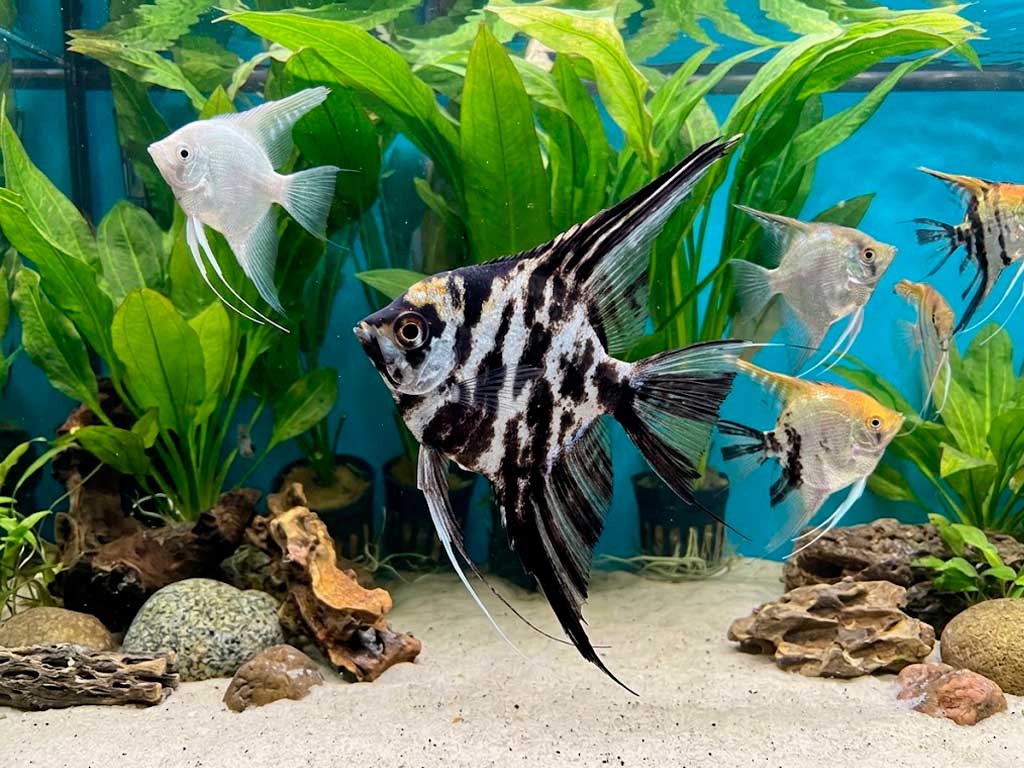
Freshwater angelfish need a tank of 132 L (35 US gal) or more and water between 24 and 30 °C (75 and 86 °F).
Adults reach about 15 cm (6 in) of body length and close to 20 cm (8 in) of total height with the fins, and they usually live 10 to 12 years in a well-kept tank.
This guide covers freshwater angelfish size, tank size, natural habitat, the three Pterophyllum species, colors, price, and four compatible tankmates that suit a community setup in the US or UK.
Freshwater Angelfish at a Glance
The table below holds the numbers most buyers look for first.
| Trait | Detail |
| Scientific name | Pterophyllum scalare (Schultze, 1823) |
| Common names | Freshwater angelfish, angelfish, scalare |
| Family | Cichlidae |
| Origin | Amazon basin in Peru, Colombia and Brazil, plus French Guiana and Guyana |
| Adult size | 15 cm (6 in) body, up to 20 cm (8 in) tall with fins |
| Weight | around 25 g (0.9 oz) at maturity |
| Lifespan | 10 to 12 years in captivity |
| Temperament | Semi-aggressive, territorial when spawning |
| Water temperature | 24 to 30 °C (75 to 86 °F) |
| pH | 6.0 to 7.5 |
| Hardness | 5 to 13 dGH |
| Minimum tank | 132 L (35 US gal), 90 cm (36 in) long |
| IUCN status | Least Concern, assessed 2020 |
How Big Do Freshwater Angelfish Get?
Most adults in home tanks land between 10 and 15 cm (4 and 6 in) of body length, and height matters more than length when you plan a tank.
FishBase records a maximum total length of 10.5 cm (4.1 in) for measured specimens and cites 15 cm (6 in) as the species maximum, while the National Aquarium lists up to 7 in (18 cm). A mature fish measures close to 20 cm (8 in) from the tip of the dorsal fin to the tip of the anal fin, which is why shallow tanks and narrow gaps between plants cause problems later.
| Measurement | Typical adult figure |
| Body length | 10 to 15 cm (4 to 6 in) |
| Height including fins | 18 to 20 cm (7 to 8 in) |
| Body weight | about 25 g (0.9 oz) |
| Time to near-adult size | 12 to 18 months |
Size also decides which fish can live beside them. A 15 cm (6 in) angelfish treats anything under roughly 3 cm (1.2 in) as food, no matter how peaceful it looks at the store.
Freshwater Angelfish Natural Habitat
The species comes from slow, warm water across a wide stretch of northern South America. FishBase lists the Amazon basin in Peru, Colombia and Brazil along the Ucayali, Solimões and Amazon rivers, the rivers of Amapá, the Oyapock in French Guiana and the Essequibo in Guyana.
Adults live in swamps and flooded grounds where aquatic and riverine vegetation grows dense, in water that runs clear in some places and silty in others. Body color tends to run deeper in clear water, which is one reason tank-bred fish look different under bright light.
Four features of that habitat are easy to copy at home:
- Vertical cover from tall plants, sword plants and driftwood branches.
- Dappled light instead of a bright, open tank.
- Warm water with gentle movement rather than a strong current.
- A clear mid-water lane for swimming, with cover on both sides.
Freshwater Angelfish Species: Three Names, One Trade
Angelfish species in freshwater come from a single genus, Pterophyllum, and only three are recognized. Almost everything sold as a freshwater angelfish is P. scalare, whatever the label says.
| Species | What sets it apart |
| Pterophyllum scalare | Amazon basin; the fish sold in nearly every store |
| Pterophyllum altum | Upper Orinoco and Rio Negro; taller body, needs pH 4.5 to 6.0 and 350 L (92 US gal) |
| Pterophyllum leopoldi | Rio Negro and Amazon tributaries; smallest of the three, narrow bars, rarely offered |
True altum is not a tall variety of scalare. It comes from soft, strongly acidic blackwater, grows considerably taller, and needs a tank of 60 cm (24 in) of height or more. Sellers use names like “Peru altum” for tall scalare forms, so ask for collection locality before you pay altum money.
The discus shares much of that same Amazon range and the same warm, soft water. Keepers who like one usually end up reading about the other, and our discus care guide covers where the two species differ in difficulty.
Freshwater Angelfish Colors and Exotic Varieties
Every color form below is P. scalare. Selective breeding changed the pattern, not the species.
| Variety | What you see |
| Silver (wild type) | Silver body with four dark vertical bars in adults |
| Zebra | Heavy black vertical striping |
| Black lace | Dark body with a light lace pattern in the fins |
| Marble | Mottled black, grey and silver |
| Koi | Orange, white and black patches, no two fish alike |
| Gold | Solid yellow to orange body |
| Platinum | Solid white with a metallic sheen |
| Albino | Pale body with red eyes |
| Blue diamond | Blue-silver body with a dark sheen |
| Veiltail | Any color, with long trailing fins |
Exotic freshwater angelfish is a seller’s phrase rather than a category. It usually covers newer or slower-breeding strains such as platinum leopard, panda, red shoulder Manacapuru and Bulgarian green, all of them scalare with a different pattern and a higher price.
Two practical notes on color. Background and light change what you see: dark substrate and plants deepen the bars, while a white gravel tank washes pale fish out. And no color form is hardier than another, though the long-finned veiltail strains swim less efficiently and damage fins more easily.
Freshwater Angelfish Tank Size
Tank size is where most angelfish purchases go wrong, because the fish you bring home at 3 cm (1.2 in) is not the fish you own a year later.
| Setup | Minimum tank |
| One juvenile under 5 cm (2 in) | 60 L (16 US gal), 60 cm (24 in) long |
| One adult | 132 L (35 US gal), 90 cm (36 in) long |
| Mated pair | 150 L (40 US gal) |
| Group of five or six | 240 L (63 US gal), 120 cm (48 in) long |
Height deserves its own number. Aim for at least 45 cm (18 in) of water depth so the dorsal and anal fins have room, and expect a filled 132 L (35 US gal) tank to weigh close to 180 kg (400 lb) once glass, substrate and rock are counted. That figure is an estimate, and it decides the stand and the floor, not just the decor.
FishBase lists 100 cm (39 in) as the minimum aquarium length for adults, so a 120 cm (48 in) tank is the safer target if you plan to keep a group.
Equipment that suits this species:
- A heater rated for the full volume, set to hold 26 °C (79 °F).
- A filter that turns the tank over four to six times per hour; our guide to aquarium filtration systems explains the media order.
- A tight lid, because angelfish jump when startled.
- Sand or fine gravel at 2 to 3 cm (1 in) depth.
- Tall plants and driftwood for cover, with open water in the middle.
Water Parameters for Freshwater Angelfish
Stable water beats perfect water. Fish bred in Asia and Florida for decades tolerate a wider range than the wild collection data suggests.
| Parameter | Target |
| Temperature | 24 to 30 °C (75 to 86 °F) |
| pH | 6.0 to 7.5 |
| GH | 5 to 13 dGH |
| KH | 3 to 8 dKH |
| Ammonia and nitrite | 0 ppm |
| Nitrate | under 20 ppm |
| Weekly water change | 25 to 30% |
FishBase records wild tolerance from pH 6.0 to 8.0, so a steady 7.4 will not harm a tank-bred fish. Breeding is the exception: pairs spawn more reliably in soft, slightly acidic water around pH 6.0 to 6.5.
The aquarium water chemistry guide covers how to move parameters slowly. A pH swing of even half a point stresses angelfish more than a slightly “wrong” but stable reading.
Diet and Feeding
Angelfish are omnivores that lean predatory, and they eat more animal protein than the average community fish.
- Staple pellet, 1 to 2 mm, offered twice a day.
- Frozen bloodworm, brine shrimp or mysis two or three times a week.
- Live daphnia or grindal worms when you can get them.
- Spirulina flake or blanched courgette once a week for plant matter.
- Three or four small feeds a day for juveniles under 5 cm (2 in).
Feed only what the fish clear in one to two minutes. Uneaten food drives nitrate up faster than any stocking mistake, and angelfish beg convincingly whether they need food or not. Build the rotation around one staple, then rotate the frozen and live items so the fish does not fixate on a single food.
One food to skip: live feeder fish. The disease risk outweighs the nutrition, and a well-fed angelfish does not need them.
Behavior and Temperament
Angelfish are cichlids, and the “semi-aggressive” label is accurate. They hold small territories, they pair off, and they eat what fits in their mouth.
A pair that cleans a leaf together, locks jaws for a second and chases a tankmate away from one corner is behaving normally. A fish pinned in a corner, shredded fins, dark color, clamped fins or a refusal to feed is a problem that needs a change of layout or stocking.
Two habits surprise new owners. Angelfish learn the front glass means food and will follow you across the room. They also stop eating for a day or two after a big water change or a temperature drop, which is usually stress rather than disease.
Four Compatible Tankmates for Freshwater Angelfish
These four species share the angelfish’s warm, soft water, stay large enough not to be swallowed, and do not compete for the same space in the tank.
| Species | Why it works |
| German blue ram (Mikrogeophagus ramirezi) | 5 to 7 cm (2 to 2.8 in); same warm soft water; works the bottom and leaves open water free |
| Pearl gourami (Trichopodus leerii) | 10 to 12 cm (4 to 4.7 in); slow mid-water swimmer, far too big to be eaten |
| Rummy-nose tetra (Hemigrammus bleheri) | 5 cm (2 in); a tight school that makes angelfish feel secure |
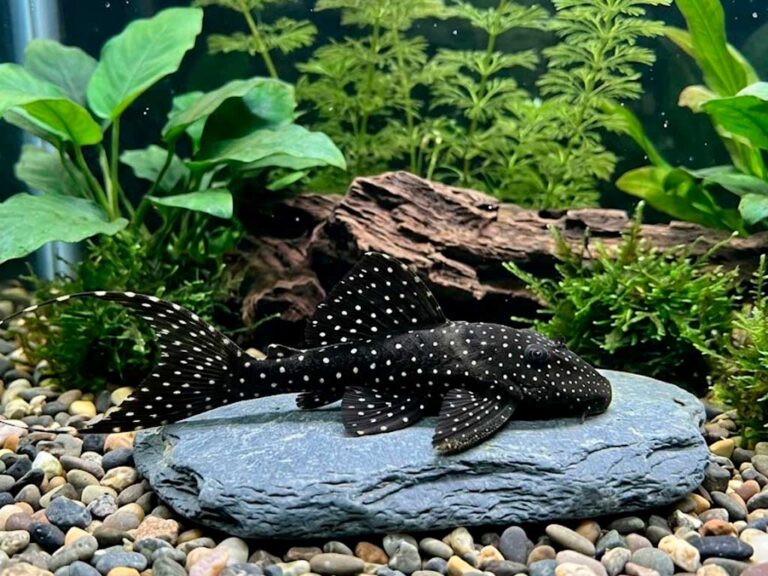
| Bristlenose pleco (Ancistrus species) | 10 to 12 cm (4 to 4.7 in); grazes algae off glass and wood, ignores the mid-water |
Full care guides for two of them are already published: the German blue ram and the pearl gourami. The rummy-nose tetra and the bristlenose pleco do not have their own guides on Happy Pet Zone yet, and both are on the writing list; the notes above cover the basics until those pages exist.
Add rummy-nose tetras as a school of eight or more, and add them before the angelfish reaches adult size. A 15 cm (6 in) adult can pick off a small tetra that strays from the group.
What to avoid in the same tank:
- Neon tetras, chili rasboras and any fish under 3 cm (1.2 in) once the angelfish matures.
- Guppies and bettas, which share the same water layer and invite fin nipping in both directions.
- Goldfish, which need cold water and produce far more waste.
- African cichlids, which want hard, alkaline water and a different temperament entirely.
- Anything sold as a “community” fish without a size check.
The community aquarium fish by zone guide is a useful second opinion before you stock.
Freshwater Angelfish for Sale: What to Check Before You Pay
Freshwater angelfish for sale turn up in chain stores, independent shops and specialist breeders, and the difference in quality between them is large.
- Watch the fish swim for a minute; a healthy angelfish holds its fins up and moves through the whole tank.
- Reject clamped fins, white spots, sunken belly, cloudy eyes or labored breathing.
- Ask what the fish was eating and see it feed.
- Ask whether the batch was quarantined, and for how long.
- Check the size in person; “large” means different things to different sellers.
- Look at the tank, not just the fish. A dirty sales tank usually means parasites.
If you want a group, buy five or six juveniles at once and let pairs form naturally. Expect to rehome one or two as pairs break away, and plan the tank around that.
Freshwater Angelfish Price
Freshwater angelfish price depends far more on strain and size than on species, because every fish in the trade is scalare.
| What you buy | Typical price, 2026 |
| Common juvenile at a local store (silver, gold) | $5 to $15 / £4 to £12 |
| Marble, koi or zebra juvenile | $15 to $40 / £12 to £32 |
| Exotic strain juvenile (platinum leopard, red shoulder) | $40 to $160 / £32 to £130 |
| Proven breeding pair | $250 and up / £200 and up |
The upper figures come from US specialist sellers, where a platinum leopard juvenile was listed at $40 to $130 in late 2026 and a proven pair sat near $300. Local stores sit at the bottom of the range, and shipping or a UK import premium adds to the total.
The fish is the least expensive part. A 132 L (35 US gal) tank, filter, heater, lid and stand cost several times more than the angelfish itself, which is the argument for buying the tank first.
Breeding Freshwater Angelfish
Angelfish spawn readily once a pair forms, and the hard part is usually keeping the parents from eating the eggs.
- Condition the pair with frozen and live food for two to three weeks.
- Give them a vertical spawning site: a piece of slate, a PVC pipe or a broad leaf.
- Expect the pair to clean the site for a day or two before spawning.
- Eggs hatch in roughly 48 to 72 hours at 27 °C (81 °F).
- Fry become free-swimming five to seven days after hatching.
- Move the slate to a separate tank if you want to raise the brood.
Many selectively bred strains have lost parental instinct and eat their own eggs. That is normal for the strain, not a sign that something is wrong with the pair.
Conservation Status
The IUCN Red List classifies Pterophyllum scalare as Least Concern, assessed in 2020. The wide Amazon range and decades of captive breeding keep pressure off wild stock.
Captive-bred fish are also the better buy for a community tank: they arrive acclimated to tap water, they carry fewer parasites than wild imports, and they cost less. Ask the seller which one you are getting.
Frequently Asked Questions
Set the Tank Up Before You Buy the Angelfish
Order of operations matters more than any single product. Cycle a 132 L (35 US gal) tank or larger, plant the back and sides for vertical cover, and hold 26 °C (79 °F) for two weeks before the fish arrives.
Then buy five or six juveniles from one batch, quarantine them if you have a spare tank, and let the group settle before you add tankmates. A stable tank with a modest stocking list produces fewer problems than a perfect equipment list on an unstable one.