Pearl Gourami (Trichopodus Leerii): Care Guide & Breeding
Pearl gouramis carry a scientific name that’s been genuinely mislabeled for the better part of a century, only recently getting corrected back to its original form. In practice, that naming confusion hasn’t stopped this from becoming one of the most popular gouramis in the hobby, prized for a pattern that genuinely looks like scattered pearls across its flanks.
This guide covers real tank requirements, breeding this species from start to finish, and why buying captive-bred stock matters more here than for many other fish.
Quick Identity Card
| Trait | Detail |
| Scientific name | Trichopodus leerii (Bleeker, 1852) |
| Common names | Pearl Gourami, Lace Gourami, Mosaic Gourami, Diamond Gourami |
| Family / Order | Osphronemidae (subfamily Trichogastrinae), Anabantiformes |
| Origin | Thailand, Malaysia, Indonesia (Sumatra, Borneo) |
| Adult size | Up to 12 cm (4.7 in) |
| Diet | Omnivore, live, frozen, dry, and plant-based foods |
| Temperament | Peaceful, calm |
| Water temperature | 24 to 28°C (75 to 82°F) |
| pH | 5.5 to 7.5 |
| GH (hardness) | 2 to 16 dGH |
| Minimum tank | 120 cm (47 in) length recommended |
| Lifespan | Around 5 years |
| Breeding | Bubble-nest builder, 200 to 500 eggs |
| IUCN status | Near Threatened |
Origin and a Genus Name Correction
Here’s what actually matters before anything else: this fish’s scientific name has been wrong in common use for decades. Pieter Bleeker originally described it as Trichopus leerii in 1852, honoring a collector named Leer who brought the species to Europe. A 1923 paper by Myers led to a taxonomic misinterpretation that shifted the accepted genus to Trichogaster for much of the following century. That error has only recently been corrected, restoring the currently accepted name, Trichopodus leerii.
The genus name itself describes a real physical feature: Greek thrix (hair) and pous (foot), referring to the thread-like pelvic fins this species uses to feel its surroundings, much like antennae.
Origin and Natural Habitat
This species is native to Thailand, Malaysia, and Indonesia, specifically the islands of Sumatra and Borneo, with introduced populations also established in Singapore and Colombia. It inhabits coastal swamp areas, slow-flowing rivers, lowland swamps, and shallow, densely vegetated water with weak current.
That habitat runs warm, soft, and slightly acidic, typically surrounded by dense tropical vegetation and floating plants that dim the light overhead.
Identification
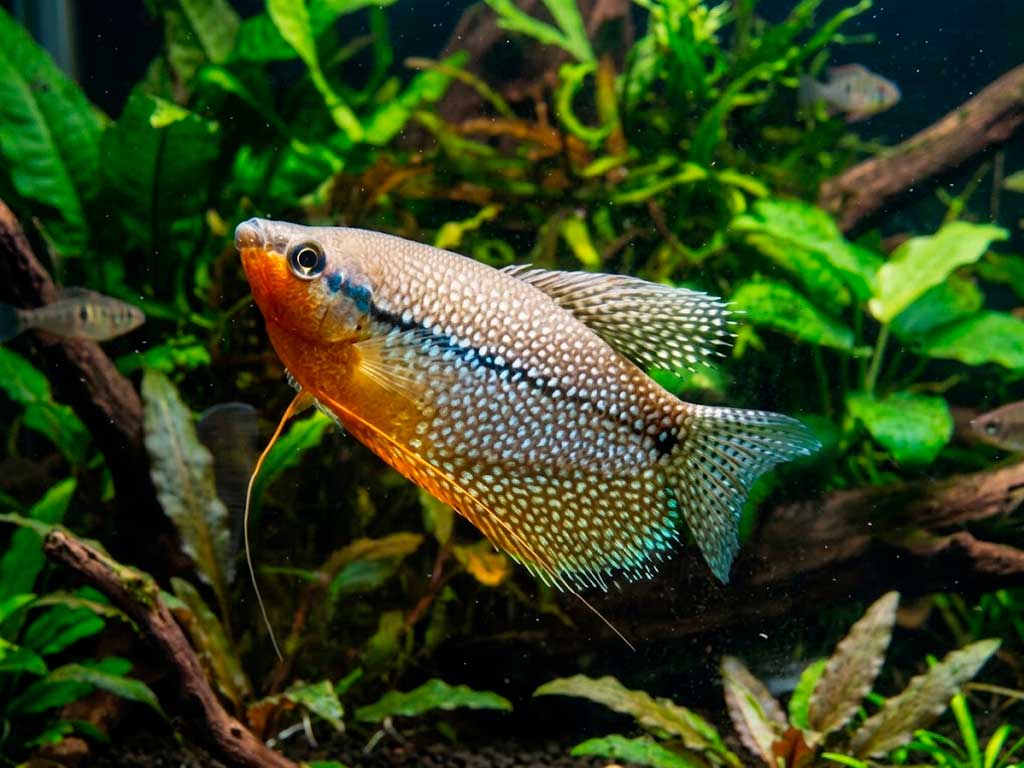
A row of dark spots runs from the nose to the base of the tail, forming a distinct black stripe in adult fish. Numerous small white dots, resembling scattered pearls, cover the entire body and fins, giving the species its common name and dazzling appearance.
Sexual dimorphism is genuinely easy to spot. Males run more colorful, developing an orange to red glow across the throat and belly, especially during breeding, along with longer, more pointed dorsal and anal fins and more fringed pelvic fins. Females stay smaller, stockier, and comparatively plain by comparison.
Behavior and Temperament
Pearl gouramis read as calm and genuinely peaceful, occupying the upper to middle water column and generally leaving other fish alone. That said, this isn’t a strongly social, shoaling species. Pairs or small groups work better than a large school.
Combining this species with overly busy, aggressive tankmates like cichlids causes real stress, sometimes visible as lost color, reduced appetite, or outright harassment. A calmer community setup suits this fish far better.
Diet and Feeding
In the wild, this species feeds on small invertebrates, zooplankton, organic waste, and algae. In the aquarium, that translates into a genuinely varied diet: live foods like mosquito larvae, artemia, daphnia, and tubifex, frozen alternatives with similar nutritional value, quality dry granules or flakes, and plant-based options like spirulina.
The feeding guide for ornamental fish covers building that kind of rotation, and skipping the plant-based component specifically, a common mistake, can lead to nutritional gaps over time.
Tank Requirements and Water Parameters
A tank at least 120 cm (47 in) long gives this species real room to thrive, reducing the stress, aggression, and illness that can show up in more cramped conditions. Dense edge planting, floating plants to dim the light, and driftwood or rock for hiding spots all matter for this species’ sense of security.
Water chemistry stays comfortably moderate: temperature between 24 and 28°C (75 to 82°F), pH from 5.5 to 7.5, and general hardness anywhere from 2 to 16 dGH. This species dislikes strong current, so a filter with a wide, gentle outlet suits it better than one creating noticeable flow. The water chemistry guide covers holding these parameters steady.
Tankmates and Compatibility
Peaceful, calm tankmates that aren’t overly active make the best companions, including many of the tetras, corydoras, and other gentle community fish covered elsewhere on this site. Dwarf gouramis, a smaller relative in the same family, share a broadly similar temperament, though territorial tension between different gourami species is worth watching for in a mixed setup.
Fast, aggressive, or overly boisterous species should be avoided entirely, since this fish stresses easily under that kind of pressure.
Breeding
Pearl gouramis are bubble-nest builders. The male constructs a foam nest at the water’s surface, often supported by floating plants or a piece of foam, and can build a nest up to 25 cm across. Courtship involves the male displaying intense coloration, especially across the throat and belly, and guiding the female toward the nest, sometimes with some chasing involved.
Spawning happens through repeated embraces, with the pair releasing 200 to 500 eggs into the nest. Eggs hatch within 20 to 30 hours, and fry become free-swimming after 3 to 4 days, at which point removing the male prevents any risk of predation. First food needs to be genuinely microscopic, such as infusoria, before fry can move on to newly hatched brine shrimp after about a week.
Breeding can present real challenges, particularly if the male turns overly aggressive or the female isn’t fully ready, but proper conditioning over several weeks to months and a dedicated breeding tank with shallow water and minimal current meaningfully improve success rates.
Conservation Status
The IUCN Red List classifies Trichopodus leerii as Near Threatened, a more serious rating than several other gouramis covered on this site. Encouragingly, the aquarium trade for this species relies overwhelmingly on captive-bred stock rather than wild collection, meaningfully reducing pressure on natural populations even as those populations face broader habitat concerns.