Acanthicus Adonis: Care Guide for the Adonis Pleco
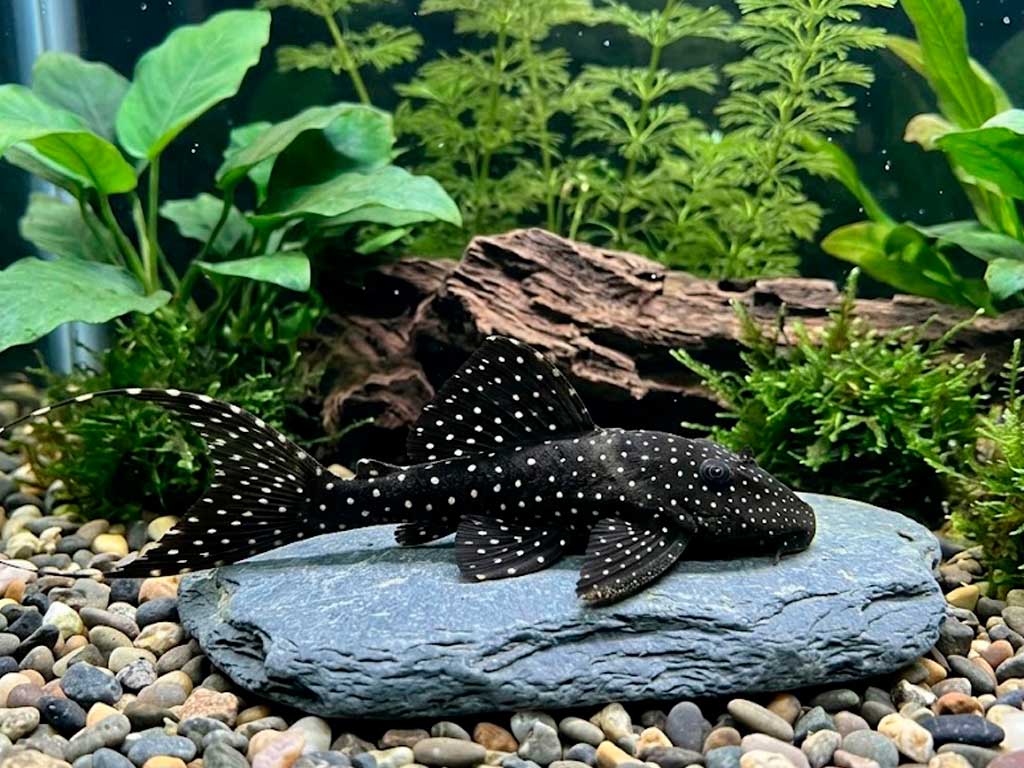
Acanthicus adonis gets sold as an adorable, spotted 10 cm juvenile, and that sale rarely comes with a warning about what happens next. In practice, this is one of the more honest test cases in the aquarium trade for the gap between “cute at the store” and “realistic to keep.”
This guide covers what the fish actually needs as an adult, where the size numbers get genuinely confusing even among experts, and how to tell it apart from the only other species sharing its genus.
Quick Identity Card
| Trait | Detail |
| Scientific name | Acanthicus adonis (Isbrücker & Nijssen, 1988) |
| Common names | Adonis Pleco, Polka Dot Lyre-Tail Pleco (L155) |
| Family / Order | Loricariidae, Siluriformes |
| Origin | Lower Rio Tocantins, Brazil; also reported from the Solimões and Ucayali basins in Peru |
| Adult size | Officially measured max 30.5 cm SL; hobbyist and field reports suggest up to 100 cm |
| Diet | Omnivore, herbivore-leaning, grazes periphyton |
| Temperament | Territorial, solitary, nocturnal |
| Water temperature | 20 to 30°C (68 to 86°F) |
| pH | 6.0 to 7.8 |
| GH (hardness) | 9 to 19 dGH |
| Minimum tank | 600 x 200 cm base for an adult per specialist sources; “largely unsuitable for private aquaria” |
| Lifespan | Around 20 years |
| IUCN status | Least Concern |
Origin and Natural Habitat
Acanthicus adonis was first described from the lower Rio Tocantins near Cametá, in Pará state, northern Brazil, and it occurs throughout the lower part of that river system. Additional populations turn up far from that type locality: the Solimões basin near the triple border of Brazil, Colombia, and Peru, plus the Ucayali and Yujo basins in Peru.
Habitat descriptions vary somewhat depending on the source. Some specialist accounts describe slower-moving river sections and tributaries, often associated with human settlements.
Others describe clear-water rivers with moderate to strong current over rocky bottoms. Both pictures likely hold true somewhere across this species’ range, which spans multiple distinct river systems.
Identification
The dark brown body, densely covered in white spots and light patches across both the body and fins, is the single most recognizable feature of this species. That polka-dot pattern, combined with the absence of an ochre-to-gray stripe pattern on the caudal fin, separates it cleanly from its only close relative.
Structurally, Acanthicus adonis shares its genus’s defining traits: no adipose fin, small abdominal plates, and dramatically expanded pectoral spines. The entire dorsal surface of the head carries stout, sharp odontodes, and the caudal fin ends in long filamentous lobes, the “lyre-tail” that gives the genus its common nickname.
Behavior and Temperament
Here’s what actually matters for anyone keeping this fish: it’s territorial, solitary, and nocturnal by nature. During the day it hides under rocks or roots, staying out of sight rather than patrolling the tank openly.
Mature males develop noticeably longer and sturdier odontodes on their pectoral spines, operculum, and cheeks compared to females, and that development tends to come paired with increased aggression. A tank housing more than one adult male risks real conflict over shelter and territory.
Diet and Feeding
In the wild, this species grazes periphyton and organic matter off submerged rocks and driftwood, an omnivorous diet with a clear herbivorous lean. That feeding style translates directly into aquarium care.
Sinking wafers or tabs formulated for larger plecos work as a daily base, and the diet should include genuine vegetable matter rather than relying on protein-heavy foods alone. The feeding guide for ornamental fish covers the general principles of building out a varied, balanced diet that applies here as much as anywhere else.
Tank Requirements and Water Parameters
This is the section that matters most before buying this fish. Specialist sources are blunt about it: an adult Acanthicus adonis needs an aquarium base in excess of 600 x 200 cm, a size that makes this species largely unsuitable for private aquaria. That’s not a typo or an exaggeration from an overly cautious source. It reflects what a fish potentially reaching a meter in length actually requires to live normally.
Some retailers list smaller minimum volumes, occasionally around 800 liters, but that number describes a young or sub-adult fish, not the animal this species eventually becomes.
Water chemistry itself stays fairly standard for a tropical Amazonian species: temperature between 20 and 30°C (68 to 86°F), pH from 6.0 to 7.8, and general hardness around 9 to 19 dGH. What genuinely separates this species from an easy keeper is current and oxygenation.
This is a strong-flow fish, and an undersized or standard filter won’t cut it. The filtration systems guide and the water pump guide both cover how to build toward the kind of oxygen-rich current this species actually evolved in.
Tankmates and Compatibility
Given the territorial, solitary temperament and the sheer eventual size of this fish, tankmate selection needs to happen at the scale of “large public aquarium,” not “home community tank.” Anything small enough to be seen as food, or delicate enough to be crushed or outcompeted, doesn’t belong in the same system.
In practice, the honest answer for most aquarists is that this species doesn’t pair well with a typical home setup at all once it reaches adult size, regardless of which tankmates get chosen.
Breeding
Reproduction happens in protected cavities, under rocks or inside hollow logs, with the male guarding both eggs and fry after spawning. Breeding season and fecundity data remain thin, though the pattern likely tracks the seasonal rainfall and flood cycles typical across Amazonian river systems.
Captive breeding is rated as very difficult by specialist sources, unsurprising given how rarely private keepers can offer the space this species needs even before breeding becomes a consideration.
How It Differs From Acanthicus Hystrix
The genus Acanthicus contains exactly two recognized species, and the comparison matters because both get traded under overlapping names.
Acanthicus hystrix, the other species, carries the darker, more uniform coloration that Acanthicus adonis specifically lacks, along with ochre-to-gray stripes on the caudal fin that adonis doesn’t show.
Size comparisons between the two species get genuinely murky in the literature. Some sources describe adonis reaching roughly half the size of hystrix, while others report both species converging on similarly enormous lengths around a meter in the wild.
That inconsistency itself is worth knowing about going in: even specialists don’t fully agree on how large either species gets outside a handful of officially measured specimens.
Conservation Status
The IUCN Red List classifies Acanthicus adonis as Least Concern. The species is considered rare in museum collections and scientific sampling, though that apparent scarcity may reflect limited research effort in its remote river habitats rather than a genuine population decline.
Aquarium trade pressure exists, given the species’ popularity, but current assessments don’t suggest it threatens wild population viability at this point.