Cherry Barb (Puntius Titteya): Care Guide for This Colorful Barb
Cherry barbs have spent the last few years in a genuine scientific tug-of-war over which genus they even belong to, something almost nobody buying one at a shop would ever guess. In practice, this is one of the easiest, most forgiving barbs in the hobby, prized for a red coloration that intensifies dramatically in breeding males.
This guide covers real care basics, the unresolved taxonomy behind its current scientific name, and why “easy to breed at home” and “increasingly threatened in the wild” turn out to both be true at once.
Quick Identity Card
| Trait | Detail |
| Scientific name | Rohanella titteya (Deraniyagala, 1929), formerly Puntius titteya |
| Common names | Cherry Barb |
| Family | Cyprinidae, subfamily Smiliogastrinae |
| Origin | Endemic to Sri Lanka (Kelani to Nilwala river basins); introduced in Mexico and Colombia |
| Adult size | Around 5 cm (2 in) |
| Diet | Omnivore, plant matter, diatoms, algae, small invertebrates |
| Temperament | Peaceful, loosely schooling |
| Water temperature | 23 to 26°C (73 to 79°F) |
| pH | 6.0 to 8.0, very adaptable |
| GH (hardness) | Soft to hard, genuinely tolerant |
| Minimum tank | 51 cm (20 in), roughly 38 L (10 US gal) |
| Lifespan | 5 to 7 years |
| Breeding | Very easy, egg scatterer |
| IUCN status | Disputed; see conservation section |
Origin and an Active Taxonomic Dispute
Here’s what actually matters before anything else: the scientific name on this fish’s label has changed twice in the last few years, and the second change is genuinely contested. Cherry barbs were long known as Puntius titteya, first described by Sri Lankan naturalist Paul E. P. Deraniyagala in 1929 from a type specimen collected at Ambagaspitiya, Sri Lanka.
In 2023, researchers moved the species into a brand-new genus, Rohanella, making it the sole member. That reclassification hasn’t gone unchallenged. A 2025 study sequencing the species’ complete mitochondrial genome found the genetic data clustered it most closely with a different species, Puntius eugrammus, and explicitly stated this offered no support for the move to Rohanella. As of now, this is a live scientific disagreement rather than settled fact, so don’t be surprised to see this fish labeled under either name for a while yet.
Identification
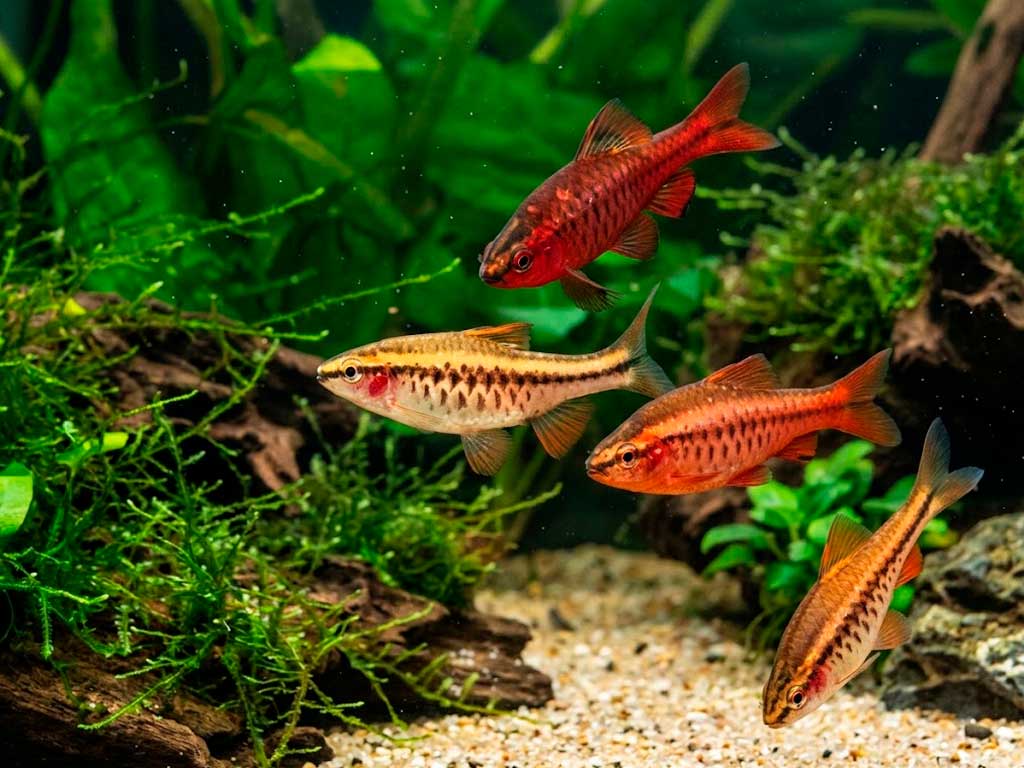
The body runs torpedo-shaped and slender, distinctly more streamlined than the rounder profile of a relative like the tiger barb. A dark stripe extends from the tip of the snout, through the eye, and along the body to the base of the tail, present in both sexes.
Sexual dimorphism is genuinely easy to spot. Males develop an intense, velvety maroon-red coloration, especially vivid during breeding, often with an iridescent green sheen along the back. Females run duller and more rounded, typically fawn to golden-brown with only hints of red, most visible in the fins. An albino morph has also become established in the hobby.
Behavior and Temperament
This species reads as genuinely peaceful, among the least aggressive barbs commonly kept, and it forms loose schools rather than tight, structured ones. Groups of six or more encourage the most natural behavior and noticeably reduce stress on individual fish.
Its calm temperament makes it a solid community fish, and it generally avoids the fin-nipping tendencies that give some barb species a rougher reputation.
Diet and Feeding
In the wild, this species feeds mainly on plant debris, diatoms, and algae, supplemented with small invertebrates and detritus picked up along silty, leaf-littered streambeds. That plant-leaning omnivorous diet carries directly into aquarium care.
Most prepared foods get accepted readily, and the feeding guide for ornamental fish covers building a diet that leans appropriately toward vegetable-based options rather than protein-heavy foods alone.
Tank Requirements and Water Parameters
A tank around 51 cm (20 in) long, roughly 38 liters (10 US gallons), suits a school of cherry barbs well, with more room always helping given their active, schooling nature. A well-planted setup with partial floating cover and open swimming space, over a fine gravel bottom, matches this species’ natural shaded-stream habitat closely.
Water chemistry runs genuinely forgiving: temperature between 23 and 26°C (73 to 79°F), pH anywhere from 6.0 to 8.0, and general hardness from soft to hard. The water chemistry guide covers the basics, though this species tolerates more variation than most fish on this site without real issue.
Breeding
Cherry barbs rank among the easiest egg-scattering fish to breed at home. A conditioned, well-fed pair typically lays 226 to 284 adhesive eggs among plants or a spawning mop, and the parents should be removed immediately afterward, since they’ll eat their own eggs given the chance.
Eggs hatch within roughly a day, with fry becoming free-swimming just a couple of days later. Newly hatched fry need genuinely tiny first foods, such as microworms or vinegar eels, before they’re large enough to move on to brine shrimp nauplii.
Health Note
This species carries a known susceptibility to velvet disease, a parasitic infection that shows up more readily under stress or inconsistent water quality. Regular partial water changes meaningfully reduce that risk, alongside the general water-quality practices that protect most freshwater fish.
Conservation Status
Conservation reporting on this species is genuinely inconsistent across sources, worth stating plainly rather than picking one figure to sound authoritative. Some references list it as Vulnerable, older records describe a Least Concern status following an earlier Vulnerable listing in the late 1980s and early 1990s, and at least one current fish-specific tracker lists it as Not Evaluated entirely.
What multiple sources agree on is more concrete: this species is farmed in large numbers for the aquarium trade, yet wild populations, particularly the most vividly colored individuals prized specifically for their appearance, face real pressure from overcollection and habitat loss. Given that combination, favoring captive-bred stock over wild-caught specimens is a reasonable, low-cost choice for anyone shopping for this fish.