Podenco Canario: A Complete Guide to This Ancient Hunting Breed
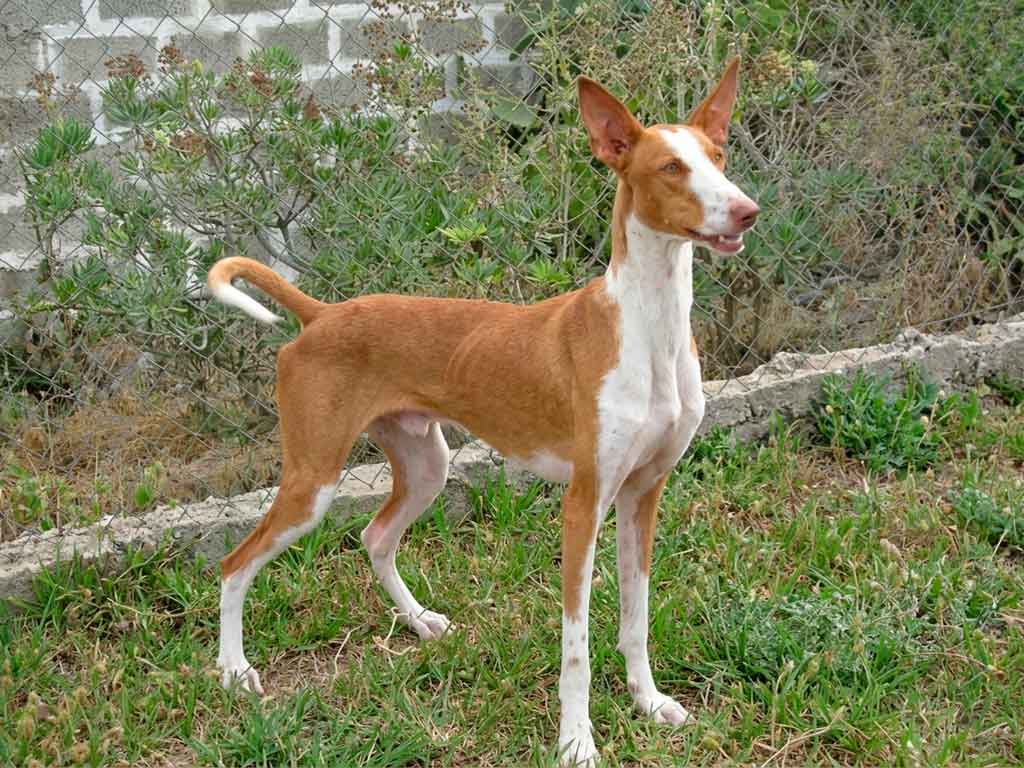
Podenco Canario is a primitive hunting breed from the Canary Islands, selected to find rabbits over volcanic ground with its nose, its eyes and its ears. Males stand 55 to 64 cm at the shoulder and females 53 to 60 cm, and the coat is short, dense and almost always red and white.
That working history explains the rest of the profile: the figures from the FCI breed standard, home life, exercise and training, the health risks that come with Spanish origins, and how the breed differs from the Ibizan Hound and the Podengo Português.
What Is a Podenco Canario Bred For?
The FCI standard is unusually specific about the job. The breed is used for rabbit hunting, and it adapts to broken ground by using what the standard calls a prodigious nose, alongside its sight and hearing.
It is a tracker rather than a chaser. The standard says the dog must neither bark nor catch the game while it is scenting, and that it usually carries the rabbit in its mouth once the work is done. That single line separates this breed from the hounds most English-speaking owners know.
On a walk, the difference is obvious within minutes. This is not a dog scanning its handler for instructions. It reads ground, and it finds rabbits in cracks in walls, heaps of stone at the edge of a field, volcanic tubes and thorny scrub.
Two details rarely make it into English profiles. The breed also works with a ferret, a method the standard notes is authorised on the islands. And it is expected to hunt from dawn to nightfall in heat that would stop most dogs by mid-morning.
These are the numbers worth checking before you look at a litter or a rescue listing.
| Origin | Spain, Canary Islands |
| FCI standard | No. 329, Group 5, Section 7 |
| Accepted by the FCI | 24 June 1987 |
| UKC recognition | 1 July 2006 |
| Height, males | 55 to 64 cm, plus or minus 2 cm |
| Height, females | 53 to 60 cm, plus or minus 2 cm |
| Weight | Not stated in the FCI standard, commonly 20 to 25 kg |
| Coat and colour | Short, smooth, dense, red and white in any combination |
| Lifespan | Published figures run from 10 to 14 years |
| Energy | High, with a strong urge to range |
What Does a Podenco Canario Look Like?
The standard asks for a medium-sized dog on longish lines, slender and light, with the rib cage, spinal column and hip bones visible. Muscle should read through the skin.
Owners used to softer breeds often read that as thin. It is the intended shape, and the standard treats the absence of fat layers as part of the breed’s construction.
The identifying details are all in the head and the outline:
- The head is a truncated cone about 21 to 22 cm long, with parallel planes and a stop that is barely marked.
- Ears are large, broad where they sit and pointed, pricked and slightly divergent when the dog is alert, tipped back at rest.
- Eyes are small, almond shaped and set obliquely, in amber that darkens with the coat.
- The nose is flesh coloured and should match the coat, so a black nose is a departure from the standard.
- The tail sits low, reaches just below the hock, tapers to a usually white tip and is never carried curled.
- Feet are cat feet, turned slightly out in front and straight behind, with no dewclaws on the hind legs.
Colour runs from orange through to mahogany, always in combination with white. A solid red dog is possible. Black does not appear in the standard, so a black puppy is not a Podenco Canario by pedigree definition, whatever the seller says.
Size matters more than the range suggests. The standard allows 2 cm of tolerance either side because terrain varies between islands, and a male at the top of the range is a serious dog to hold.
Where Does the Podenco Canario Come From?
Spain, and more precisely the Canary Islands. The FCI standard says the breed is found on all the islands and most often on Gran Canaria and Tenerife.
The origin story in that standard is Egyptian. It says the dog was probably brought to the islands by the Phoenicians, the Greeks, the Carthaginians and the Egyptians, and it dates the breed at about seven thousand years, citing engravings, statues and bas-reliefs in pharaonic tombs and in the Louvre and the British Museum.
Read that as the breed’s founding account rather than a proven pedigree. The United Kennel Club repeats the same history in its own standard, which tells you the story is consistent across registries and nothing more. Tomb art shows a dog shape. It does not trace a bloodline.
What is documented is the working context, and it is more useful to an owner. The English name in the FCI nomenclature is Canarian Warren Hound. A warren is a rabbit colony, and the dog was kept to find them on ground where a horse could not follow. Our Spanish Hound guide covers a heavier, pack-oriented cousin from the mainland.
What Is the Podenco Canario’s Temperament Like?
The standard uses words that read differently to a pet owner than to a judge: courageous, nervy, agitated, full of enthusiastic dynamism. Those terms describe a dog that reacts fast and works at high arousal.
They do not describe aggression. The standard is explicit that the breed should be imposing without being aggressive, and a Podenco Canario is loud only when it has found something.
Attachment is the other half. The standard calls the dog stoically devoted to its master. In a home, that means a close bond with the person who feeds and walks it, some reserve with visitors, and little interest in performing for a crowd.
Independence shows up as problem solving. A dog that can work a kilometre ahead of a hunter has little practice at waiting for permission, and the brain that opens a gate will open a kitchen bin.
With other dogs, most are fine after careful introductions, though the chase instinct is a separate switch. A cat that runs is a rabbit as far as the dog is concerned, and introducing an adult Podenco Canario to a household cat is genuinely difficult work.
If you keep rabbits, guinea pigs or birds, treat that as the deciding factor rather than one line in a list. Very few adult Podenco Canarios can be trusted with small pets, and the ones that can were usually raised with them.
How Much Exercise Does a Podenco Canario Need?
Plan on an hour to ninety minutes of real activity every day, and more at weekends. The standard’s own benchmark is a dog that can hunt from dawn to nightfall, so one lap of the block will not touch the tank.
Split the day into three parts. Two walks cover distance and street manners. A long line session in a field covers sniffing, which tires this breed more efficiently than running does.
Free running needs a fence that has been checked rather than assumed. Walk the perimeter, test the gates, and look for gaps a lean dog can compress under. Escape attempts are the standard failure mode with this breed.
Heat is the other constraint. The breed tolerates high temperatures well, yet hot asphalt and midday sun still burn paws and overload a dog that will not stop on its own. Early mornings work better.
Mental work fills the gap on short days. Scatter feeding, scent games and puzzle feeders cost nothing and take twenty minutes. If the weather kills the walk, these ways to tire out a high-energy dog cover the indoor options.
A bored Podenco Canario does not sleep the afternoon away. It digs, chews, climbs and vocalises, and the behaviour that follows is entirely predictable.
Can a Podenco Canario Live in an Apartment?
Yes, with a routine that most owners underestimate. The breed is quiet indoors for much of the day and settles well once its needs are met.
The problems are practical. There is no garden to absorb the morning energy, so the walks become non-negotiable in rain and wind. Stairs and lifts need training from the start, and balconies need a barrier, because thin dogs fit through gaps that look closed.
Noise is the usual complaint. A dog that alerts to every footstep in a corridor will not be popular, and separation distress in a rescue dog makes the problem worse before it gets better.
The honest summary: a flat works for a Podenco Canario if the owner walks twice a day in all weather. It fails for anyone who expects the garden to do the exercising.
How Do You Train a Podenco Canario?
Recall is the whole job, and it is the hardest thing you will teach this breed. Selection rewarded dogs that stayed on the line of a rabbit and ignored the handler. That instinct does not switch off because you are holding a treat.
Start indoors and in the garden, with food the dog will cross a room for. Move to a long line in a field, and pick a field where you can see a rabbit before the dog does.
- Reward every check-in, not only the formal recall, so the dog learns that coming back is worth the trip.
- Teach a stop or a hand signal that works at distance, because a recall will sometimes lose a race with a rabbit.
- Practise while the dog is already moving towards you, then add difficulty in small steps.
- Never punish a dog that returns late, since the recall you are training is always the next one.
- Keep sessions to five minutes and finish while the dog is still succeeding.
Harsh corrections end the partnership this breed needs. A Podenco Canario that expects pain from a handler stops offering behaviour, and you are left with a dog that is both independent and unreadable.
Socialisation belongs in the first months. Traffic, livestock, children, vet handling and car travel all need repetition before six months, and that window closes faster than most owners expect.
Some owners add a GPS collar, which is a reasonable precaution for a breed that hunts out of sight.
Shop for Your Breed

Just Food For Dogs – Fresh Frozen
Fresh meals. Gently cooked, then frozen to lock in nutrients. 100% Human Grade Ingredients. Gently Cooked in the USA. #1 Vet-Recommended Fresh Food.
Shop on JustFoodForDogs
Raw Paws Pet Food – Frozen Raw Pet Food
Feeding your pet a frozen raw pet food diet is a simple way to deliver real, whole-food nutrition in its most natural form.
Shop on RawPawsPetFood
Bravecto Chews for Dogs
Bravecto is a long-lasting flea and tick protection option for your dog. 1 dose of Bravecto chew provides up to 12 weeks of powerful protection, which is nearly 3 times longer than a monthly treatment.
Shop on BestVetCare.com
Deworming Treatments for Dogs
BestVetCare offers you a wide range of worm treatments which come in a variety of forms such as oral paste, tablets, granules, and liquid solutions.
Shop on BestVetCare.comHappyPetZone participates in various affiliate programs with brands and retailers. We may receive a commission on purchases made through our links, at no extra cost to you.
What Does Day-to-Day Care Involve?
Grooming
The coat is the easy part. A weekly rub with a soft brush or a rubber curry removes loose hair, and the breed sheds modestly for most of the year.
Skin is where attention pays. The coat is thin and the body carries little padding, so check for cuts and grazes after a run in cover, and look at the paw pads after a hot day.
Prick ears ventilate well, which lowers the risk of the infections that hang around heavy drop ears. A monthly look inside is still worth the thirty seconds. Nails need checking every few weeks, and teeth need brushing more often than most owners manage.
Feeding
Feed to body condition rather than to the bag. A Podenco Canario should look lean, and a dog that looks thin to a neighbour is often at exactly the right weight.
The FCI standard gives no weight for the breed, which is worth knowing when a listing quotes one. Adults commonly sit between 20 and 25 kg, and that range covers a large difference in frame.
Adjust portions with activity. A week in the field and a week of sofa and short walks are not the same calorie problem. Ask a vet to confirm portions for your dog’s age, weight and health, and avoid free feeding in a multi-dog home.
What Health Problems Should You Watch For?
Published, breed-specific health data for the Podenco Canario is thin. That is a statement about the evidence, not a clean bill of health, and any article that lists ten inherited conditions for this breed is guessing.
The FCI standard makes one health statement of its own: only functionally and clinically healthy dogs with breed-typical conformation should be used for breeding. That is a breeding principle rather than a screening protocol.
The risks that matter in practice cluster in four places. Heat and exertion, because the breed will not self-limit. Injury, because thin skin meets rock and wire. Teeth, which are the routine problem in most medium breeds. And vector-borne disease, because of where the dog comes from.
Sandflies are the one to understand before you buy or adopt. Leishmaniasis is caused by a parasite transmitted by the bite of infected female phlebotomine sandflies, and the World Health Organization lists the Mediterranean basin among the regions where the cutaneous form is concentrated. Dogs are one of the animal reservoirs.
For an imported dog, screening is the practical answer rather than avoidance. ESCCAP publishes guidance for people importing a rescue dog from abroad, and it is worth reading before you agree to transport rather than after the dog arrives.
A sensible first vet visit for a Spanish dog covers a full examination, a talk about sandfly and tick prevention, and a plan for monitoring rather than one test and a shrug.
Any dog that collapses, struggles to breathe, bleeds heavily or shows sudden severe pain needs a vet immediately, before you read any further. This guide is educational and does not replace veterinary advice for the dog in front of you.

Lemonade Pet Insurance
Explore customizable pet insurance coverage and learn whether Lemonade is the right fit for your dog or cat.
- Customizable coverage options
- Online policy management
What Is It Like to Live With a Rescue Podenco Canario?
Most Podenco Canarios outside Spain are adults rehomed through rescue organisations, and an adult ex-hunter is a different starting point from a puppy. The first fortnight is not the dog you adopted. Kennel stress and transport produce a shut-down or over-alert animal that needs quiet and a routine.
Housetraining usually returns within weeks once the dog understands where to go. Leash manners take longer, because a dog that has spent years pulling against a collar has the neck strength to match.
Expect a rescue Podenco Canario’s prey drive to appear around week three, when the dog has enough confidence to test the garden. That is the moment to fit a long line and check the fence, not the moment to conclude the rescue lied about the dog.
Medical history is the part worth pressing on. Ask what the dog was tested for, when, and with what result, then take the paperwork to your own vet.
How Does the Podenco Canario Compare With Similar Breeds?
The confusion is understandable. These breeds share a silhouette: long head, pricked ears, deep chest, tucked belly. What separates them for an owner is size, coat and the country they were developed in.
| Breed | What separates it |
|---|---|
| Ibizan Hound | Taller and longer legged, developed on Ibiza, and registered in both a short-coated and a wire-coated variety |
| Podengo Português | Portuguese rather than Spanish, and registered in three sizes with smooth and wire coats |
| Podenco Maneto | A short-legged working podenco from mainland Spain, built to work cover rather than open ground |
If you are weighing up the Iberian hunting breeds, the Podenco Maneto breed guide covers the short-legged version in detail, and the Portuguese Podengo guide explains how the three sizes differ in drive and housing needs.
The practical difference for a first-time buyer is paperwork. A Podenco Canario should come with FCI or UKC pedigree documentation, or with rescue records that name the dog’s origin. A breeder who cannot produce either is selling a lookalike.
Is the Podenco Canario the Right Dog for You?
The breed suits an active owner who enjoys training, has secure space or time for long walks, and wants a dog with a working brain. It is a poor fit for a household that wants a dog waiting at the door for instructions, and for a home with free-roaming small pets.
Two questions decide most of it:
- Can you give the dog an hour or more of activity every day, in bad weather, for the next decade?
- Can you keep it contained, on a lead or behind a fence you have tested yourself?
If both answers are yes, the breed is manageable and rewarding. If either is no, another breed will make everyone happier, including the dog.
Availability is the last hurdle. The FCI accepted the breed in 1987 and the UKC followed in 2006. There is no American Kennel Club breed page, so most dogs outside Spain arrive through organisations that rehome Spanish hunting dogs.
That route has advantages. Adult dogs arrive with a known size and temperament, and most rescue groups test them with cats and other dogs before rehoming. Compare the breed against the wider field in our Dog Breeds hub before you commit to anything.