The Tropheus Challenge: Care, Diet, and Secrets of a Demanding Cichlid
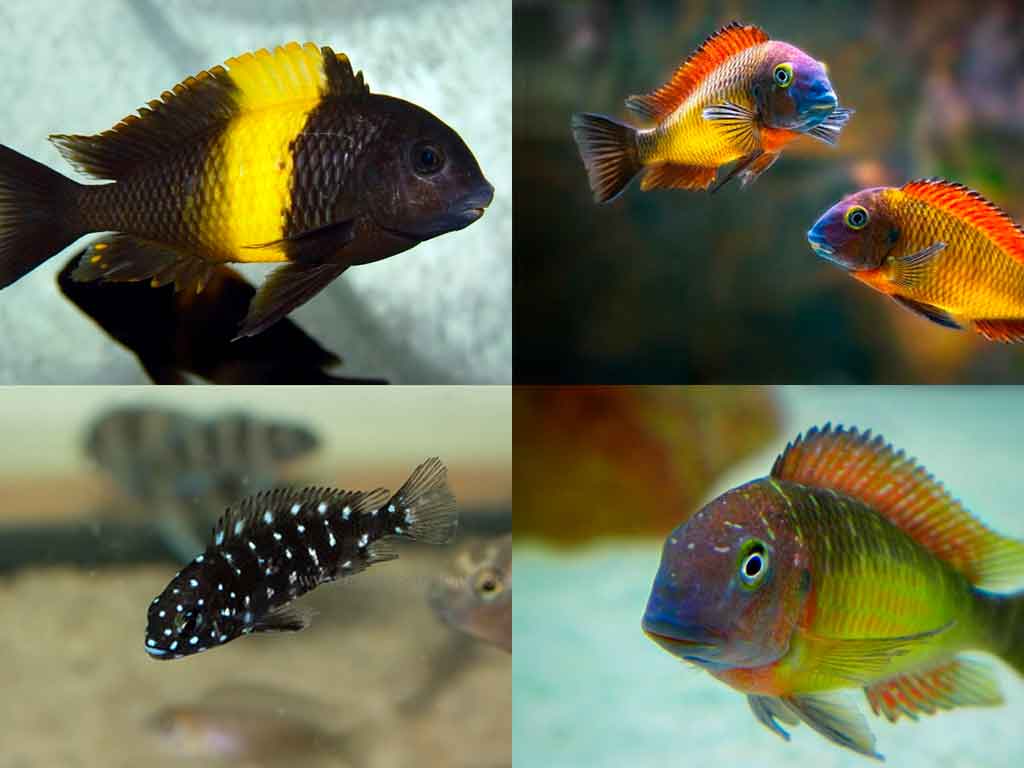
A group of Tropheus in a properly set up aquarium can display over a dozen distinct color variants, each tied to a specific location on Lake Tanganyika’s shoreline. In practice, that’s exactly what makes Tropheus cichlid care one of the most rewarding — and unforgiving — projects in freshwater aquaristics.
Get the diet wrong and you’re looking at a fatal condition within weeks. Get the group size wrong and the dominant male will systematically kill the weaker fish. This guide covers exactly what it takes to succeed with them, from tank dimensions to the mouthbrooding cycle that makes their reproduction so distinctive.
Quick Facts: Tropheus Cichlid Care
- Minimum tank size: 80–100 gallons (300–400 liters)
- Minimum group size: 12–15 individuals
- Diet: Strictly herbivorous — spirulina-based flakes and pellets only
- Water pH: 8.0–9.0 (hard, alkaline)
- Biggest killer in captivity: Bloat, caused by protein-heavy food
- Sex ratio: 1 male to every 3–4 females
The Tropheus Challenge: Are These Cichlids for You?
Tropheus are gregarious and contentious at the same time, which is an unusual combination for a fish. They live in large colonies built around a strict dominance hierarchy, and that hierarchy gets enforced through near-constant low-level aggression. A dominant male claims leadership, other males challenge him regularly, and the fights are real — not just posturing.
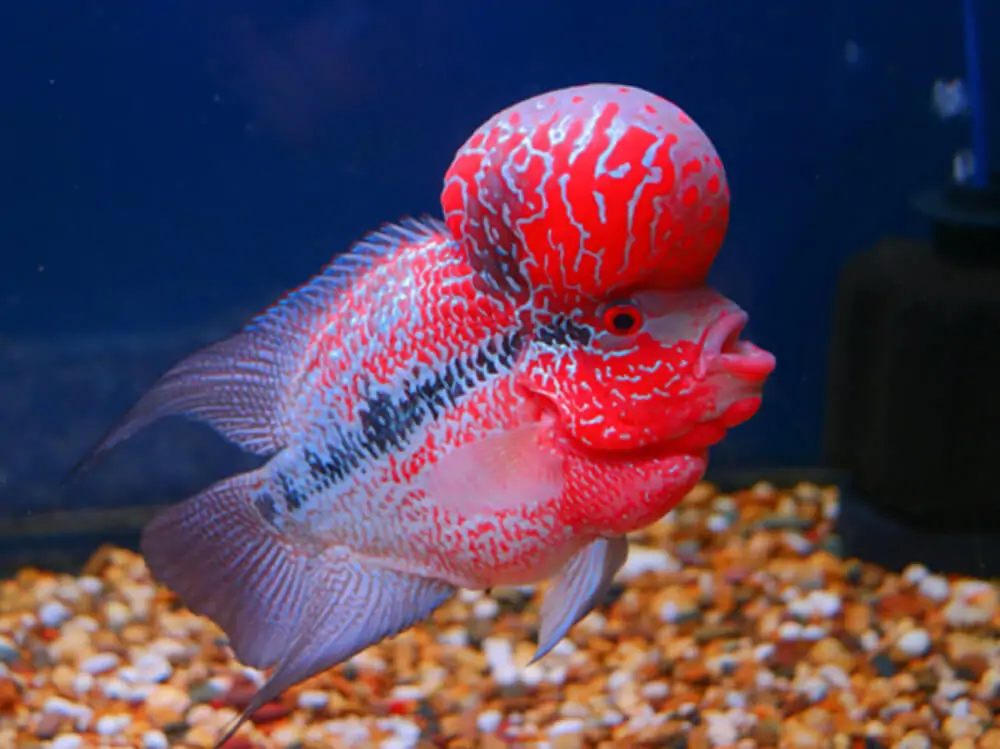
In an undersized tank or a group that’s too small, that aggression concentrates on the weakest individuals until they die. The numbers don’t lie: anything under 80 gallons, or a group under 12 fish, is set up to fail before you even add water. If you want a peaceful community fish, this isn’t it. If you’re drawn to demanding, high-personality cichlids in general, our guide to Flowerhorn cichlids covers another famously demanding species worth comparing before you commit.
Getting to Know the Tropheus Genus: Popular Species and Varieties
Tropheus taxonomy is genuinely complicated, but hobbyists mostly work with two well-known groups.
Tropheus duboisi: The “Polka-Dot” Transformation
Juveniles are deep black with bright white or bluish spots scattered across the body, almost like a night sky. As they mature, those spots fade out completely, the body settles into solid black or dark blue, and a distinct vertical band — white or yellow — develops just behind the head. It’s one of the more dramatic color transformations in the aquarium hobby.
Tropheus moorii: A Rainbow of Locations
This isn’t one fish, it’s a complex of dozens of geographic variants, each tied to a specific stretch of Tanganyikan shoreline. Adult coloration is where these fish really deliver. Some of the most sought-after variants include:
- Tropheus “Bemba”: Dark body with a wide, intense orange vertical band.
- Tropheus “Icola”: Bright yellow vertical band against a black body.
- Tropheus “Moliro”: Deep red coloring across most of the body.
- Tropheus “Ilangi”: Rich yellow head fading into an orange-red body, prized among specialists.
- Tropheus “Kaiser II”: Orange-red overall coloring with a more uniform pattern than most variants.
Each variant should be kept in its own single-species colony rather than mixed with other moorii variants, since crossbreeding muddies the distinct location-specific patterns that make them valuable in the first place.
The Tropheus Aquarium: Recreating a Corner of Tanganyika
Size and Dimensions: Space Is Non-Negotiable
Given their adult size of 4.5–6.5 inches (12–16 cm), constant activity, and aggression, space is the single most important variable in this entire guide. A stable group needs at least 80–100 gallons (300–400 liters), with a tank length of 4–5 feet (120–150 cm) minimum. Length matters more here than depth, since it gives displaced fish somewhere to retreat to.
Water Parameters: The Chemistry of the Great Lake
Lake Tanganyika’s water is unusually hard and alkaline, and replicating that chemistry isn’t optional — it’s foundational to keeping these fish alive long-term.
| Parameter | Ideal Range | Notes |
|---|---|---|
| Temperature | 24°C – 27°C (75°F – 81°F) | Stability matters more than the exact number. |
| pH | 8.0 – 9.0 | A high, stable pH is fundamental to their health. |
| General Hardness (GH) | 10 – 20 dGH | They need genuinely hard water. |
| Carbonate Hardness (KH) | 15 – 25 dKH | A high KH keeps pH from crashing. |
| Ammonia / Nitrite / Nitrate | 0 ppm / 0 ppm / < 20 ppm | Excellent water quality is required, not optional. |
Decor and Substrate: A Landscape of Rock and Sand
Use fine sand, such as silica sand, since it supports their natural digging behavior — this becomes especially important during breeding. Build rock formations that create visual barriers and some shelter, but avoid stacking too many small, defensible caves, since that tends to intensify territorial disputes rather than reduce them.
Most plants won’t survive a Tropheus tank, since these fish are voracious herbivores that treat soft vegetation as a snack. Only tough, bitter-tasting species like Anubias or Java Fern, tied securely to rocks, have a realistic chance of surviving.
The Key to Success: A Strictly Herbivorous Diet
In the wild, Tropheus spend most of the day scraping algae (“aufwuchs”) off rocks, and their unusually long digestive tract is built specifically to process plant matter. This is the part most beginners get wrong, and it’s the leading cause of death in captive Tropheus.
- Recommended foods: High-quality flakes and pellets formulated specifically for herbivorous cichlids, with spirulina as a primary ingredient.
- Foods to avoid entirely: Protein-rich flakes, bloodworms, adult brine shrimp, or anything formulated for carnivorous or omnivorous species.
- Promote natural grazing: Intense lighting encourages algae growth on tank rocks, giving your Tropheus a natural food source and near-constant grazing behavior — which also keeps aggression levels lower.
Common Health Issues: Recognizing and Preventing Bloat
Bloat is the single biggest threat to captive Tropheus, and in practice, it traces back to diet almost every time. High-protein food overwhelms their herbivore-adapted digestive tract, leading to intestinal inflammation and swelling that’s frequently fatal without early intervention.
Watch for these warning signs:
- Visible abdominal swelling, sometimes with scales protruding slightly outward.
- Loss of appetite or refusal to eat, even during normal feeding times.
- Lethargy and hiding, especially in a fish that’s normally active and visible.
- Pale or stringy feces, a sign the digestive tract isn’t processing food normally.
Prevention comes down to one number worth remembering: keep animal protein at effectively zero percent of the diet. Fasting a suspected bloat case for 24–48 hours while maintaining pristine water quality is the standard first response, followed by a vet consult if symptoms don’t improve.
Social Management: The Art of Assembling a Stable Group
Controlling aggression here is genuinely an art, and the strategy is built around diluting it across as many individuals as possible.
- Group size: Keep a minimum of 12–15 individuals. A smaller group lets the dominant male concentrate his aggression on just a few fish until they’re killed off.
- Sex ratio: Aim for one male per 3–4 females, which spreads out the harassment that happens during courtship.
- Sexing Tropheus: Visual sexing is nearly impossible. The only reliable method on sub-adult fish is “venting” — catching the fish and examining the ventral area, where females show a larger, rounder ovipositor than males.
Tank Mates: Why Community Tanks Don’t Work
It’s tempting to want a colorful community setup, but Tropheus genuinely don’t work well outside a single-species colony, and the reasons are practical rather than arbitrary.
Their diet is the first obstacle — most community fish need protein-based food, and any protein in a Tropheus tank raises bloat risk for the entire group. Their water chemistry is the second — very few community species tolerate the extremely hard, alkaline conditions Tropheus require long-term. Their aggression is the third — Tropheus direct most aggression at their own species, but a tank already running near its social capacity leaves little room for anything else competing for space or hierarchy position.
If you want a multi-species Tanganyikan tank, other cichlids from the same lake, like our Frontosa Cichlid, share compatible water chemistry, though a mixed-species Tanganyikan setup is still an advanced project best attempted after you’ve successfully run a single-species Tropheus colony first.
Reproduction: The Fascinating Art of Mouthbrooding
Tropheus are maternal mouthbrooders, and the process is one of the more distinctive breeding rituals in the aquarium hobby. The pair cleans an area of sand, the female lays a single egg, turns to scoop it into her mouth, and the male releases sperm to fertilize it right there inside her mouth.
The female then incubates the eggs for 3–4 weeks without eating anything at all. Broods run small, typically 7 to 20 fry, and the fry emerge as fully formed miniature replicas of the adults, self-sufficient from day one.
Frequently Asked Questions
Can I keep a small group of 3 or 4 Tropheus?
No. A group that small doesn’t dilute natural aggression, and the dominant fish will very likely harass and kill the others. Twelve to fifteen individuals is the realistic minimum.
What happens if I feed them standard tropical fish food?
It’s genuinely dangerous. Protein-heavy food is the leading cause of bloat, an often-fatal intestinal condition. Stick to spirulina-based, herbivore-formulated food exclusively.
Why are they so aggressive with each other but not with other fish?
Their aggression is primarily intraspecific — directed at establishing and maintaining hierarchy within their own species. That said, their diet and water needs still make them unsuitable for most community setups.
How can I tell if I have males or females?
Visual sexing is nearly impossible with Tropheus. The only reliable method is venting, which involves examining the ventral opening on a fish large enough to assess accurately.
Is Tropheus a good fish for a community tank?
No. Their tank size, water chemistry, and diet requirements, combined with intraspecific aggression, make them a poor fit for anything but a dedicated single-species setup.
How do I know if my Tropheus has bloat?
Watch for abdominal swelling, appetite loss, lethargy, and abnormal feces. Early intervention with fasting and pristine water quality gives the best chance of recovery.
What’s the ideal water pH for Tropheus?
Between 8.0 and 9.0. Stability at that range matters as much as hitting the exact number, since sudden swings stress the fish more than a slightly off baseline.
Can Tropheus live with other Tanganyikan cichlids?
Sometimes, in a large enough tank with compatible water chemistry, but it’s an advanced setup. Master a single-species Tropheus colony before attempting a mixed Tanganyikan tank.
How long do Tropheus cichlids live?
With proper diet and water quality, Tropheus commonly live 8 to 10 years in captivity, sometimes longer in a stable, low-stress colony.
Do Tropheus need a specific substrate?
Fine sand, like silica sand, works best. It supports their natural digging behavior and becomes especially important once breeding activity starts.
Tropheus cichlid care is a genuinely demanding project, and it rewards aquarists who respect every part of the equation — tank size, water chemistry, diet, and group dynamics. Get those four variables right, and you’ll end up with one of the most visually striking, behaviorally complex setups freshwater aquaristics has to offer.
Tropheus punishes chemistry mistakes fast, so it’s worth reviewing the fundamentals of pH and hardness before stocking your tank.