
Cat Beds: Why Your Cat Needs a Place of Its Own
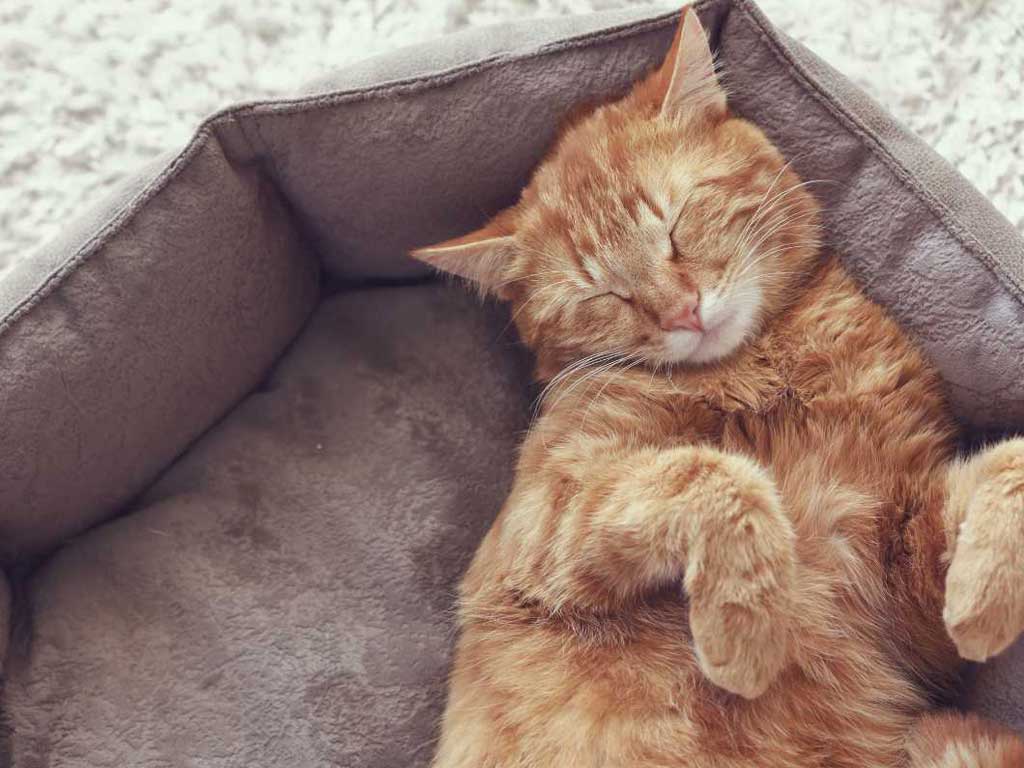
Cat beds give cats a warm, quiet, familiar place to sleep, and that matters because cats spend most of their time asleep. A bed is not decoration. It is a resource, and how a cat uses it tells you whether the shape, the placement, and the smell all match what the cat actually wants.
That gap between what owners buy and what cats accept is the whole problem. This guide covers why a dedicated resting spot matters, which bed type fits which cat, where to put it, and how to tell when a cat is avoiding its bed for a medical reason.
Why Do Cats Need Their Own Bed?
A cat needs a bed because sleep occupies most of its day, and sleep quality depends on feeling safe. A cat that dozes on the sofa with one ear up is not resting the way a cat does in a spot it controls.
Cats Sleep Most of the Day
Cats spend most of their time asleep, which turns a resting spot into the single most used piece of furniture in the house. That ratio is why bed choice matters more than most owners expect, and why a bad bed gets ignored for months.
It also explains the shedding pattern in most homes. Hair concentrates where the cat sleeps, so a washable bed moves that problem into one place instead of every cushion and blanket you own. Our guide to cat hygiene at home covers the grooming side of the same issue.
A Bed Works as a Safety Zone
Cats are territorial, and a predictable resting place is part of how they read a room. An enclosed bed or a raised perch gives a cat somewhere to withdraw when the house gets loud, which is the feline version of closing a door.
That retreat matters in households with children, visitors, or another cat. A cat with nowhere to go does not relax, and chronic low-level tension is the kind of thing that shows up later as spraying or over-grooming rather than as an obvious problem.
nThe same preference for a familiar person explains why some cats follow one family member around the house and settle on that lap every evening, a pattern covered in our guide to what it means when a cat sits on you.
nWarmth Matters More Than Plush
Cats seek warm surfaces, which is why a laptop, a radiator, or a pile of laundry beats an expensive bed more often than owners like to admit. Warmth is not a luxury for a cat. It is a comfort signal, and it matters most for older cats with stiff joints.
Routine Survives Change
A fixed sleeping spot stays the same when everything else moves. During a house move, a renovation, or a new baby, that consistency gives a cat one predictable anchor, and predictability is what keeps stress from stacking up.
What Do Cats Actually Want From a Cat Bed?
Five features decide whether a bed gets used. The table below pairs each one with what it looks like in practice.
| Feature | What it looks like in practice |
|---|---|
| Height | A raised bed, shelf, or perch above floor traffic |
| Cover | Raised sides, a hood, or a box shape to hide inside |
| Warmth | Sunlight, a radiator, or a heat pad |
| Familiar scent | Bedding that is not washed on a strict schedule |
| Escape routes | More than one way out in a multi-cat home |
Height is the one owners underestimate. Many cats feel vulnerable sleeping on the floor, and a bed placed at chest height near a wall gets chosen far more often than the same bed in the middle of a room.
Scent is the second surprise. Cats gravitate toward places that smell like themselves and like home, so a freshly laundered bed can read as unfamiliar rather than clean. That detail drives the washing advice further down.
Why Do Cats Prefer a Box to a Cat Bed?
A cardboard box wins for reasons that have nothing to do with cushioning. It is enclosed, it holds body heat, and it is small enough to feel defensible.
The enclosure is the main draw. A box gives a cat walls on every side except one, and that single entrance is easy to watch. It is the same logic behind a hooded bed, minus the price tag.
If the box keeps winning, work with it. Put the new bed inside the box for a week, then move both to the spot where you want the bed to stay, and let the cat follow.
Which Type of Cat Bed Suits Which Cat?
Personality narrows the list faster than price does. A shy cat and a bold cat want opposite things from a bed, and buying for the wrong profile is the most common reason a new bed sits unused.
Cats That Curl Up and Hide
Shy, anxious, and cold-sensitive cats usually choose a round bed with raised sides they can sink into. The Bedsure Small Round Cat Bed fits that profile, with plush material, an anti-slip base, and a machine-washable cover.
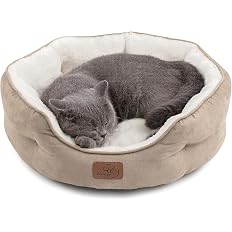
Bedsure Small Dog Bed Washable,Round Cat Beds for Indoor Cats,20in Camel
Soft Plush Pet Bed,Dog Beds for Small Dogs for Puppy and Kittens,Anti-Slip Bottom,Easy to Clean.
Shop on AmazonHappy Pet Zone may earn a commission when you click through to Amazon.com, at no extra cost to you.
Some links in this section are affiliate links. Happy Pet Zone may earn a small commission at no extra cost to you. See the affiliate disclaimer for details.
The limitation is size. A small round bed rewards a cat that curls into a ball, and a large cat that sprawls will drape over the edge and go back to the sofa.
Cats That Want a Perch and a View
Bold, curious cats tend to pick height over softness, especially near a window. A cat window perch combines the two things that profile wants, and the Zakkart Cat Window Perch uses a hardwood and metal frame with a hammock-style cushion rated for larger cats.
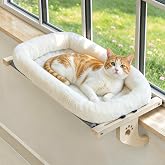
Zakkart Cat Perch for Windowsill with Bolsters (Natural Wood/Gray, L)
Hook-On Windowsill Mount, Machine Washable Hammock Bed, Premium Hardwood & Robust Metal Frame, Hold up to 40 lbs, 24″L x 15″W.
Shop on AmazonHappy Pet Zone may earn a commission when you click through to Amazon.com, at no extra cost to you.
The limitation is installation. A window perch depends on a window that can take the load and a cat that can make the jump, so it is a poor fit for an arthritic senior or a cat recovering from surgery.
If neither shape matches your cat, start from the table below and work backward from behavior rather than from the product page.
| Bed type | Best for |
|---|---|
| Round plush or cave bed | Shy, anxious, or cold-sensitive cats |
| Elevated window perch | Bold cats that want height and sunlight |
| Flat orthopedic bed | Senior cats and cats with stiff joints |
| Heated or radiator bed | Older cats and cats in cold rooms |
| Bed type | Main drawback |
|---|---|
| Round plush or cave bed | Too small for a cat that sprawls |
| Elevated window perch | Needs a suitable window and a cat that can jump |
| Flat orthopedic bed | No cover, so shy cats may avoid it |
| Heated or radiator bed | Cords need checking in homes with chewers |
More options sit in our cat beds and furniture guides, including setups for small rooms and multi-cat homes.
Are Heated Cat Beds Safe?
A heated bed helps older cats and cats in cold rooms, and it needs two checks before it goes on the floor.
The first is the cable. Cats chew cords, and a heated bed left plugged in is a shock risk in a home with a chewer. Choose a model with a chew-resistant cord, or a microwaveable pad with no cable at all.
The second is the cat’s ability to move away. A cat with arthritis or reduced mobility can struggle to leave a hot surface, so keep the setting low and the bed easy to step out of. Heat is comfort, not treatment, and it does not replace pain management for an arthritic cat.
Cat Bed or Cat Tree?
A cat tree combines height, scratching, and a resting platform, which makes it efficient in a small apartment. A standalone bed does one job and does it better for a cat that wants to sleep away from the action.
The usual compromise is both, with a tree in the main room for watching and a quiet bed in a bedroom for deep sleep. If space allows only one, the tree covers more behavior for a single purchase.
Where Should a Cat Bed Go?
Placement decides more outcomes than the bed itself. International Cat Care’s home guidance recommends raised positions, warmth, and quiet corners, and those three rules explain most of the failures owners run into.
- Put the bed above floor traffic, on a shelf, a chest, or a windowsill, so the cat can watch the room without being stepped over.
- Place it near warmth, which means sunlight in winter and a shaded spot in a hot climate, not a radiator in July.
- Keep it out of doorways, off the path to the litter tray, and away from the washing machine.
- Separate it from the litter tray and the food bowls, since those are different jobs in different parts of a cat’s territory.
- Leave it alone once the cat starts using it, and resist rearranging the room every few weeks.
How Many Cat Beds Does a Multi-Cat Home Need?
The working rule for cat resources is one per cat, plus one extra, spread around the home instead of lined up together. Beds follow the same logic, because two beds side by side behave like one contested bed.
Choose shapes with more than one exit. A covered bed with a single opening becomes a trap when another cat guards it, which is exactly the setup that produces tension and, eventually, urine marking around the house.
Watch for the quiet signs of competition: one cat waiting while another sleeps, a bed that is always warm on the same side, or a cat that only uses the bed when the room is empty. Those patterns usually mean the count is adequate and the placement is not, and moving one bed to another room fixes it faster than buying a third.
How Do You Get a Cat to Use a New Bed?
A new bed is an unfamiliar object, and cats are conservative about unfamiliar objects. The goal is to make it smell like the cat and feel like a hiding place before you expect any use out of it.
- Rub the bed with a cloth the cat already sleeps on so it carries a familiar scent.
- Place it where the cat already rests, then move it a little at a time if the spot is awkward for you.
- Add a pinch of catnip or silvervine for cats that respond to either one.
- Skip the cat and let it investigate on its own, since forcing the issue teaches a cat to avoid the bed.
Catnip is not universal. Some cats ignore it completely, and the response is inherited, so a non-reaction says nothing about whether the bed is any good.
How Often Should You Wash a Cat Bed?
Less often than most cleaning schedules suggest. International Cat Care makes the point directly: bedding should be washable, but it should not be cleaned too frequently unless it is soiled, because cats are drawn to places that carry a familiar scent.
A practical rhythm is to remove hair weekly with a lint roller or a vacuum attachment, wash the cover every few weeks, and wash immediately after accidents, flea evidence, or illness. Frequent washing with strongly scented detergent can make a good bed smell wrong to the cat that has to sleep in it.
That is also why unscented detergent matters here. Our guide to smells cats dislike explains which household fragrances push cats away, and bedding is where that effect shows up first.
Fabric choice matters for the same reason. A cover that unzips and washes hot stays fresher than a bed with a foam core that cannot go in the machine, and a bed you avoid washing becomes a bed you replace.
Flea control changes the schedule. In a household with a flea history, bedding becomes part of the treatment plan, and our guide to preventing fleas in cats year round covers how often to wash and what to wash.
When a Cat Stops Using Its Bed
A sudden change in sleeping spot is information. The cat may be avoiding a draft, a new piece of furniture, or another cat, and it may also be avoiding pain.
Arthritis is the common one in older cats, and the signs are easy to miss because cats hide discomfort well. International Cat Care’s guidance on arthritis in cats lists reluctance to jump, stiffness after resting, and hesitance on stairs as the early pattern. A bed that requires a jump stops being an option at that point, and a soft bed in a draft-free, easy-access spot becomes the better choice.
If the cat also seems withdrawn or flinches when handled, a pain assessment is worth doing before you buy another bed. The feline grimace scale is a practical starting point for that conversation with a veterinarian.
Do Cats Still Need a Bed If They Sleep on Yours?
No rule says a cat must sleep alone, and plenty of cats split the night between your bed and their own. The practical case for a second spot is about your sleep and the cat’s options, not about discipline.
If you want the cat nearby without the 3 a.m. wake-up, put a bed on a bedside table or at the foot of the bed. The cat stays close, and the choice stays with the cat.
One middle ground works for a lot of households: a bed on the floor beside your side of the bed. The cat can start the night with you and move down when the room gets too warm, which is what many cats do on their own anyway.
Frequently Asked Questions
Fix the Placement Before You Buy Another Bed
If a bed is already sitting unused, move it before spending money on a replacement. Raise it off the floor, push it against a wall near warmth, and leave it there for two weeks without moving it again.
If the cat is older and has stopped jumping onto favorite spots, book a veterinary check instead of buying a ramp. Stiffness after rest and a reluctance to jump are treatable, and the bed is the easier fix once the pain is managed.