Cat Sitting on You: Spiritual Meaning and What It Really Signals
A cat sitting on you has no confirmed spiritual meaning, though many traditions read it as protection, trust, or comfort. What follows separates three things that usually get mixed together: what the behavior signals, what different cultures have believed about it, and what remains a matter of personal belief.
That separation matters, because most pages on this topic state folklore as fact. The behavior itself is well studied, and the history is documented. The meanings attached to it are interpretations, and they are worth reading as interpretations.
What Does It Mean Spiritually When a Cat Sits on You?
There is no single answer, because spiritual meaning is assigned by culture and by the person, not by the cat. Four readings come up again and again, and each one has a traceable origin rather than appearing from nowhere.
| Interpretation | Where the reading comes from |
|---|---|
| Protection | Cats as household guardians in Egyptian art and later European folklore |
| Trust | The cat’s choice to be vulnerable and close to a person |
| Healing | The calming effect of a purring cat, extended into metaphor |
| Grounding | The stillness of a cat that settles and stops moving |
Notice what those four have in common. None of them predicts anything, and none of them can be tested. That does not make them worthless. It makes them a frame you choose, which is a different thing from a fact about your cat.
What Does the Behavior Actually Signal?
Attachment research gives the clearest answer available. In a 2019 study published in Current Biology, researchers tested cats the same way psychologists test infants, and found that roughly 65% of cats and kittens were securely attached to their caregiver. Securely attached cats used the person as a safe base and returned to exploring once the person came back.
A cat settling on your lap is a smaller version of the same behavior. The cat chooses proximity, accepts a position it cannot easily leave, and stops monitoring the room. For an animal that survives by staying alert, that is a meaningful concession.
Warmth and a Good Position
A human lap is warm, soft, and slightly elevated, which covers three preferences at once. Cats seek warm surfaces, and a lap beats a cold floor by a wide margin on a winter evening.
Scent and Familiarity
Cats navigate by scent, and a household member carries a familiar one. That is why a cat often prefers the person who sits in the same chair every evening over a visiting guest who wants to be chosen. The same sensitivity explains which household smells push a cat away, including the detergent on the lap it is about to land on.
Cover, Height, and Control
Your body works as a windbreak and a screen. A cat on your lap can watch the room from a slightly raised position with something solid behind it, and that combination shows up in every cat’s list of preferred resting spots, whether the spot is a lap or a raised bed by a window.
Why Between Your Legs Specifically?
The gap between your legs is warmer than your knees, enclosed on three sides, and close to your center of mass. It is also a position the cat can leave quickly, which matters for an animal that hates feeling trapped.
There is no evidence that this exact position carries a special message. It is the warmest available pocket with a built-in exit, and that explains the behavior without needing a metaphysics.
What Does the Rest of the Body Language Say?
A cat on your lap is doing several things at once, and the smaller signals around it carry as much information as the sitting itself.
| Signal | What it usually means |
|---|---|
| Kneading with the front paws | A kitten behavior that persists into adulthood, usually at calm moments |
| Purring | Often contentment, though cats also purr when unwell or anxious |
| Drooling while settled | Relaxation in some cats, and a dental or nausea sign in others |
| Tail wrapped against you | Contact-seeking, the same gesture cats use with each other |
| A paw on your face | Boundary-setting as often as affection |
Read the whole cat rather than one signal. Purring with a relaxed body and half-closed eyes reads very differently from purring with tense posture and a flicking tail, and only one of those is an invitation to stay.
Why Does My Cat Sit on One Person Only?
Cats are not democratic about laps. They choose on scent, stillness, routine, and the history of who has been safe to approach, which is why a cat will ignore a willing visitor and settle on the person who is least interested.
Stillness is underrated in that calculation. A person who sits quietly and does not reach for the cat offers a stable surface and no threat, and that is a better offer than enthusiasm.
What Does It Mean When a Cat Sits on Your Chest?
The chest is the warmest high point within reach, and it is also where your breathing is most visible. Many cats settle there because the rhythm is steady and the surface moves slightly, which reads as alive without being unpredictable.
No spiritual tradition singles out the chest, despite what some lists claim. The practical note is weight and comfort. A kitten on the chest is harmless, and a large cat pressing on the chest of someone with breathing difficulties is worth redirecting to the lap.
Where the Spiritual Interpretations Come From
The cultural history is real, even where the metaphysics is not. Three traditions explain most of the symbolism that gets recycled online.
Ancient Egypt, With a Correction
The usual claim is that Egyptians worshipped cats. Curators who study the evidence describe something more specific: Egyptians associated cats with deities because of how the animals behaved, reading a cat’s protectiveness toward its kittens as a divine trait and connecting it to the goddess Bastet.
That is a relationship of symbolism, not worship of the animal itself. The distinction matters, because the “ancient Egyptians worshipped cats” line is the foundation stone of half the spiritual content written about this behavior.
The same record complicates the story further. Cats were also mummified in large numbers as temple offerings, a religious practice built on the animal’s symbolic role rather than on pet keeping. A household cat curled on a lap and a temple offering belong to the same culture and to very different practices.
Norse and Japanese Traditions
Norse mythology gives the goddess Freya a chariot pulled by two cats, which links the animal to fertility and household protection. In Japan, the maneki-neko figure remains a symbol of prosperity and invitation, usually with one paw raised.
Neither tradition says anything about a cat sitting on a person. The symbolism gets borrowed and stretched, which is normal for folklore and worth knowing when a listicle presents it as a rule.
Black Cats in Europe
The black cat’s bad reputation is a European development tied to centuries of superstition about witchcraft, and it never displaced the older and more varied readings. In parts of the United Kingdom and Japan, a black cat crossing your path is treated as good fortune rather than bad.
What Do the Common Interpretations Actually Offer?
Setting aside whether any of them is true, the four readings do different jobs for the person holding them. That is worth naming, because it explains why the interpretations survive.
- Protection turns a cat into an ally. It is comforting in a house that feels empty or unsafe, and it asks nothing of the cat.
- Trust is the reading closest to the behavior, since a cat settling on you is demonstrating something real about its comfort with you.
- Healing borrows credibility from a real effect, the calming response to a purring cat, and stretches it further than the evidence goes.
- Grounding describes a practice rather than a message. A warm weight that keeps you still for twenty minutes is a genuine pause in a fast day.
The pattern is worth noticing. One reading is supported by the behavior, one is a real effect with a borrowed conclusion, and two are frames that help people make sense of a quiet moment.
Does Coat Color Change the Meaning?
No. Coat color does not change how a cat behaves, and the meanings attached to it are folklore rather than anything a cat participates in. The table below lists the associations most often repeated, and they vary by region and by century.
| Coat color | Common folk association |
|---|---|
| Black | Protection, or bad luck, depending on the country |
| White | Purity and peace in European tradition |
| Orange | Warmth, luck, and sociability |
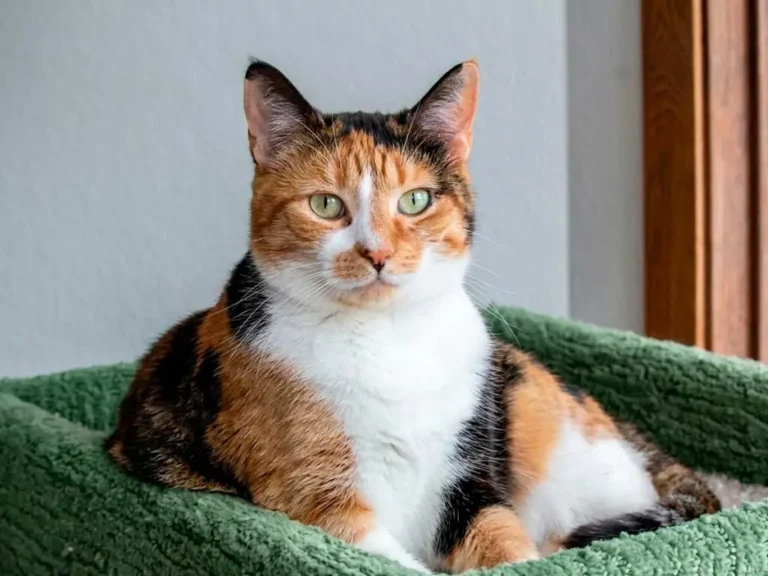
| Calico | Fortune, especially in Japan and the United States |
Treat the table as cultural history, not as a reading of your cat. A black cat sitting on you is a black cat sitting on you. The orange-cat personality myth has its own following, and our guide to orange cat characteristics covers how much of that reputation survives contact with actual cats.
What Can a Cat Sitting on You Tell You About Health?
The useful signal is change, not the habit. A cat that has always slept on your lap is doing something ordinary. A cat that suddenly cannot get close enough, or suddenly stops, is telling you something different.
- Sudden clinginess. A cat that follows you from room to room and presses against you may be seeking comfort from pain or illness.
- Avoiding your lap. A cat that stops jumping up may be protecting a sore joint, especially if it also hesitates on stairs.
- Hiding while seeking contact. Withdrawal combined with clinginess is a pattern worth a veterinary call.
- Restlessness on your lap. A cat that cannot settle in a position it used to hold comfortably may be uncomfortable rather than affectionate.
Pain in cats is easy to miss because the signs are subtle and easily read as personality. The feline grimace scale is a structured way to check, and it gives you something concrete to describe to a veterinarian.
This article is educational and does not diagnose anything. A cat with a sudden change in behavior deserves a professional assessment, not a spiritual reading.
How Should You Respond When a Cat Sits on You?
The moment is short and easy to break. A few habits keep it available without turning it into a trap.
- Let the cat choose the position, and do not rearrange it once it settles.
- Keep an exit open, since a cat that feels trapped will stop coming back.
- Return a slow blink if the cat is looking at you, a signal studied as positive communication between cats and people.
- Let the cat leave on its own, and skip the urge to hold it in place for one more minute.
If you want more of the behavior, make the lap predictable. Cats return to places and people that behave the same way each time, which is why the same chair at the same hour works better than an enthusiastic invitation.
Do Cats Sense When You Are Sad?
Cats respond to changes in a household, including tone of voice, routine, and posture, and many owners report that a cat comes closer during a hard week. That is a reasonable observation, and it is not the same as mind reading.
The safer reading is that cats notice difference and adjust to it. A quiet person who sits still for an hour is an easier lap than a busy one, and a cat does not need a sixth sense to work that out. Our guide to whether cats understand us goes through what the evidence does and does not support.
What About the Healing Claim?
The idea that a purring cat heals tissue is the most repeated claim in this corner of the internet, and it is the weakest one. Purring happens at low frequencies, and many people find the sound calming, which is a real effect on the person listening.
The step from “calming” to “promotes bone growth” is a hypothesis, and it has not been demonstrated as a clinical effect in cats or in people. Enjoy the purr. Just do not treat it as a treatment.
Frequently Asked Questions
Keep the Story, Check the Claim
If the spiritual reading helps you feel closer to your cat, keep it. It costs nothing and it is yours to hold. Just do not let a nice story override a behavior change that a veterinarian should see.
The practical version is simpler than the folklore. A cat that settles on you feels safe, warm, and familiar, and that is already a strong statement from an animal that does not hand out trust casually.
More on reading feline behavior without the guesswork sits in our cat care guides.