Sunshine Peacock (Aulonocara Baenschi): Care Guide & Conservation Warning
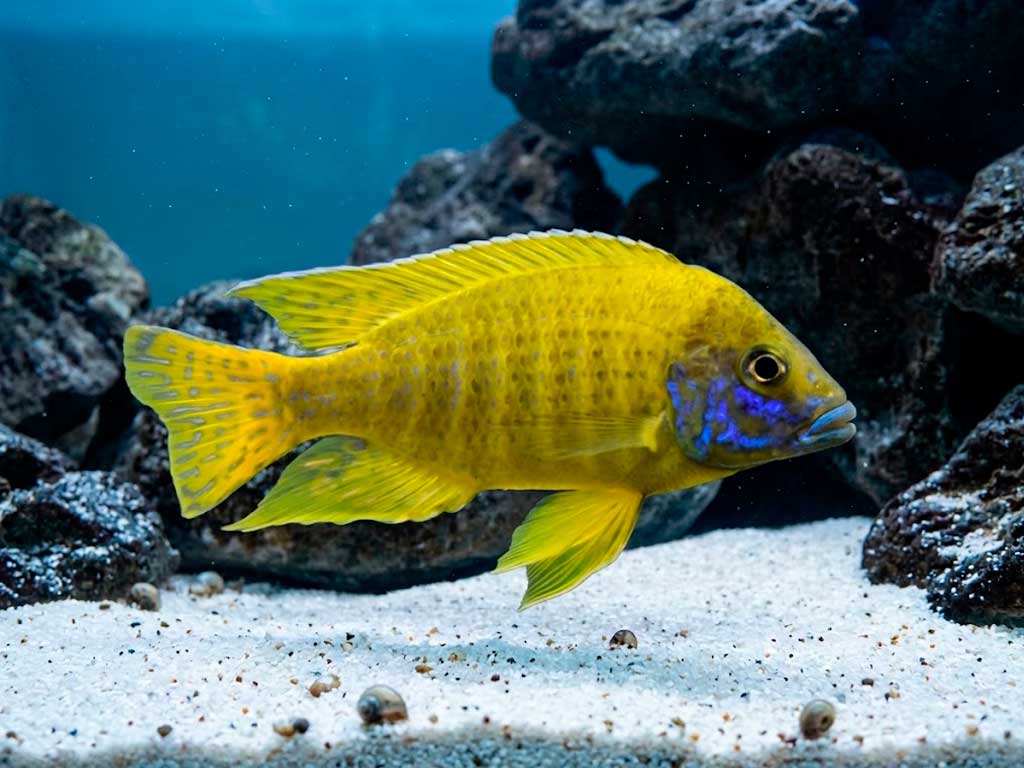
The sunshine peacock is one of the most popular yellow cichlids in the hobby, and it is rated Critically Endangered in the wild. In practice, both statements hold at once: the fish is bred in large numbers in captivity, while its only recorded wild population, on a single Lake Malawi reef, has been hit hard by collection for the trade.
This guide covers what the name really refers to, how the fish lives and breeds, what the tank needs, and where the sources disagree.
Quick Identity Card
| Trait | Detail |
| Scientific name | Aulonocara baenschi (Meyer & Riehl, 1985) |
| Common names | Sunshine Peacock, Nkhomo-Benga Peacock, Benga Peacock, Yellow Regal Peacock |
| Family | Cichlidae (Lake Malawi peacocks) |
| Origin | Nkhomo Reef near Benga, Lake Malawi |
| Adult size | Males up to about 13 cm (5 in); 8 to 10 cm common in tanks |
| Diet | Micro-predator, invertebrates sifted from sand |
| Temperament | Fairly peaceful for a Malawi cichlid; males territorial toward each other |
| Water temperature | 22 to 26°C per FishBase; up to 28°C (82°F) in other sources |
| pH | 7.0 to 8.8 across sources |
| GH (hardness) | 10 to 25 dGH |
| Minimum tank | Sources range from 150 L (40 US gal) to 200 L (55 US gal) |
| Lifespan | Reported at 6 to 10 years |
| Breeding | Maternal mouthbrooder, 3 to 4 weeks |
| IUCN status | Critically Endangered (2018) |
A Fish Named for the Inventor of TetraMin
The species name honors Ulrich Baensch, the biologist who invented TetraMin in 1955, the first universal dry food suited as a staple for many aquarium fish. Meyer and Riehl described the fish in 1985, in a paper published in the aquarium atlas of Baensch and Riehl, together with a second peacock, Aulonocara stuartgranti. The genus name comes from Greek words for flute and head.
That shared 1985 description helps explain a naming problem that still confuses buyers.
Which Fish Is a Sunshine Peacock?
Here’s what actually matters before buying: the name sunshine peacock gets applied to more than one fish. The IUCN and Wikipedia restrict Aulonocara baenschi to Nkhomo Reef and possibly nearby areas of western Lake Malawi. Animal-World, on the other hand, describes the sunshine peacock as a Maleri Island form of Aulonocara stuartgranti, and Aqua-Fish.Net lists one sunshine peacock page under baenschi and another under Aulonocara maleri. Older listings go further and group four color morphs from Chipoka, Nkhomo-Benga, the Maleri Islands, and Usisya under baenschi.
The most practical identification clue comes from SeriouslyFish: the snout profile of A. baenschi is steeper and more curved than in similar-looking relatives. Listings labeled Maleri and Benga both circulate under the same common name, so it pays to ask a seller which population and species they mean.
Captive strains add another layer. An albino sunshine peacock is sold as a captive-bred variety, with a yellow-white body, pink eyes, and reduced blue pigment.
Origin and Natural Habitat
Wild sunshine peacocks live over sandy areas scattered with rocks at Nkhomo Reef near Benga, on the southwestern side of Lake Malawi. SeriouslyFish records them mostly in shallow water from 2 to 6 meters, and as deep as 16 meters, though one retailer cites 5 to 20 meters.
Like all Aulonocara, they find prey in the sand with enlarged sensory pores on the head. They either sift the substrate through their mouths or watch for movement and strike.
Color, Sexing, and Why Your Male Isn’t Yellow Yet
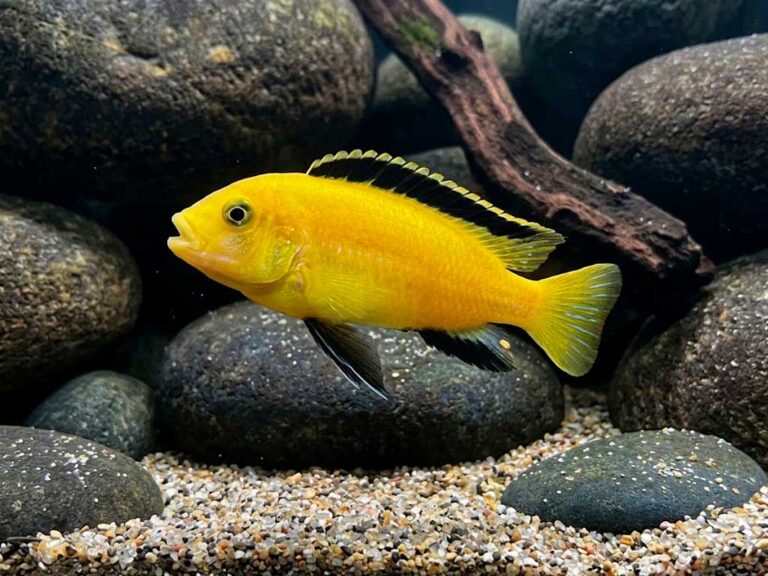
Adult males carry a golden-yellow body with metallic blue on the chin, lips, and cheeks, blue bands on the dorsal and tail fins, and pronounced egg-spots on the anal fin. Females and juveniles are silvery-grey to olive-brown with faint vertical bars, sometimes with a little yellow in the fins.
Color takes time. Males start showing it around 2 to 3 inches (5 to 8 cm), and the full yellow-and-blue look develops over 6 to 12 months. Diet, water quality, and social status all influence it, and subordinate males can deliberately dull their color to avoid conflict, so a pale male in a crowded tank may simply be outranked.
Behavior and Temperament
Compared with mbuna, sunshine peacocks are calm. Aqua-Fish.Net rates them peaceful toward other species and aggressive or territorial toward their own kind, especially during breeding. Wikipedia adds that males stay in breeding color all year and center their territory on a shelter they excavate, while females live in small schools.
Males court with a shaking display, and a lone female with a single male can be chased relentlessly. Sources recommend one male with three or four females. Male-to-male conflict is described as moderate, mostly display and lip-locking.
Diet and Feeding
In the wild this is a micro-predator, so the aquarium menu leans on protein: quality sinking cichlid pellets as the staple, with frozen mysis, brine shrimp, and cyclops a few times a week. One source reports that pellets rich in astaxanthin intensify the yellow.
Two sources warn against mammalian protein such as beef heart, and one adds tubifex worms and floating foods to the avoid list. Sources disagree on how prone the species is to Malawi bloat, one calling it a fatal risk with improper foods and another calling it uncommon in peacocks compared with mbuna, so moderate portions are the safe reading.
There is a fitting irony here, given who the species is named for: a good prepared food does most of the work. The feeding guide for ornamental fish covers building a balanced rotation.
Tank Requirements and Water Parameters
Volume recommendations run from 150 L (40 US gallons) in one care sheet to 200 L (55 US gallons) in others, with 75 gallons preferred for a mixed peacock community. Build the tank with open sand and a few rock piles with caves, using less rock than a mbuna tank. Sources recommend fine sand such as aragonite or play sand, and one warns that sharp gravel can damage the sensory pores on the jaw. The African cichlid tank setup guide covers building a Malawi system, and for this species the balance should tilt toward sand.
Water needs to stay hard and alkaline: temperature between 22 and 26°C per FishBase, with other sources reaching 28°C (82°F), pH from about 7.0 to 8.8, and general hardness of 10 to 25 dGH. Weekly water changes of 20 to 30 percent are the standard advice, and stability matters more than hitting an exact number.
Tankmates and Compatibility
Other peacocks and haps are the natural companions, but females of different Aulonocara species look alike, so mixing similar yellow peacocks risks hybrids. Choose contrasting colors instead.
Aqua-Fish.Net and AquariumStocking both list the yellow lab as a workable mild mbuna companion in enough space, and the Labidochromis caeruleus guide covers that fish. Aggressive mbuna are the main danger. AquariumStocking singles out the auratus cichlid as far too aggressive for peacocks, which fits the picture in the Melanochromis auratus guide. Small community fish such as tetras and rasboras don’t share the water chemistry.
Breeding
Sunshine peacocks are maternal mouthbrooders, and breeding is rated easy. The male excavates a pit in the sand and performs a shaking display. As the female lays, she picks up each egg, and the egg-like spots on the male’s anal fin draw her to open her mouth again, at which moment he releases milt and fertilizes the eggs inside her mouth.
Sources give the brooding time as three to four weeks, and one reports clutches of 15 to 40 fry. Newly released fry take baby brine shrimp and crushed pellets.
Conservation Status: Critically Endangered
The IUCN assessed Aulonocara baenschi as Critically Endangered in 2018, and the main threat is capture for the aquarium trade. The species has only been recorded from Nkhomo Reef and possibly nearby areas.
Ad Konings describes it as one of the few Malawi cichlids affected by over-collection. After a dive in late 2006 found only a very small number of males in color on the reef, he asked collectors to let the population recover for at least a year. A month later, he heard that a new site on the reef had been found and was being exploited.
He also notes that the species is bred in relatively large numbers, so the natural habitat doesn’t need to be plundered for the last few specimens. One breeder adds that the CARES preservation program lists the species as Endangered.
For buyers, the message is unusually clear. Buy captive-bred fish from a breeder, and skip any seller who can’t say where the stock comes from.