Pseudomugil Gertrudae Care Guide: Tank Setup, Diet, and Breeding
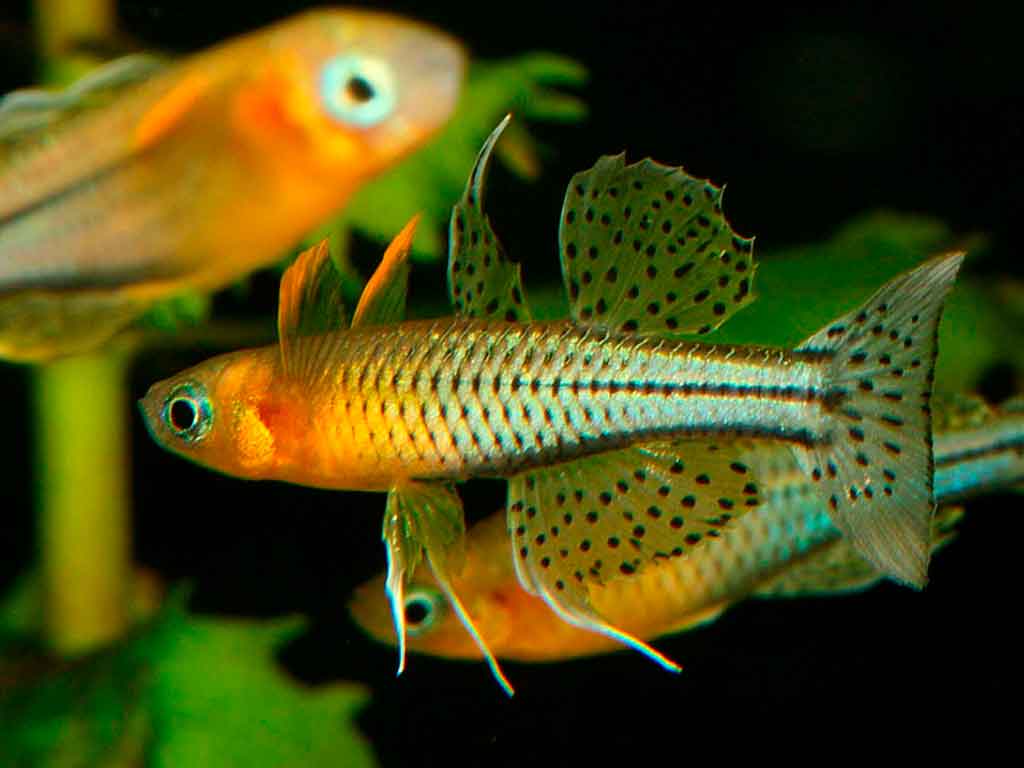
Pseudomugil gertrudae, the spotted blue-eye, is a small freshwater fish known for its bright blue eyes and spotted fins. It is tiny enough for a nano tank, and that is exactly why keepers underestimate it. Stable water, the right food size, and a proper group decide whether it thrives or quietly declines.
This guide covers tank setup, water parameters, feeding, tank mates, and breeding, with the details that matter most in practice.
Quick Facts
- Common name: Spotted blue-eye, Gertrude’s blue-eye
- Scientific name: Pseudomugil gertrudae
- Origin: Northern Australia, Papua New Guinea, and the Aru Islands of Indonesia
- Adult size: Up to 3.8 cm (1.5 inches)
- Minimum tank: About 41 liters (11 US gallons) for a small, carefully planned group
- Comfortable tank: 60 to 80 liters (16 to 21 US gallons)
- Temperature: 21 to 28°C (70 to 82°F)
- pH: 4.5 to 7.5 (wide outer limits, see the water parameters section)
- General hardness: About 5 to 12 dGH for the commercial ornamental strain
- Temperament: Peaceful, active, and social
- Diet: Micro-pellets, crushed flake, and small live or frozen foods
- Care level: Moderate
- Typical lifespan: Often 2 to 3 years, depending on conditions
What Is Pseudomugil gertrudae?
The spotted blue-eye belongs to the family Pseudomugilidae, a group of small fish closely related to rainbowfish. Its natural range covers northern Australia, Papua New Guinea, and the Aru Islands in eastern Indonesia.
In the wild, it lives in shallow margins of streams, small lakes, and swamps. These places usually have plants, submerged roots, and leaf litter, and water chemistry changes a lot from one location to the next.
Why the Name “Spotted Blue-eye”?
The name describes two features. The eyes show a clear blue that stands out under good aquarium lighting. Males also carry larger, more colorful fins with dark spots.
The body is slender and partly translucent. Depending on the population, you will see silvery, yellowish, or golden tones, and the fin markings vary as well.
Males have the more elaborate fins. Females are rounder and have shorter, plainer fins.
How Big Does It Get?
Adults usually reach 3 to 3.8 cm (1.2 to 1.5 inches). That size suits a planted aquarium, as long as the tank gives the group enough open swimming space.
Small does not mean easy. In a very small tank, waste builds up and water chemistry shifts fast, so there is little margin for error.
Aquarium Supplies
Tetra LED 20 Gallon Complete Fish Tank Kit for Freshwater Fish
Aquarium Kit Includes LED Light, 20 Gallon Glass Tank With Hinged Hood, Filter, Filter Cartridge, Décor, For Freshwater Fish
Shop on Amazon
Hikari® Micro Pellets® Semi-Floating Fish Food for Small-Mouthed
Ultra-small, slowly sinking pellets fit comfortably in micro-mouthed fish while offering a balanced blend of marine.
Shop on Amazon
Tetra SafeStart Plus for New Freshwater Aquariums
Establishes Healthy Bacteria In New Fish Tanks, Reduces Ammonia & Nitrite, Starts Working Immediately
Shop on Amazon
Tetra AquaSafe Plus Water Conditioner & Dechlorinator For Aquarium
Treats 2X the Water as Standard AquaSafe, Makes Tap Water Safe, Reduces Fish Stress, Removes Chlorine, Use Monthly
Shop on AmazonAs an Amazon Associate, Happy Pet Zone earns from qualifying purchases, at no extra cost to you.

12 Spotted Blue Eye Rainbowfish – Pseudomugil gertrudae – Colorful
Pseudomugil gertrudae Common Name: Spotted Blue Eye Rainbowfish Quantity: 12 Live Fish Adult Size: Approximately 1–1.5 inches
Shop on AmazonHappy Pet Zone may earn a commission when you click through to Amazon.com, at no extra cost to you.
Aquarium Setup
A mature, planted aquarium with open swimming areas and gentle flow gives this fish the best start.
Seriously Fish lists a base of about 45 × 30 cm (18 × 12 inches) as the smallest tank worth considering. That footprint works out to roughly 41 liters only with a standard height of around 30 cm, so check the actual dimensions before you buy.
Choosing the Right Tank Size
Size the tank for the whole group, not for the adult length of one fish. A group needs room to move, and the males need space to display.
At around 41 liters, you can keep a small group if you stock carefully and maintain the tank well. A 60-liter tank is more forgiving, and an 80-liter tank gives you room for plants, better filtration, and easier maintenance.
Plants, Substrate, and Decoration
Use fine-leaved plants to create sheltered zones, and leave the middle and upper water column open. Dense planting everywhere turns the tank into a thicket, and the group loses its swimming space.
Useful additions:
- Fine-leaved plants that create cover at the edges.
- Floating plants that soften strong overhead light.
- Java moss or similar mosses, which double as spawning material.
- Driftwood for a natural layout.
- Open water where the group can swim and males can show their fins.
A dark substrate makes the fish’s colors stand out. It is a visual choice, though, not a biological requirement.
Filtration and Flow
A mature biological filter is essential. Cycle the tank first, then add fish only when ammonia and nitrite both read 0 ppm.
The species likes well-oxygenated water and some circulation, but it should not fight a strong current all day. A sponge filter or an adjustable-flow filter with the outlet aimed at the glass works well.
Water Parameters
Stability matters more than hitting a perfect number. The commercial ornamental strain tolerates a fairly wide range, but sudden swings stress it.
| Parameter | Practical target |
|---|---|
| Temperature | 21 to 28°C (70 to 82°F) |
| pH | 4.5 to 7.5 as outer limits, aim for a steady value in the middle |
| General hardness | 5 to 12 dGH |
| Ammonia | 0 ppm |
| Nitrite | 0 ppm |
| Nitrate | Keep low through water changes and sensible stocking |
These are starting points, not targets to chase. The water your fish came from and the stability of your tank matter more than any single reading.
Temperature
Keep the tank steady within the range. A heater may be needed in a cool room, and a thermometer will catch drift you would otherwise miss.
Avoid raising or lowering the temperature to trigger colors or breeding. Change it slowly, and only for a clear husbandry reason.
pH and Hardness
Seriously Fish gives 4.5 to 7.5 for pH and 5 to 12 dGH for the ornamental strain. Other references narrow that window, so treat 4.5 and 7.5 as limits you should stay away from, not goals.
In practice, a stable reading near the middle of the range, held consistently, beats chasing a number. Do not add pH-altering products to match a single figure on a care sheet. Sudden changes do more harm than a steady value that sits a little off the ideal.
Water Changes and Testing
A common routine is 20 to 30% weekly, adjusted for stocking, feeding, and nitrate readings. Match the temperature of the replacement water to the tank.
Test ammonia and nitrite when the tank is new, after a big stocking change, or when fish behave oddly. Monitor nitrate and pH during routine maintenance.
Diet and Feeding
In the wild, these fish eat zooplankton and tiny invertebrates. Their small mouths mean food size matters as much as variety.
What to Feed
- High-quality micro-pellets made for small freshwater fish.
- Finely crushed flake that they can swallow easily.
- Newly hatched brine shrimp.
- Small portions of Daphnia or Moina.
- Appropriately sized frozen foods.
Live food is excellent for conditioning breeders and for encouraging natural feeding. It does not have to appear at every meal. A good prepared diet with live or frozen food a few times a week covers the needs of most keepers.
How Often
Feed small portions once or twice a day. Watch the group, and make sure every fish gets a chance to eat.
Remove uneaten food. Leftovers in plants or substrate add load to the tank and pull water quality down.
If new fish refuse prepared food, offer frozen or live food first, then introduce the regular diet gradually. Refusal combined with weight loss or unusual swimming means you should check water quality and health before anything else.
Behavior and Tank Mates
This is a social, peaceful fish that should live in a group. A group of at least six is a sound starting point, and more is better when the tank can support them.
Males display their fins to each other and court females. It is fun to watch, but it should not stop anyone from eating or resting.
Choosing Companions
Pick small, peaceful fish with matching water needs. Suitable candidates include small rasboras, some small tetras, and other calm community fish that will not outcompete the group at feeding time.
Before adding any species, ask three questions:
- Does it tolerate the same temperature and water chemistry?
- Is it small and peaceful enough that it will not harass or eat the blue-eyes?
- Will both species get enough food without competition?
Avoid large or boisterous fish. Even a species that rarely attacks can cause problems by taking all the food or keeping the blue-eyes hiding.
For more community options, see our Galaxy Rasbora care guide or the Cherry Barb care guide.
Can They Live With Shrimp?
Adult freshwater shrimp can live with spotted blue-eyes in a peaceful, planted tank. Shrimplets are another matter, since the fish will eat them when they can catch them.
Dense moss helps, but it will not save every baby shrimp. If shrimp breeding is the goal, use a separate tank.
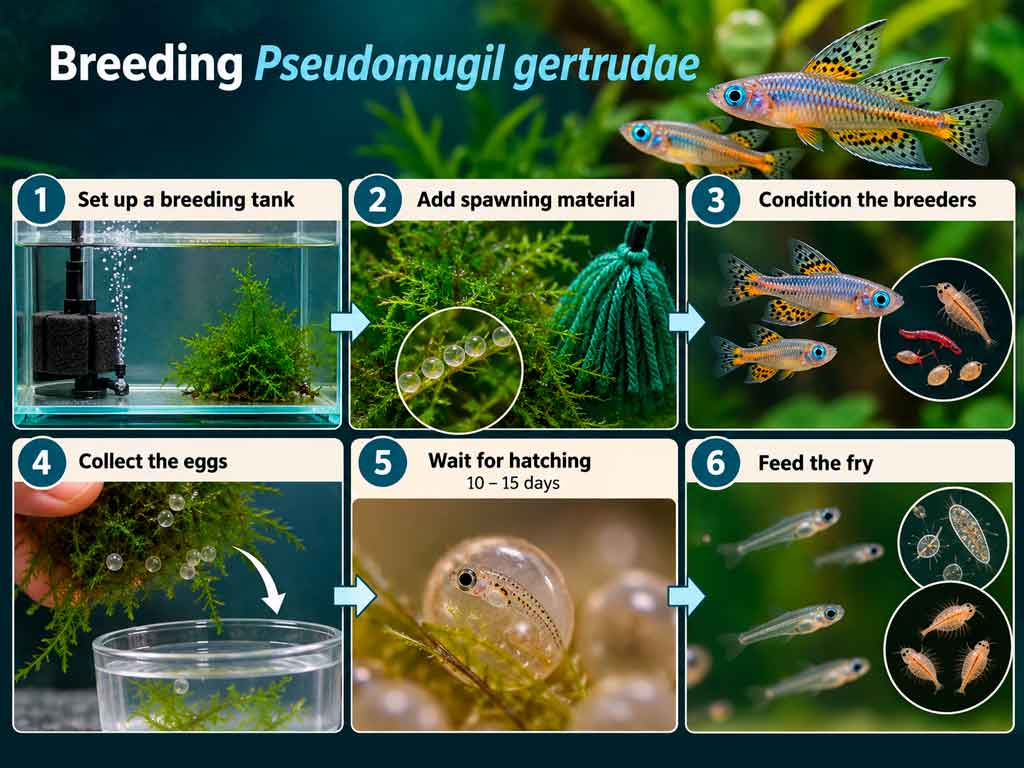
Breeding Pseudomugil gertrudae
Getting adults to spawn is often easier than raising the fry. This species is an egg-layer. Females scatter adhesive eggs among spawning material instead of guarding a nest.
Geographic Variants: Aru II, Aru IV, and Others
Shops often sell these fish under labels such as Aru II or Aru IV. The labels usually refer to a collection locality or a trade name.
They are not proof of a separate species. The fish may differ in color, fin shape, or spotting, but a store label does not confirm the exact origin.
If a specific population matters to you, ask the seller where the fish were collected and whether they were bred apart from other lines. Keeping documented lines separate helps preserve their traits.
Common Mistakes
A Tank That Is Too Small
Small fish produce waste just like big ones, and small tanks swing faster. Pick the tank for the group and for the stability you can maintain.
Adding Fish Before the Tank Is Mature
A new tank can look clean while its filter is still too weak to handle waste. Cycle it first, and confirm 0 ppm ammonia and nitrite.
Food That Is Too Big
Large pellets get ignored or spat out. Use micro-pellets, crushed flake, or small frozen and live foods.
Keeping Too Few Fish
A solitary fish or a tiny group does not show normal social behavior. Plan for at least six when the tank can handle it.
Mixing Incompatible Species
Peaceful temperament is not the same as compatibility. A larger fish can monopolize food or frighten the group without attacking anyone. Compare adult size, feeding habits, and water needs before you add anyone.
Chasing Exact Numbers
Constant chemical adjustments create the instability you are trying to avoid. Choose conditions that suit your fish, keep them steady, and change things gradually when there is a real reason.
Is Pseudomugil gertrudae Right for Your Tank?
This fish suits keepers who enjoy small, active species and planted layouts. Its blue eyes and spotted fins make it a standout in a nano community.
It can work in a smaller tank, but its size should never be an excuse to skip stable water or group housing. The numbers don’t lie: stability and group size do more for this fish than any equipment upgrade.
It is a good match if you can provide:
- A mature tank of about 41 liters (11 US gallons) or larger, with more space preferred.
- Stable water suited to the population you buy.
- A group of at least six.
- Fine foods and a varied feeding routine.
- Gentle flow and well-oxygenated water.
- Peaceful tank mates, if you want a community tank.
Before buying, confirm the fish’s identity and ask the seller about their current water conditions. A gradual introduction avoids the shock of a sudden change.
Frequently Asked Questions
A practical next step: Before buying a group, cycle the tank, confirm the biological filter is established, and check that the water suits the population you plan to keep. Those three checks give your blue-eyes the best possible start.
Sources