Red Zebra Cichlid (Maylandia Estherae): Care Guide & Color Morphs
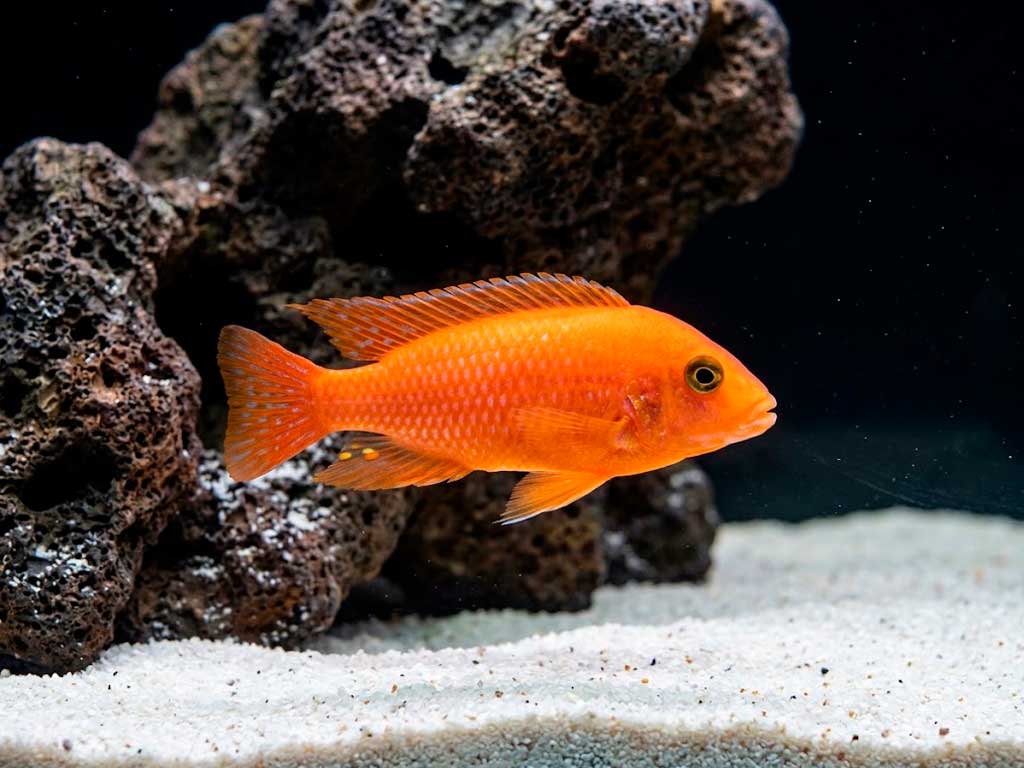
Maylandia estherae spent more than twenty years in home aquariums before it had a scientific name. In practice, the fish sold as a red zebra is often a line-bred strain that differs from the wild animal, which is why its colors surprise people who expect the name to describe the whole species.
This guide covers what the wild fish actually looks like, how the color morphs and trade names work, what the tank needs, and where the sources disagree.
Quick Identity Card
| Trait | Detail |
| Scientific name | Maylandia estherae (Konings, 1995), also written Metriaclima estherae and Pseudotropheus estherae |
| Common names | Red Zebra Cichlid, Red Zebra Mbuna, Esther Grant’s Zebra |
| Family | Cichlidae (mbuna, Lake Malawi) |
| Origin | Eastern coast of Lake Malawi, from Minos Reef and Metangula (Mozambique) to Gome Rock (Malawi) |
| Adult size | About 10 cm (4 in) in the wild; up to 12.5 to 13 cm (5 in) in aquaria |
| Diet | Algae grazer (aufwuchs), plant-leaning |
| Temperament | Semi-aggressive; not for non-cichlid community tanks |
| Water temperature | 24 to 26°C (75 to 79°F); 22 to 28°C reported |
| pH | 7.5 to 8.5 |
| GH (hardness) | 12 to 16 dGH typical; up to 25 reported |
| Minimum tank | Most sources: 55 US gal (200 L), 48 in long |
| Lifespan | Reported at 5 to 10 years |
| Breeding | Maternal mouthbrooder, about 21 days |
| IUCN status | Least Concern (2018) |
Twenty Years Without a Scientific Name
The red zebra first appeared in the aquarium hobby in the fall of 1973 and commanded a hefty price because of its brilliant color. Ad Konings did not describe it formally until 1995, in a paper whose own title calls it the well-known red zebra cichlid of Lake Malawi.
That early hobby history explains a lot about what’s sold today. In the mid-1970s a few red or orange males were imported and became the foundation stock for a line bred to produce only that color, and for several decades red males with red females were the only version of the fish on the market. Wild collecting resumed in the late 1990s, once the political situation stabilized.
The fish was first treated as a variety of Pseudotropheus zebra before Konings described it as Pseudotropheus estherae. Later authors used Metriaclima, including Konings and Stauffer in 2016, and Eschmeyer’s Catalog of Fishes currently lists Maylandia estherae as the valid name, so labels vary.
Maylandia Estherae Color Morphs and Trade Names
Here’s what actually matters for anyone shopping by color: the name describes the female. In the wild, adult males are a uniform light blue with no broad vertical bars, while females run orange-red, blotched (the OB morph), or brown-beige. AquaInfo puts the orange-red form at around 80 percent of females, with the blotched and brown-beige forms at about 10 percent each. Wikipedia instead calls beige to brown the normal female color, with red and blotched forms limited to certain localities, so how common the red female is depends on the population and the source.
Rare male variants exist too. Konings estimates orange-red males at only about 1 percent of the Minos Reef population, and he has seen a single blotched male in all his dives there, roughly 0.1 percent. Estimates for the blotched female range from 2 to 5 percent in his numbers to about 10 percent in AquaInfo’s. Hobbyists call the rarest male variants “marmalade cats,” though sources apply the term to different morphs.
That history explains the labels in shops. Names such as Red x Red, Blue x Red, and OB x Red appear to give male color first and female color second, and Cichlid-Forum defines Red x Red as red males with red females. Because the orange-red male comes from that line-bred strain, the most common shop fish is more a captive-created color form than the wild animal. Animal-World adds that most captive-bred stock was line bred for color in Florida fish farms.
Telling It Apart From Look-Alikes
Konings’ original description gives two reliable clues. Males carry yellow, ocellated spots at the trailing edge of the dorsal fin, a feature absent from other described Pseudotropheus except for rare OB males of Pseudotropheus zebra, which never show the overall light-blue body.
The species also resembles Metriaclima callainos, the former Bright Blue Zebra, in color and shape. The two differ in the mouth: in estherae the jaws do not completely close the gape, so teeth are always visible. AquaInfo adds that its body is somewhat less deep than that of Metriaclima zebra, which lives alongside it at Minos Reef, and that in the cases it could verify, males colored like M. callainos did not breed with red zebra females.
Origin and Natural Habitat
The type locality is Minos Reef, near Meluluca in Mozambique, a rocky reef several kilometers offshore. AquaInfo notes that the reddest females come from there, while fish from Chilucha Reef, south of Metangula, are not as intensely red. Other recorded localities include Nkhungu Reef, Chiofu Bay, Meponda, N’kolongwe, Narungu, and Gome Rock in Malawian waters.
AquaInfo describes the range as limited to part of the eastern coast, though one care sheet calls the distribution lake-wide. The fish lives on rocky habitat with dense biofilm cover, and Cichlid-Forum notes that the aquarium trade collects it principally from Minos Reef.
Behavior and Temperament
Sources rate the species semi-aggressive or moderately aggressive. Fishkeeper puts it a step below the “very aggressive” rating it gives the fish in the kenyi cichlid guide, which shares the genus. Males are territorial, and a group of four or more with one male and at least three females is the standard plan, so no single female absorbs all the attention of a male that is always ready to spawn.
Experience-level ratings vary. One Cichlid-Forum review calls the fish undemanding and suitable for beginners, while Animal-World rates it for intermediate keepers and warns that it is not a community tank specimen for fish other than cichlids. Animal-World also flags susceptibility to Malawi bloat and stresses frequent water changes.
Diet and Feeding
AquaInfo describes the red zebra as a typical aufwuchs eater that scrapes algae growth off rock at a 90-degree angle. In the aquarium it has no special demands, but AquaInfo recommends adding plant food regularly. Fishkeeper lists spirulina flake, granules, cichlid pellets, and frozen foods as the standard menu. The feeding guide for ornamental fish covers building a balanced rotation in more depth.
Tank Requirements and Water Parameters
Most sources cite a minimum of 55 US gallons (200 L) with 48 inches of length, though one guide accepts 40 gallons. Build the tank around medium to large rocks with plenty of caves, over sand or gravel, and place a few rocks directly under the light so algae can grow for grazing. Limestone and other rock that raises pH suits the species. The African cichlid tank setup guide covers building that kind of system from the ground up.
Water needs to stay hard and alkaline like the rest of Lake Malawi: temperature between 24 and 26°C (75 to 79°F), with 22 to 28°C reported as tolerable, pH from 7.5 to 8.5, and general hardness roughly 12 to 16 dGH, with up to 25 dGH reported. Fishkeeper lists medium lighting.
Tankmates and Compatibility
Care sheets list a Malawi cichlid community as the right company, and AquaInfo recommends keeping several other mbuna species alongside it in a rocky-shore setup. That points to other robust rock-dwelling cichlids in a tank big enough for each to hold a territory.
Temperaments vary widely inside the mbuna group. The Melanochromis auratus guide covers another combative mbuna, and the kenyi guide covers a more aggressive genus-mate, so pairing decisions deserve real thought.
Breeding
Red zebras are maternal mouthbrooders. The female holds the fertilized eggs and then the fry in her mouth for about 21 days before release. Breeding difficulty is rated low, and the standard harem ratio of one male to three or more females helps keep spawning pressure spread out.
Conservation Status
The IUCN rates the species Least Concern, based on a 2018 assessment. Konings explains that because it lives in rocky environments, it is unlikely to be overfished by fishermen dragging nets, and that its distribution is wide enough that many populations sit far from fishing villages. At least one older academic handout still lists it as Vulnerable, but the current listing is Least Concern.
The trade does collect wild fish from Minos Reef, yet farm-bred stock dominates what’s sold. Since the popular red-male look comes from a captive line anyway, choosing farm-bred fish costs the buyer nothing.