Flavescent Peacock (Aulonocara Stuartgranti): Care Guide & Color Morphs
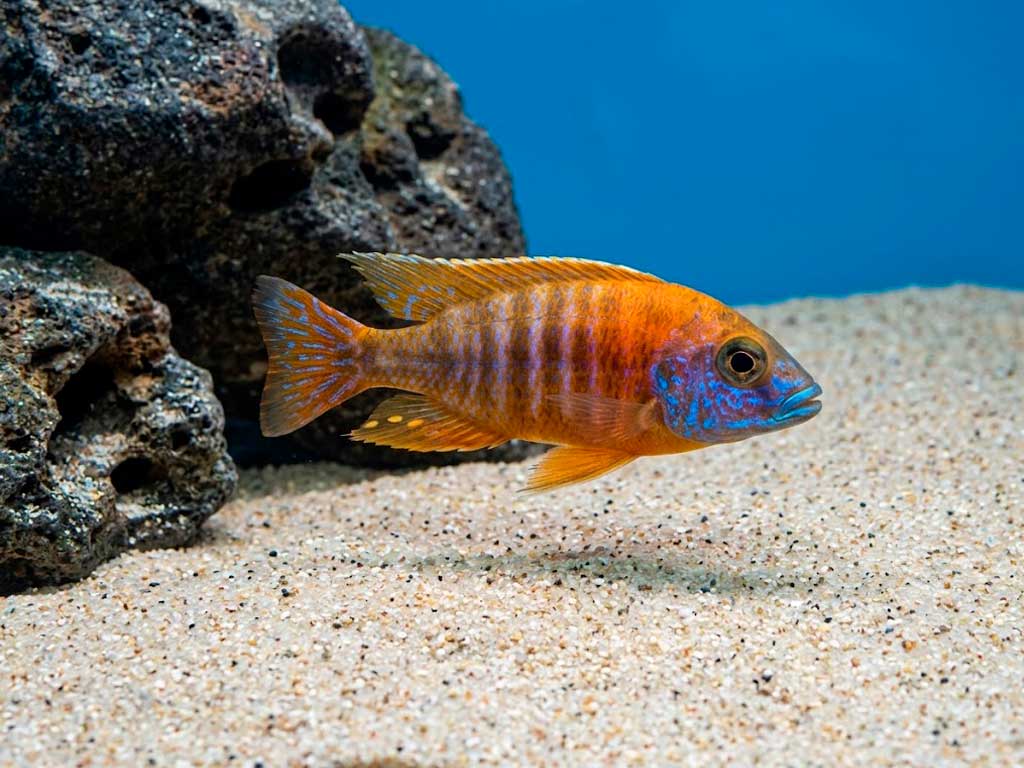
The flavescent peacock is sold under a dozen different names, and its color runs from blue to yellow to red depending on which part of Lake Malawi the population comes from.
In practice, several forms that hobbyists once treated as separate species now sit inside Aulonocara stuartgranti, and one of them, the Maleri form, is also sold as a sunshine peacock.
This guide covers the best-known local forms, the way this fish hunts by sensing vibrations, what the tank needs, and where the sources disagree.
Quick Identity Card
| Trait | Detail |
| Scientific name | Aulonocara stuartgranti (Meyer & Riehl, 1985) |
| Common names | Flavescent Peacock, Grant’s Peacock, Ngara Aulonocara, Blue Neon (trade name) |
| Family | Cichlidae (Lake Malawi peacocks) |
| Origin | Widely distributed along the shores of Lake Malawi (Malawi, Mozambique, Tanzania) |
| Adult size | Males about 12 to 15 cm (5 to 6 in); females up to about 11 cm |
| Diet | Carnivore, invertebrates sifted from sand |
| Temperament | Fairly peaceful; males territorial when breeding |
| Water temperature | 22 to 26°C (72 to 79°F); up to 28°C reported |
| pH | 7.5 to 8.5 |
| GH (hardness) | Roughly 8 to 16 dGH typical; 4 to 25 reported |
| Minimum tank | Sources range from 160 cm (about 300 L) to 400 L |
| Lifespan | Reported at 5 to 10 years |
| Breeding | Maternal mouthbrooder, about 20 to 22 days |
| IUCN status | Least Concern (2018) |
A Species Built From Local Forms
Manfred Meyer and Rüdiger Riehl described the species in 1985, naming it for Stuart M. Grant (1937 to 2007), a legendary exporter of Lake Malawi cichlids. The same 1985 paper described Aulonocara baenschi, the fish behind the sunshine peacock, which is why the two share such a tangled history.
Color varies so much by locality that several forms were first described as species of their own. SeriouslyFish notes that A. baenschi, A. korneliae, and A. hueseri were all once considered forms of A. stuartgranti before being recognized as distinct. Wikipedia and AquaInfo list Aulonocara hansbaenschi and Aulonocara steveni as synonyms, while SeriouslyFish still treats them as valid and says some authors favor synonymy.
Two southwestern forms, called Maleri and Mbenji, may turn out to be distinct species because of their color patterns and geographic isolation. The Chitimba Bay population is also sold under the fictitious name A. masoni. The sunshine peacock guide covers the other side of that mix-up.
The Best-Known Local Forms
Ngara is sold as the flametail peacock. Maulana, also sold as the bicolor peacock or Bi-Color 500, has a bluish head and body with a wide yellow band behind the head. It is named after Alfred Maulana, one of Stuart Grant’s divers, and AquaInfo says it occurs in the wild only in Chitimba Bay.
Maleri is a yellow form recorded around the Maleri, Nankoma, and Nakantenga islands, Chidunga Rocks, and Chipoka. Animal-World lists it under names including sunshine peacock, orange peacock, and yellow regal peacock.
Hansbaenschi, from the southeastern lake, lives at only four sites, Masinja (the type locality), Fort Maguire, Mara Point, and Thumbi West Island, in shallow water of roughly 4 to 6 meters.
As a rough geographic rule, SeriouslyFish notes that blue males occur mostly toward the north of the lake and yellow ones toward the south. Selective breeding has added more.
The German Red and Rubin Red peacocks are line-bred color forms of the Chipoka population, and Animal-World warns that peacocks may be so inbred that true strains are hard to find unless the fish are wild-caught or come from a reputable dealer.
Origin and Natural Habitat
The species lives in the transition zone between rock and sand, where loose rocky outcrops sit among wide sandy stretches, often with a thick layer of sand and no aquatic plants.
AquaInfo lists Malawi, Mozambique, and Tanzania among its range countries, and other sources describe populations from Ngara and Kande Island in the northwest to the Ruhuhu River and the southern end of the lake.
Depth varies by form. Animal-World says flavescent peacocks inhabit deeper water than many other Malawi cichlids, while the Hansbaenschi and Maulana forms live in shallows. FishBase adds that some individuals in a population are very shy and stay hidden in caves, while others form large schools over sand.
Hunting by Sonar
The genus name comes from Greek words for flute and head, a reference to the greatly enlarged sensory canals in the skull of these fish. Those canals hold neuromasts, sensory cells that detect tiny water movements, and they run along the lower jaw, the bone behind the gill cover, and the bones under the eye.
A hunting flavescent peacock hovers almost motionless with its head near the sand, reads the vibrations of a buried invertebrate, and then dives to grab it. AquaInfo cites a 2012 study by Schwalbe and colleagues in which treating fish with cobalt chloride, which temporarily disables the lateral line, significantly reduced their ability to locate prey, especially in low light. For the aquarium, this is a good reason to use fine, round sand.
Identification, Size, and Sexing
Adult males usually have a blue head with a fluorescent sheen, while the flanks and fins vary by locality from fully blue to yellow, sometimes with red patches on the shoulders. Females are a dull grey-brown with eight or nine dark bands across the flanks, and juveniles look like females and color up gradually.
Fishipedia adds that spots on the anal fin appear in both sexes, which helps separate the species from A. koningsi, while A. hueseri shows larger and more numerous spots and a pale yellow edge on the fins.
Size figures differ. AquaInfo lists adult males at 12 to 15 cm total length with females up to about 11 cm, Fishipedia gives 12 cm on average and 14 cm at most, FishBase records 11.8 cm, and Animal-World lists up to 19 cm. Wild fish are usually smaller than aquarium ones, so plan for the larger figures.
Behavior and Temperament
Compared with mbuna, flavescent peacocks are fairly peaceful. Males defend a spawning territory and turn assertive during breeding, and Fishipedia notes that some subpopulations have been described as particularly fierce. The same source adds a curious detail: it is not unusual to see several males sharing one cave in the wild.
The natural structure is a small group with one dominant male and several females. AquaInfo recommends one male with three or four females, and Fishipedia asks for at least four fish with roughly three females per male. Fishipedia also says a lone fish tends to stress and become susceptible to disease, so a group is the baseline.
Diet and Feeding
In the wild this is a carnivore that sifts small invertebrates from the sand. In the aquarium it accepts high-quality flakes and pellets, live brine shrimp and mosquito larvae, and frozen krill and mysis.
AquaInfo notes that dry foods containing spirulina support color and health, and recommends several small portions a day instead of one large meal. Fishipedia adds that meals should be eaten within two to three minutes.
The feeding guide for ornamental fish covers building a balanced rotation in more depth.
Tank Requirements and Water Parameters
Volume advice runs from about 300 L (140 cm long) for a group of four in Fishipedia, to at least 160 cm for a harem in AquaInfo, which suggests around 400 L for a group. Build the tank around open sand with a few rock piles for shelter and territory.
AquaInfo recommends fine, round sand such as filter sand to prevent injuries, says plants are not needed, and allows hardy ones like Vallisneria if they don’t block swimming space. The African cichlid tank setup guide covers building a Malawi system, and this species needs more open sand than a mbuna tank.
Water needs to stay hard and alkaline: temperature between 22 and 26°C (72 to 79°F), with Fishipedia giving 23 to 28°C, pH from 7.5 to 8.5, and general hardness typically 8 to 16 dGH, though AquaInfo’s text allows 4 to 25. Fishipedia adds that limestone-type rock such as travertine helps.
Sources disagree on water changes: AquaInfo and Fishipedia suggest 20 to 30 percent monthly, while other peacock care sheets recommend weekly changes, so more frequent changes look like the safer reading in a stocked tank.
Tankmates and Compatibility
AquaInfo lists peaceful, medium-sized Malawi cichlids such as Cyrtocara moorii, Otopharynx, Placidochromis, and Copadichromis as workable companions. Mbuna are generally poor tankmates unless the aquarium is very large with plenty of hiding places, and the kenyi cichlid guide shows how aggressive some of them are.
Keep only one Aulonocara species per tank. AquaInfo and Fishipedia both warn about hybridization, and Fishipedia adds that this species should not share a tank with large territorial fish, which can cause stress or injury.
Breeding
Flavescent peacocks are maternal mouthbrooders, and breeding is considered easy. AquaInfo recommends a harem of one male and three or four females, so the male can turn his attention to other females while one broods. Fishipedia gives ideal spawning conditions around 25°C and pH 8.
The male digs a shallow pit in the sand, often among rocks, and displays with fins spread and a trembling flank. The pair circles, the female lays eggs in the pit and gathers them in her mouth, and the male fertilizes them along the way. In total 15 to 40 eggs are laid and collected this way. The female releases the fry 20 to 22 days after spawning, and AquaInfo suggests moving her to a rearing tank at day 14 to 16, because adult fish quickly eat the fry.
Conservation Status
The IUCN rates the flavescent peacock Least Concern (2018). It is endemic to Lake Malawi, but its distribution is very wide and no major threats to the whole population are recognized.
That rating contrasts sharply with the Critically Endangered sunshine peacock, a reminder that closely related peacocks can sit at opposite ends of the conservation scale. Because the trade sells so many local forms, buying from a reputable dealer who can name the population also protects the buyer from mislabeled or heavily inbred fish.