Ocicat: The Wild-Looking Cat With Zero Wild Blood

Your cat isn’t part ocelot — despite the name, despite the thumbprint spots, despite looking like it wandered in from a nature documentary. The Ocicat is 100% domestic, built entirely from three ordinary house cat breeds. It just happens to look like it should be stalking something in tall grass.
The name itself came from a kid, not a scientist. When breeder Virginia Daly’s daughter saw the very first spotted kitten of this kind, she declared he looked just like an ocelot and wanted to call him “Ocicat.” Spoiler: that kitten was never meant to start a breed at all — he was almost placed as a neutered pet before a geneticist saw real potential.
Quick Facts: Large, muscular, athletic build. Males 9-14 lbs, females 6-9 lbs. Spotted coat in brown, chocolate, cinnamon, blue, lilac, or fawn, plus silver versions of each. TICA championship status since 1986.
History: An Accident That Almost Didn’t Become a Breed
In 1964, Virginia Daly was actually trying to develop a Siamese with Abyssinian-colored points, breeding a ruddy Abyssinian male to a seal point Siamese female. The resulting litter looked entirely Abyssinian, and she kept a female she named Dalai She, later breeding her to a chocolate point Siamese. That combination produced the expected pointed kittens — plus one genuine surprise: an ivory kitten with golden spots, unlike anything in either parent breed. Virginia’s daughter named him Tonga.
A new breed wasn’t the plan, so Tonga was neutered and placed as a pet. But when Virginia mentioned him in correspondence with geneticist Dr. Clyde Keeler, he saw something bigger: an opportunity to recreate the look of the extinct Egyptian Spotted Fishing Cat using entirely domestic genetics. Virginia repeated the original pairing and produced a spotted male she named Dalai Dotson, the actual foundation of the breed. American Shorthair was added next, both for bone structure and to introduce silver coloring into the mix.
Other breeders picked up the project through the 1980s, and TICA granted the Ocicat full championship status in August 1986 — a breed built from Siamese, Abyssinian, and American Shorthair, with zero wild ancestry anywhere in the pedigree.
That extinct Egyptian Spotted Fishing Cat Dr. Keeler hoped to evoke never actually existed as a documented historical breed — more a romantic reference point than a literal target — but the aesthetic goal shaped exactly the kind of bold, wild-looking spotting breeders selected for going forward.
Ocicat vs. Egyptian Mau: Two Different Kinds of Spots
These two often get lumped together as “the spotted domestic cats,” and it’s a fair comparison — but the spots come from very different places. Our Egyptian Mau guide covers the only naturally spotted domestic breed, with markings that occurred without any deliberate crossbreeding. The Ocicat’s spots, by contrast, are entirely engineered — the product of Virginia Daly’s specific, documented breeding program combining three existing breeds.
Physical Characteristics
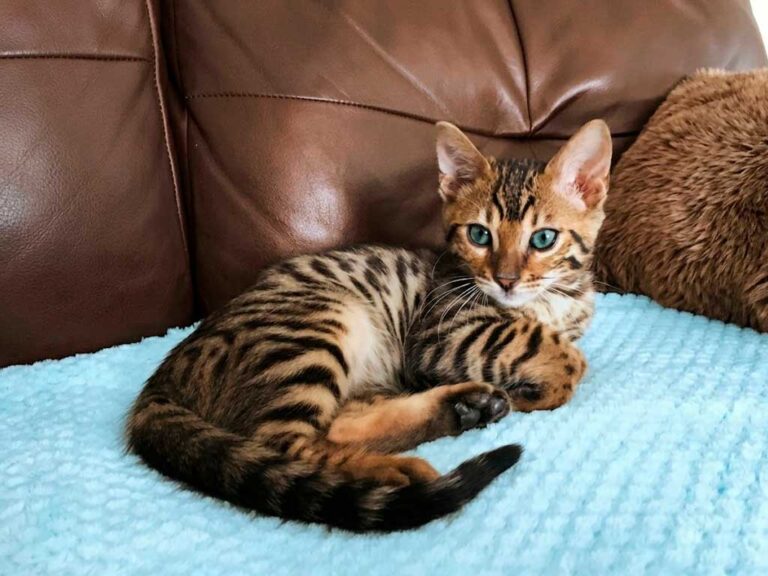
Everything about the Ocicat reads athletic: a large, well-muscled, semi-foreign body with real substance through the chest, built for a powerful, ready-to-pounce impression even at rest. Large, almond-shaped eyes sit at a slight angle, adding to that exotic look.
The spots themselves form where color bands on individual hairs line up — darker “thumbprint” markings against a lighter ground color, arranged in a classic bull’s-eye pattern across the body. Color runs lighter around the eyes, chin, and lower jaw, with the darkest color concentrated at the tip of the tail. Occasionally a full classic tabby pattern shows up in a litter instead of spots; these cats make wonderful pets but aren’t eligible for showing.
Legs run medium in length but carry a solid, substantial feel that supports the lithe, athletic body underneath — nothing about this breed’s structure looks fragile, even at rest.
Personality and Temperament
Your cat isn’t shy about greeting your guests — Ocicats are famously confident and outgoing with strangers, eagerly checking whether a new arrival might be up for a game or willing to offer a lap. Bright and quick to learn, many pick up fetch easily and can be taught to respond to verbal commands, genuinely dog-like in both trainability and enthusiasm.
That same enthusiasm comes with a possessive streak over favorite toys — try to take one away mid-play, and expect a determined game of tug-of-war rather than easy surrender. Full of energy and genuinely powerful, Ocicats leap to high places with real grace, and they adapt quickly to household routines and rules.
This is a deeply social breed, and that’s worth taking seriously: Ocicats genuinely don’t do well left alone for long stretches. A busy, active household — ideally with another pet for company — suits this breed far better than a quiet, empty one.
Vocally, Ocicats tend to be moderate — not silent, not constantly chatty, just willing to make their opinion known when something genuinely matters to them, like an empty food bowl or a toy that’s gone missing.
Caring for an Ocicat
Grooming stays low-maintenance thanks to that short, tight coat. A weekly pass with a rubber brush removes dead hair, and a chamois polish afterward brings out real shine. If you bathe your Ocicat, match the shampoo to the coat: a bronze-tone shampoo works best for brown, chocolate, and cinnamon spotted cats; a pearl-tone shampoo suits blue, lilac, and fawn; and a whitening shampoo brings out the shimmer in silver Ocicats specifically.
Diet doesn’t require anything specialized — any quality commercial cat food works, though the breed committee recommends wet food at least once daily and suggests avoiding fish-based formulas. Keep the water bowl at least three feet from food, since the smell can discourage some cats from drinking enough.
Nail trims and dental care follow standard schedules — nothing breed-specific there, just consistency over what’s typically a long, active life.
Health Conditions to Know
The Ocicat is generally considered a healthy breed. Annual veterinary visits for vaccinations and routine checkups cover most of what this breed needs, along with regular teeth brushing and nail trims.
Health Disclaimer: This guide is for educational purposes only and doesn’t replace professional veterinary advice. Routine wellness exams remain the best way to catch any issue early, regardless of breed.
Finding an Ocicat: Price and Availability
A cat show is a solid way to meet breeders in person, and TICA’s breeder directory is a reliable starting point for a more targeted search. Given the breed’s confident, people-oriented nature, meeting a kitten’s parents in person tends to say a lot about what to expect.
Since a full classic tabby occasionally shows up instead of spots in a litter, ask breeders directly about a specific kitten’s markings if the classic bull’s-eye spotted look is what drew you to the breed in the first place.
Is an Ocicat Right for You?
This breed suits people who want an athletic, genuinely dog-like cat with an exotic look and a confident, social personality. If the idea of a cat that plays fetch, greets guests enthusiastically, and leaps around the house with real power sounds appealing, an Ocicat delivers exactly that.
It’s a poor fit for anyone who’s away from home for long, unpredictable stretches — this breed genuinely struggles with extended isolation. Your cat isn’t going to blend into the background. It’s going to be right in the middle of everything, probably holding one of your socks hostage.
Multi-pet households genuinely play to this breed’s strengths, since Ocicats do well with company of their own kind and with dogs — loneliness, not overcrowding, is the real risk factor here.
One last thing worth knowing before you commit: because this breed genuinely thrives on activity and company, a solo Ocicat in a quiet, low-key household is far more likely to develop mischievous habits than one with a playmate and plenty going on.
Frequently Asked Questions
Is the Ocicat related to ocelots or any wild cat?
No — despite the name and the spotted coat, the Ocicat is entirely domestic, developed from Siamese, Abyssinian, and American Shorthair breeds with zero wild ancestry.
Why is it called an Ocicat if it’s not part ocelot?
The breeder’s daughter thought the first spotted kitten resembled an ocelot and suggested the name. It stuck, even though the breed has no actual wild lineage.
What colors do Ocicats come in?
Brown, chocolate, cinnamon, blue, lilac, and fawn, each also available in a silver version — always in the breed’s signature spotted pattern.
Do Ocicats get along with other pets?
Yes — they typically do well in groups and get along with other cats and dogs, provided personalities and energy levels are a reasonable match.
How much does an Ocicat cost?
Prices vary by color and breeder. Silver variations and rarer colors like lilac or fawn may command a premium over more common brown spotted cats.
An Ocicat exists because a geneticist saw an accident and thought “what if” — and six decades later, that thought experiment produced one of the most convincingly wild-looking, purely domestic breeds in the cat world. Zero ocelot required.
Browse more breed profiles in the full Cat Breeds guide.