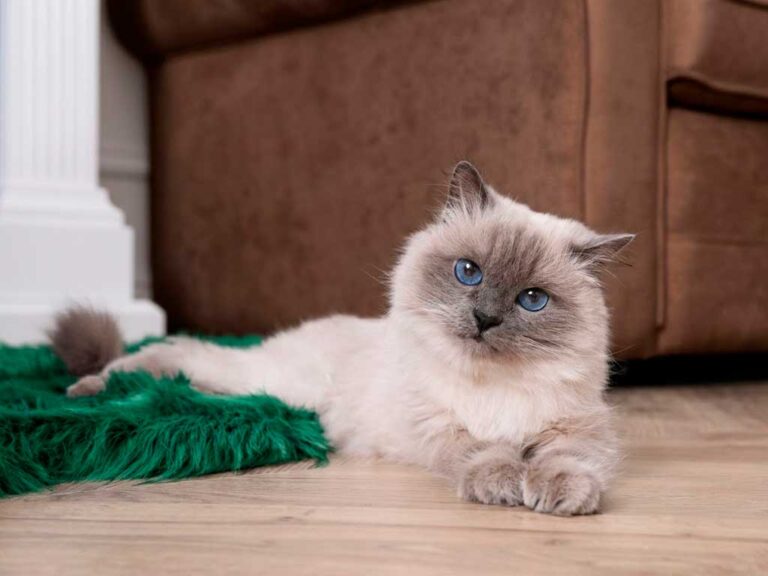
Nebelung Cat: The Breed Named After German Mist

Your cat isn’t actually made of fog — though the Nebelung comes close to looking like it. The name comes straight from the German word “Nebel,” meaning mist, a nod to the shimmering, silver-tipped blue coat that seems to glow faintly whenever the light catches it.
There’s a second layer to that name too. Nebelung also echoes the Nibelungenlied, a medieval Germanic epic poem, and the breed’s two foundation cats were named directly after its characters. Spoiler: this isn’t some ancient breed with a mythical past. It’s barely forty years old, and the whole story is documented down to exact birth years.
Quick Facts: Medium-sized, long body, well-muscled. Silky blue coat with silver-tipped guard hairs. Yellowish-green to green eyes. Lifespan 11-16+ years, sometimes reaching 18.
History: Named After a Dragon Slayer and an Icelandic Queen
Cora Cobb, working under the cattery name Nebelheim, developed the Nebelung starting with a genuinely accidental litter. In 1984, her son Karl’s black domestic shorthair, Elsa, was bred to a longhaired black male resembling an Angora. The litter produced one striking exception: a large, long-legged, long-tailed blue kitten with a medium-length coat. Cora named him Siegfried, after the dragon-slaying hero of the Nibelungenlied.
Five months later, a second litter from the same pairing produced another blue longhair — this time a female, with an even longer, lighter coat. Cora named her Brunhilde, after the Icelandic queen from the same epic poem. Siegfried and Brunhilde became the breed’s foundation pair, producing their first litter together in 1986.
With guidance from geneticist Dr. Solveig Pflueger, Cora applied to TICA for New Breed status in 1987. Breeders designated the Russian Blue as an approved outcross to widen the gene pool, and a fortunate coincidence helped: a redevelopment of the Russian Blue breed around the same time brought in new foundation cats that happened to carry the longhair gene, providing valuable bloodlines for the still-young Nebelung. TICA granted the breed full championship status in 1997.
This breed has quietly made a few pop-culture appearances too — Nebelungs have been featured on Animal Planet’s Cats 101 and shown up on screen in the 2004 film Garden State, small but real recognition for such a young breed.
Nebelung vs. Russian Blue: Close Cousins, Different Coats
These two breeds are genuinely close relatives rather than just look-alikes — the Russian Blue served as the Nebelung’s approved outcross throughout its development. The core difference comes down to coat: the Russian Blue carries a short, dense, plush coat, while the Nebelung’s medium-length fur is silkier and drapes rather than standing out from the body, with those distinctive silver-tipped guard hairs giving it a shimmering, misty quality the Russian Blue’s coat doesn’t have.
Temperament overlaps heavily too — both breeds run reserved with strangers and deeply devoted to their own families, a trait that traces directly back to their shared bloodlines.
Physical Characteristics
Everything about the Nebelung’s build reads elegant rather than delicate: a long, sturdy, well-muscled body, a long tail carrying a full, graceful plume, and large ears in proportion to the head that continue the head’s elegant lines. Wide-set eyes range from yellowish-green to true green, giving the face an intelligent, appraising look.
Only one color is recognized: blue with silver tips, a combination that creates a genuinely luminous effect as the cat moves through changing light.
That silver tipping is genuinely central to the breed standard — too little and the coat just reads as plain blue; too much and it loses the deep base color underneath. Breeders work carefully to keep that balance consistent from litter to litter.
Personality and Temperament
Your cat isn’t hiding from your guests out of unfriendliness — a Nebelung genuinely prefers the quiet, predictable company of its own family over unfamiliar faces, and it’s not unusual for one to vanish entirely when visitors arrive. Give a new Nebelung real time to adjust to a new home, and let it approach you on its own schedule rather than the other way around.
Once settled in, this breed becomes a devoted, playful companion — genuinely fond of retrieving games, jumping, and climbing to a high vantage point where it can study a new person or situation before deciding whether to get involved. Nebelungs follow their people from room to room and enjoy real affection, but they’re not needy: most handle a day home alone without any trouble, which makes the breed a solid fit for apartment living.
Highly intelligent and playful throughout life, a Nebelung does best in a stable, low-drama household — this isn’t a breed that adapts easily to constant change or a revolving door of visitors.
Caring for a Nebelung
That medium-length coat is genuinely dense, so regular combing is a real requirement rather than an occasional nicety — skipping it invites tangles and mats. Weekly attention also matters for the eyes (a soft, damp cloth wiped gently, using a separate section for each eye) and the ears, cleaned as needed with a vet-approved solution rather than cotton swabs.
Some Nebelungs can be genuinely picky eaters — worth knowing before you settle on a food, since once they find something they like, overeating and weight gain can follow. Round out care with weekly tooth brushing and nail trims every couple of weeks.
Diet needs are otherwise standard for the breed’s size and activity level, and interactive feeding toys can help slow down a cat that’s found a favorite food and gotten a little too enthusiastic about it.
Health Conditions to Know
As a relatively young, natural breed, the Nebelung is generally considered healthy, and it’s notably long-lived — reaching 18 years old isn’t unusual with good care. No widely documented breed-specific genetic conditions have been identified so far.
Health Disclaimer: This guide is for educational purposes only and doesn’t replace professional veterinary advice. Routine wellness exams remain the best way to catch any issue early, regardless of breed.
Because the breed remains genuinely young, ongoing observation across more generations will continue to shape what’s known about its long-term health — part of why choosing a breeder who stays current on the latest findings matters.
Finding a Nebelung: Price and Availability
This remains a genuinely rare breed. A cat show is a solid way to connect with a breeder, and TICA’s breeder directory is worth checking directly given how few dedicated Nebelung breeders exist relative to more established breeds.
Given the breed’s shared bloodlines with the Russian Blue, some breeders work with both, which can be a useful starting point if a dedicated Nebelung breeder isn’t easy to find nearby.
Is a Nebelung Right for You?
This breed suits people who want a calm, devoted, intelligent cat and are willing to give a new arrival real time to settle in on its own terms. If the idea of a quiet, misty-coated companion that follows you room to room but doesn’t mind an occasional day alone sounds appealing, a Nebelung delivers exactly that.
It’s a tougher fit for households that entertain often or expect an instantly outgoing cat with every visitor. Your cat isn’t going to greet strangers at the door. It’s going to watch from somewhere quiet, decide in its own time, and then, eventually, come find you.
Apartment living genuinely suits this breed well, given how comfortably it handles being home alone — a stable routine and a quiet environment matter far more to a Nebelung than square footage.
One last thing worth knowing before you commit: because the breed is still so new, don’t expect widespread name recognition — most people meeting a Nebelung for the first time will assume it’s simply a striking longhaired Russian Blue, and honestly, that’s not far off.
Frequently Asked Questions
What does “Nebelung” mean?
It comes from the German word “Nebel,” meaning mist or fog, referencing the breed’s shimmering silver-tipped blue coat. It also echoes the Nibelungenlied, the medieval poem that inspired the names of the breed’s two foundation cats.
Is the Nebelung the same as a Russian Blue?
No, though they’re closely related — the Russian Blue served as an approved outcross during the Nebelung’s development. The main difference is coat: short and plush on the Russian Blue, longer and silkier with silver tipping on the Nebelung.
Are Nebelung cats good with strangers?
Not typically at first. They tend to be shy or reserved around unfamiliar people, sometimes hiding entirely during visits, though they’re deeply affectionate with their own family.
How long do Nebelung cats live?
Typically 11 to 16 years or more, with some reaching 18 — a notably long lifespan for a cat breed.
How much does a Nebelung cat cost?
Prices vary, but expect a premium and a real search given how rare the breed remains, even at TICA-affiliated shows.
A Nebelung cat carries an epic poem in its name and a genuinely misty shimmer in its coat, wrapped around a personality that takes its time but never wavers once it’s given. Barely forty years into existence, this is a breed still writing its own quiet chapter in the cat fancy.
Browse more breed profiles in the full Cat Breeds guide.