Javanese Cat: The Colorful Cousin of the Balinese
Your cat isn’t from Indonesia — the Javanese cat has never set paw on the island its name references. Like several breeds in this Siamese-descended family, the name is pure geography-flavored branding rather than an actual origin story.
What it does have is a genuine reason to exist: a specific color palette its longhaired cousin, the Balinese, isn’t allowed to carry. Spoiler: this breed was built almost entirely around a registry technicality — and it turned into one of the most vividly colored cats in the Siamese family tree.
Quick Facts: Medium-sized, long tubular body, more muscular than the Balinese or Siamese despite a slender frame. Males 8-12 lbs, females under 8 lbs. Lifespan similar to the Balinese, often 12-16 years. Vivid eyes in blue or green.
History: Built to Solve a Color Problem
The Javanese is a man-made American breed, created by crossing the Balinese with the Colorpoint Shorthair — itself a cross between Siamese and American Shorthair developed to introduce new colors into the Siamese line. The result looked unmistakably Siamese in build, but carried longer fur and a color range the Balinese standard didn’t recognize.
As covered in our Balinese cat guide, CFA restricts the Balinese to four traditional pointed colors: seal, blue, chocolate, and lilac. Any longhaired cat from this family showing up in red, cream, tortoiseshell, tabby point, or similar newer colors gets registered as a Javanese instead — genetically almost identical, just carrying a different color card.
That layered ancestry — Siamese crossed into American Shorthair, then crossed again into Balinese — gives the Javanese a slightly broader genetic base than a breed built from a single foundation pair, which tends to work in its favor health-wise.
Both TICA and CFA recognize the breed today, though exact color classification rules can differ slightly between registries — one more reason to confirm details directly with a breeder rather than assuming every registry draws the line in the same place.
Physical Characteristics
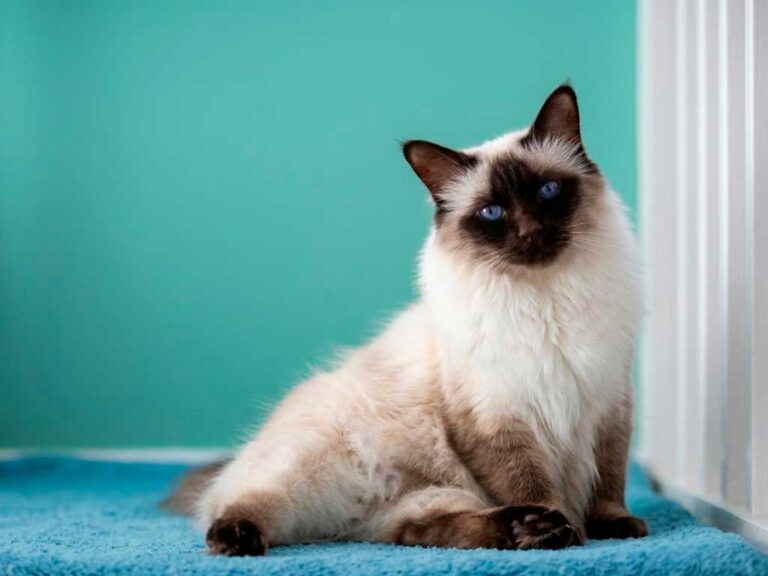
The body reads long and tubular, fine-boned but noticeably more muscular than either the Balinese or the Siamese despite the slender silhouette. The head forms a long triangle, and wide-set ears echo that same triangular shape when viewed head-on.
Coat color covers real ground: red, cream, seal, chocolate, blue, lilac, blue-cream, and lilac-cream, plus tabby and tortie point variations depending on registry. Eyes run blue or green, vivid enough to match the intensity of the coat.
Kittens are born pale and develop their full point color gradually over the first year or two — the same delayed reveal seen across the whole Siamese-descended family, so don’t judge a kitten’s final shade too early.
Whiskers and eyebrows follow the same rich point coloring as the rest of the face, adding to the vivid, high-contrast look this breed is known for compared to its more muted-color Balinese cousin.
Javanese vs. Balinese vs. Colorpoint Shorthair: The Whole Family
Three closely related breeds, three different distinguishing traits: the Balinese is longhaired in the traditional four Siamese colors; the Javanese is longhaired in everything else; the Colorpoint Shorthair is the short-coated version carrying those same newer colors. Temperament and care needs stay essentially identical across all three — the differences are almost entirely about coat length and color classification.
Personality and Temperament
Your cat isn’t just active — it’s going to claim the tallest surface in the house as personal property, whether or not you’ve provided one. Javanese cats are vocal and energetic, true to their oriental heritage, and a cat tree or high perch isn’t optional so much as a genuine requirement. Without one, expect the top of the refrigerator, bookcase, or door frame to become the default option.
That slender frame hides real jumping power — these cats clear impressive heights with apparent ease. Despite the constant motion, Javanese cats are also genuinely affectionate, happy to settle in for a quiet lap session, purring contentedly between bursts of activity.
Weight management deserves attention given the high energy this breed burns through naturally — with enough space and exercise, most Javanese cats stay lean without much extra effort from their owners.
Vocally, expect a running commentary throughout the day — this breed shares the Siamese family’s talkative streak, offering opinions on meal timing, closed doors, and pretty much anything else worth mentioning.
Caring for a Javanese
Grooming stays easy despite the longer coat, since — like the Balinese — the Javanese carries a single coat with no real undercoat. A weekly combing session controls shedding and keeps the coat’s natural sheen intact, with mats rarely becoming a real issue.
Vertical space matters as much as grooming here. Tall cat trees, wall-mounted perches, and secured high shelving give this breed the climbing and jumping outlet it genuinely needs to stay content and out of less convenient trouble.
Diet needs are standard for the breed’s size and activity level, though the high energy this breed carries means portion control matters less here than it might for a more sedentary cat — just keep an eye on body condition as your cat ages and slows down.
Nail trims, ear checks, and dental care round out the routine on a standard schedule — nothing breed-specific there, just consistency over what’s typically a long, energetic life.
Health Conditions to Know
As a close genetic relative of the Balinese and Siamese, the Javanese shares similar health considerations. Watch for signs of amyloidosis, a protein buildup that can affect the liver in Asian-lineage breeds, and progressive retinal atrophy, a genetic condition causing gradual vision loss. This breed also tends to run more sensitive to anesthesia than average, worth mentioning to your vet ahead of any procedure.
Dental disease is worth watching too, as it is for every breed — not specific to the Javanese, but easy to overlook amid the more distinctive health considerations covered above.
Health Disclaimer: This guide is for educational purposes only and doesn’t replace professional veterinary advice. Ask breeders about PRA and amyloidosis history in their lines, and flag anesthesia sensitivity to your vet before any surgical procedure.
Finding a Javanese: Price and Availability
This remains a genuinely rare breed, even more so than the Balinese it descends from. Expect a real search and a wait for a kitten, particularly if you’re set on a specific color.
Because so few breeders specialize specifically in Javanese rather than Balinese, a breeder who works with the whole family — Balinese, Javanese, and Colorpoint Shorthair together — is often the most practical way to track one down.
Given the layered breeding history behind this cat, a pedigree that clearly documents the Balinese and Colorpoint Shorthair lines behind a kitten is a good sign of a breeder who genuinely understands the family they’re working with.
Is a Javanese Right for You?
This breed suits people who want a vocal, athletic, genuinely engaged cat and are prepared to provide serious vertical space to climb. If the idea of a cat that scales the bookcase, then curls up purring on your lap ten minutes later sounds appealing, a Javanese delivers exactly that.
It’s a tougher fit for anyone wanting a quiet, low-energy cat or a household without room for tall cat furniture. Your cat isn’t going to stay on the ground. It’s going to find the highest point in every room, and it’s going to want you to notice.
Households with kids or other pets tend to do well too, given how social and interactive this breed stays throughout its life — just make sure any climbing structures are secured and stable enough for enthusiastic use.
One more thing worth flagging before you commit: since coat color drives so much of what makes a Javanese distinct from a Balinese, ask breeders directly how they classify their kittens — registry rules on this vary, and it affects both price and show eligibility.
Frequently Asked Questions
Is a Javanese cat the same as a Balinese?
They’re extremely closely related — same body type, same longhaired coat over Siamese-style ancestry — but the Javanese carries colors outside the Balinese’s traditional four, like red, cream, and tortoiseshell point.
Why is it called a Javanese cat if it’s not from Java?
The name follows a naming convention used across the Siamese-descended family, referencing Southeast Asian geography without indicating actual origin. The breed was developed entirely in the United States.
Are Javanese cats good jumpers?
Yes — despite a slender build, they’re powerful jumpers capable of reaching the tops of refrigerators, bookcases, and doorframes with ease.
How much does a Javanese cat cost?
Prices vary, but expect a premium and a real wait given how rare the breed remains, even rarer than the Balinese.
What health problems are Javanese cats prone to?
Similar to the Balinese and Siamese: amyloidosis, progressive retinal atrophy, and above-average anesthesia sensitivity are the main considerations.
A Javanese cat exists because a color chart didn’t have room for it anywhere else — and that technicality produced one of the most vividly colored, endlessly airborne members of the entire Siamese family. Give it height to climb and company to purr next to, and this breed has everything it needs.
Browse more breed profiles in the full Cat Breeds guide.