Maine Coon Cat: The Complete Guide to America’s Gentle Giant
Your cat isn’t part raccoon — despite the name, despite the bushy ringed-looking tail, despite generations of people swearing otherwise. The Maine Coon is entirely, biologically a domestic cat. It just happens to be the largest one most people will ever meet.
This is the breed that holds the world record for longest domestic cat ever measured, the unofficial title of America’s oldest natural breed, and a reputation as one of the most good-natured, dog-like cats in existence. Spoiler: none of that is exaggeration. Here’s everything worth knowing before — or after — you bring one home.
Quick Facts: Males 6-10 kg (13-22 lbs), females 4-7 kg (9-15 lbs). Doesn’t reach full size until 3-5 years old. Semi-long, water-resistant double coat. Lifespan typically 12-15 years. Largest domestic cat breed in the world.
History: Raccoons, Marie Antoinette, and New England Winters
The Maine Coon is widely considered native to the state of Maine, but exactly how it got there has never been definitively documented — and the subject remains genuinely controversial among historians. The most persistent myth, though biologically impossible, claims the breed descends from domestic cats mating with raccoons. That belief, paired with the cat’s ringed, bushy tail, is likely where the “coon” half of the name comes from in the first place.
A second popular legend credits Marie Antoinette, claiming the breed descends from six of her cats sent ahead to Wiscasset, Maine, as she planned an escape from France during the Revolution. It’s a wonderful story. It’s also almost certainly not true.
Most breed historians today favor a far less dramatic explanation: the Maine Coon developed from matings between short-haired domestic cats already established in early America and longer-haired cats brought over by European settlers and traders. Natural selection did the rest, favoring the large, muscular, densely-coated cats that could actually survive New England’s brutal winters.
Whatever the true origin, the Maine Coon is one of the oldest natural breeds in North America, and it was a genuine star of the earliest American cat shows. A brown tabby female named Cosie won Best Cat at the Madison Square Garden show in 1895 — one of the first major cat shows ever held in the U.S., predating most of the pedigreed breeds covered elsewhere in this cluster by decades.
World Record Size: Just How Big Does a Maine Coon Get?
This is, without exaggeration, the largest domestic cat breed on the planet, and several Maine Coons have held official Guinness World Records to prove it. Mymains Stewart Gilligan — “Stewie” — measured 48.5 inches (123 cm) from nose to tail when verified in 2010, making him the longest domestic cat ever officially recorded. Stewie was also a certified therapy cat who visited hospitals and senior centers before passing away in 2013.
The current record for longest living domestic cat belongs to Barivel, an Italian Maine Coon measuring 47.2 inches (120 cm), verified in 2018. Before Barivel, the UK’s Ludo held the title at 46.6 inches. And Maine Coons don’t just win on length — cats named Cygnus and later Pugsley have separately held the world record for longest tail on a living domestic cat, with Pugsley’s stretching past 18 inches.
Typical Maine Coons don’t reach those record-breaking extremes, of course, but even an average adult male commonly weighs 13-22 lbs with a body length that dwarfs most other breeds. Part of that impression comes from the coat itself — all that fluff can make a Maine Coon look even larger than the solid, muscular body underneath already is.
Physical Characteristics
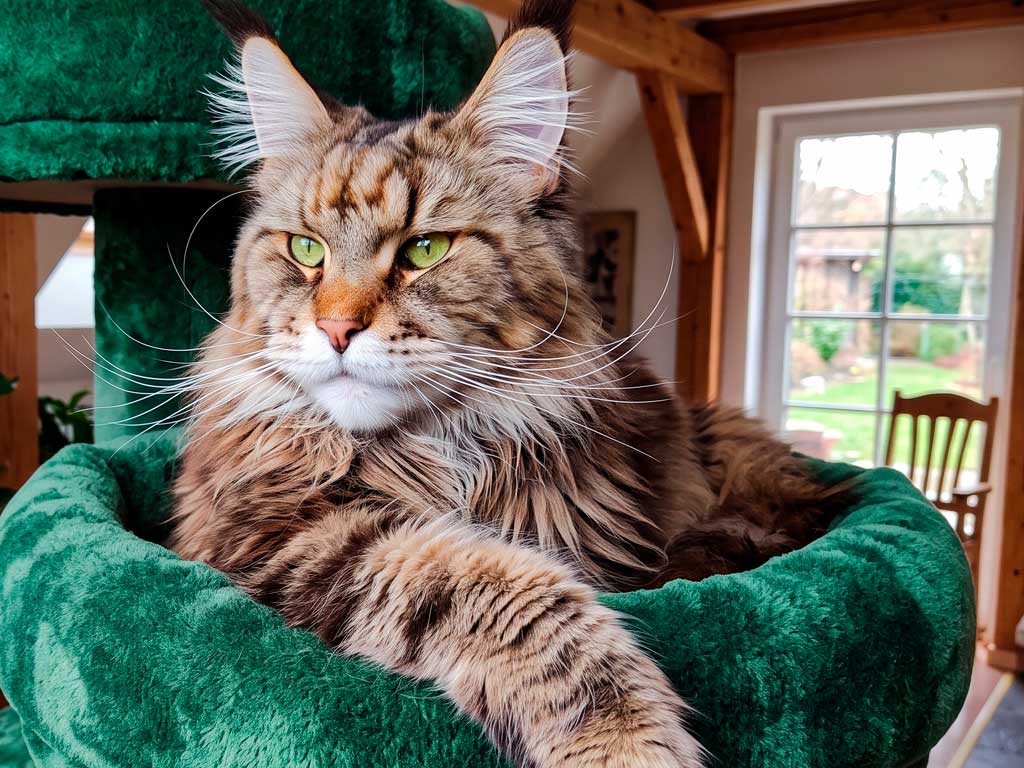
Everything about a Maine Coon’s build says survival gear. The head is large with a square-ish muzzle, and the ears are tall, heavily tufted, and pointed — often compared to a lynx’s. Many Maine Coons carry a distinct “M” marking on the forehead, especially visible on tabby-patterned cats.
The coat is genuinely built for weather: a soft, fine undercoat topped by a longer, silky, water-resistant outer layer that sheds moisture rather than soaking it up. A long, extremely bushy tail doubles as a built-in scarf, which Maine Coons will wrap around themselves for extra insulation in cold conditions. Large, tufted paws function almost like natural snowshoes, spreading weight over soft or icy ground.
Growth is famously slow for this breed. Most cats reach adult size by 12-18 months; Maine Coons typically don’t finish filling out until somewhere between 3 and 5 years old, which is part of why the breed’s imposing size takes people by surprise.
Coat Colors and Patterns: A Genuinely Huge Range
Few breeds offer the color variety a Maine Coon does. Brown tabby remains the most iconic and historically dominant look, but the breed is recognized in nearly every color and pattern combination — solid black, solid white, red (often called orange), blue, cream, silver, smoke, tortoiseshell, calico, and tuxedo bicolor patterns all show up regularly.
Black smoke Maine Coons carry a striking effect where the undercoat is pale white or silver while the tips of each hair carry the darker color, creating a shifting, shadowy look as the cat moves. White Maine Coons, like most solid-white cats, can carry a somewhat higher risk of hearing-related issues tied to the white coat gene, similar to what’s covered in our Khao Manee guide. Whatever the specific color, none of it affects temperament — a Maine Coon’s personality stays consistent across the entire color spectrum.
Personality and Temperament
Your cat isn’t demanding your attention every five minutes — a Maine Coon is famously people-oriented without being clingy. It won’t pester you constantly, but it wants to know where you are, and it will genuinely change rooms when you do, every single time, just to stay in the loop.
Unlike breeds that live for vertical space, Maine Coons tend to be more interested in what’s happening on the ground than up on a shelf. They stay playful and curious for life, often investigating anything their owners are doing rather than sleeping through it. Vocally, this breed rarely meows in the traditional sense — most communicate through a distinctive soft chirp or trill that sounds almost comically gentle coming from such a large cat.
Despite that imposing size, Maine Coons are famous for being clumsy. Many misjudge jumps and distances, especially given their bulk, which only adds to a playful personality that never really outgrows kittenhood. Patient and easygoing, this breed does especially well with children and typically gets along comfortably with dogs and other cats — a genuine family cat in nearly every sense of the word.
Caring for a Maine Coon
Despite the medium-to-long coat, grooming stays surprisingly manageable — Maine Coon fur doesn’t mat as readily as a Persian’s or other true long-haired breeds. A weekly session with a metal comb prevents tangles and keeps shedding under control, and most cats genuinely enjoy the one-on-one attention.
Exercise matters more for this breed than people expect, given its size and tendency toward weight gain once fully grown. Aim for roughly 20-60 minutes of activity a day, broken into shorter 10-minute play sessions rather than one long stretch — wand toys, crinkled paper, or anything that triggers that hunting instinct works well. Positive-reinforcement training, including clicker training, tends to go over well given this breed’s intelligence and patience.
Diet should scale with life stage. Maine Coon kittens grow unusually fast — a 3-month-old kitten can weigh close to double what a same-age kitten of another breed weighs — so kitten-specific nutrition during that long growth window matters. Adult diets should support joint health given the size and weight this frame carries, along with heart-supportive nutrients given the breed’s cardiac risk covered below.
Health Conditions to Know
Maine Coons are generally healthy, but their size brings a few predictable risks. The most serious is hypertrophic cardiomyopathy (HCM), a thickening of the heart muscle that can be genetic or linked to diet. Regular chest X-rays and echocardiograms help catch it early, and a DNA test exists to screen for one of the genetic mutations associated with the condition in this breed specifically.
Hip dysplasia is a real concern given the breed’s size and muscle mass — one genetic study found radiographic evidence of dysplasia in up to 51% of Maine Coons studied. Responsible breeders screen breeding cats to avoid pairing two carriers. Spinal muscular atrophy (SMA), a genetic condition affecting muscle control in the hind legs, is also specific to this breed, and a DNA test is available to identify carriers before breeding.
Weight management deserves ongoing attention throughout adulthood, since extra pounds on an already large frame add real strain to joints and the heart alike.
Health Disclaimer: This guide is for educational purposes only and doesn’t replace professional veterinary advice. Ask breeders for HCM, hip dysplasia, and SMA screening results on both parents, and keep up with regular cardiac monitoring as your Maine Coon ages.
Buying, Adopting, and Pricing a Maine Coon
Given how popular this breed is, kittens from registered breeders are widely available, with prices varying significantly by lineage, color, and region — expect a real range depending on how specialized the breeder’s lines are. Because Maine Coons are also one of the most commonly surrendered pedigreed breeds simply due to sheer popularity, rescue organizations and breed-specific Maine Coon rescues are genuinely worth checking before committing to a breeder waitlist, especially if you’re open to an adult cat rather than a kitten.
Whichever route you choose, ask directly about HCM and hip screening — it matters just as much for a rescue’s medical history as it does for a breeder’s pedigree.
Is a Maine Coon Right for You?
This breed suits people who want a genuinely large, dog-like, family-friendly cat that follows them from room to room without being needy about it. If the idea of a gentle giant that chirps instead of meows, tolerates kids and dogs with real patience, and somehow stays a kitten at heart well into adulthood sounds appealing, a Maine Coon delivers exactly that.
It’s a tougher fit for anyone in a small space unprepared for a genuinely large cat, or unwilling to commit to the joint- and heart-conscious care this breed’s size calls for. Your cat isn’t going to be subtle about its presence. It’s going to fill the room, physically and otherwise, and most owners wouldn’t have it any other way.
Frequently Asked Questions
Are Maine Coons part raccoon?
No — that’s a persistent myth and biologically impossible. The nickname likely comes from the breed’s ringed, bushy tail resembling a raccoon’s, not any actual ancestry.
How big do Maine Coons get?
Males typically weigh 13-22 lbs and females 9-15 lbs, with the breed not reaching full size until 3-5 years old. The record for longest domestic cat ever, held by a Maine Coon named Stewie, measured 48.5 inches nose to tail.
Do Maine Coons meow like other cats?
Rarely. Most communicate through a distinctive soft chirp or trill rather than a traditional meow, which many owners find surprisingly gentle for such a large cat.
What health problems are Maine Coons prone to?
The main concerns are hypertrophic cardiomyopathy (HCM), hip dysplasia, and spinal muscular atrophy (SMA). DNA and imaging tests exist for screening breeding cats for all three.
How much does a Maine Coon cost?
Prices vary widely by breeder, lineage, and color. Rescue and adoption is also a realistic option given how commonly this popular breed is surrendered.
Are Maine Coons good with kids and other pets?
Yes — they’re known for being especially patient and gentle with children, and typically get along well with dogs and other cats.
A Maine Coon carries more than a century of New England history in its oversized paws, and it wears its world-record size with a gentleness that never quite matches expectations. Once you understand that this breed is built for both blizzards and belly rubs, it’s easy to see why it’s stayed America’s favorite giant for well over a hundred years.
Browse more breed profiles in the full Cat Breeds guide.