Indian Almond Leaves for Aquariums: Guide to The 7 Major Benefits & Usage
Indian almond leaves are one of the most powerful natural tools for aquarium health. Whether you’re battling fish fungus, looking to breed fish safely, or creating a thriving shrimp tank, these leaves deliver results that expensive treatments can’t match.
Here’s what makes them special: They release tannins that prevent fungal infections on eggs, create a natural pH buffer, and produce food for tiny fry all while improving water quality. In fact, professional fish breeders across Asia rely on them as a cornerstone of their breeding protocols.
In this guide, I’ll walk you through exactly how to use Indian almond leaves, what benefits to expect, and the one critical mistake most aquarists make when using them.
What Are Indian Almond Leaves? Origin & Characteristics
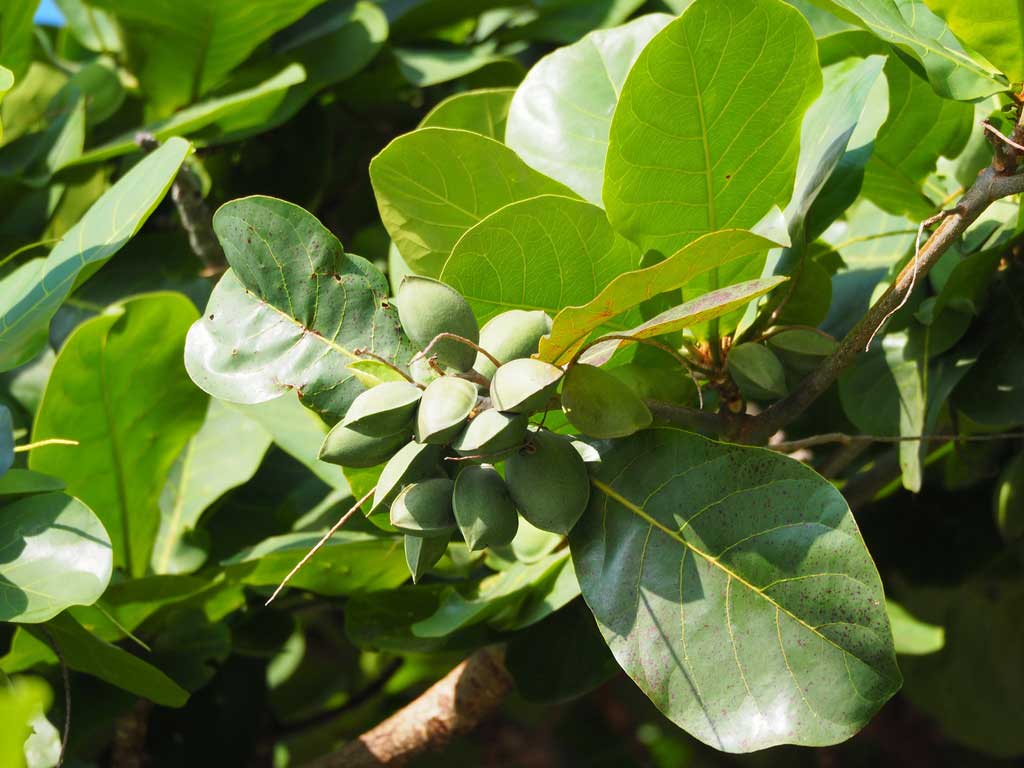
The Indian almond leaf comes from the Terminalia catappa tree, a tropical species native to Asia. When leaves fall naturally and dry completely, they become aquarium gold.
These aren’t random dried leaves. They contain specific compounds tannins, antioxidants, and antimicrobial substances that were literally designed by nature to preserve plant material and fight infection.
When you add a dried Indian almond leaf to your aquarium, it releases these compounds into the water column over several days. The result? Your aquarium becomes a more stable, healthier ecosystem.
The scientific name matters here: Terminalia catappa. If you’re buying leaves online, look for that exact species. Many sellers offer generic “almond leaves,” but Terminalia catappa is the species proven to work.
The 7 Major Benefits of Indian Almond Leaves
1. Antifungal Protection (The Egg Saver)
Fish eggs are fragile. In just 24 hours, a white fungus can cover them completely, killing the entire spawn.
Here’s why this happens: High organic loads, poor circulation, and light stress create perfect conditions for fungal blooms. One infected egg infects the whole batch.
Indian almond leaves prevent this. The compounds released actively kill fungal spores before they attack eggs.
This is why breeders use them religiously. If you’re breeding tetras, barbs, discus, or dwarf cichlids, these leaves protect your most vulnerable investment: the eggs.
In practice, breeders who add Indian almond leaves to spawning tanks consistently report fewer fungus-covered clutches compared to bare breeding setups, since the antifungal compounds reach the eggs before spores can establish. Results vary by species and tank conditions, so treat this as a strong supporting tool rather than a guarantee.
2. Antibacterial Benefits (Infection Control)
Fungus gets all the attention, but bacterial infections are just as dangerous.
Fin rot starts as tiny red streaks on fins. Without intervention, it spreads and kills the fish. Other bacterial infections cloud eyes, cause gill problems, and create open sores.
Indian almond leaves aren’t a cure they’re prevention. The antimicrobial compounds inhibit bacterial growth before infections establish themselves.
Many aquarists use them in isolation tanks for sick fish, combined with proper medication. The leaf gives your treatment a natural boost.
3. Heavy Metal Precipitation & Water Conditioning
Your tap water contains dissolved metals: iron, copper, zinc, lead. Most times they’re below toxic levels, but they accumulate.
The tannins in Indian almond leaves bind to these metals and pull them out of the water column a process called precipitation.
This is particularly important for sensitive species like Crystal Red Shrimp or Discus. These animals notice water quality changes that other fish ignore.
By adding one leaf every two weeks, you’re running an invisible filtration system that catches what your mechanical filter can’t see.
4. Tannins & Antioxidant Properties (Cellular Health)
Tannins are powerful antioxidants. Your fish encounter oxidative stress from transport, water changes, and spawning.
Tannins reduce that stress at the cellular level.
Think of it like this: Your fish are under constant low-grade stress in captivity. Antioxidants are the repair crews that fix the damage before it becomes a health crisis.
Wild fish live in “tannic” water (tea-colored rivers in the Amazon) naturally. You’re recreating that condition when you add these leaves.
5. Stress Reduction Through Natural Shading (The “Tea Effect”)
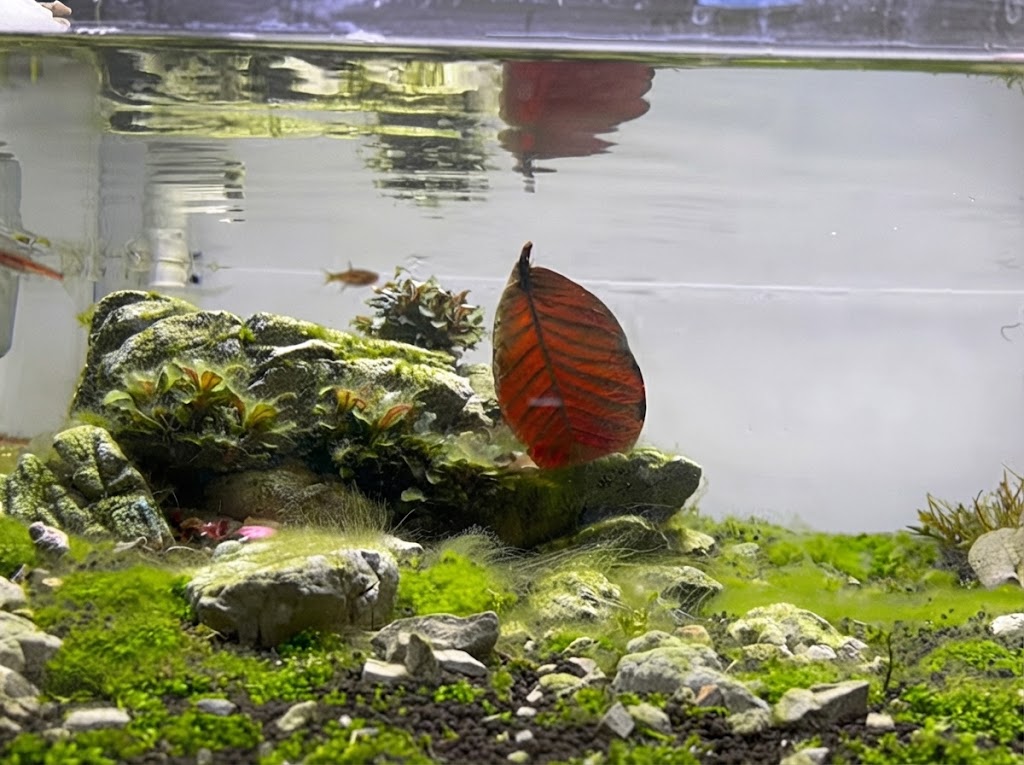
When Indian almond leaves release tannins, the water takes on a light amber tint. Aquarists call it the “tea effect.”
This isn’t just cosmetic. The subtle color change reduces light intensity, creating a calmer environment.
New fish are notoriously shy. They hide, stop eating, and develop stress diseases. With the tea tint present, they acclimate faster and become bolder within days.
This works for sensitive species especially: Angel fish, rams, discus—these fish evolved in shaded forest environments where sunlight barely penetrates. The amber water mimics their natural habitat.
6. Natural pH Reduction (Perfect for Soft-Water Species)
Lowering pH is notoriously difficult without chemicals or complex equipment.
Indian almond leaves do it naturally. They release compounds that gently acidify the water, dropping pH by 0.3–0.5 points depending on leaf quantity.
For aquarists keeping soft-water nano species, barbs, dwarf cichlids, or shrimp, this is a game-changer. Instead of using expensive pH-lowering chemicals that require constant monitoring, you add a leaf and let nature handle it.
One warning: If your tank needs high pH (African cichlids from Malawi or Tanganyika), these leaves work against you. Test before adding.
7. Shrimp Food & Microfauna Explosion (The Hidden Benefit)
When an Indian almond leaf sits in water for 3–4 days, it becomes soft and edible. Shrimp attack it immediately.
But that’s not the real benefit.
As the leaf breaks down, bacteria and microorganisms colonize its surface. This creates infusoria tiny organisms that newly-hatched fry and shrimplets eat greedily.
In shrimp tanks, one leaf can feed your colony for weeks while improving water quality. No expensive powdered foods needed.
The Downsides (Honest Truth)
I won’t pretend Indian almond leaves are perfect. They have real drawbacks.
Water Discoloration
The amber tint isn’t for everyone. If you run a planted tank with high-intensity lighting and want crystal-clear water, these leaves will disappoint you.
Some aquarists see it as a dealbreaker. Others love the “natural forest river” aesthetic.
The fix: Use fewer leaves or replace them less frequently. You can dial in the tint to your preference.
Unwanted pH Drops
In alkaline systems (African cichlids, hard water tanks), the acidifying effect becomes a problem.
You add leaves, pH drops, fish stress. That’s a losing trade.
Always know your target pH range before using these leaves.
Cost (Regional Issue)
Where the Terminalia catappa doesn’t grow naturally, you pay for imported leaves.
A single leaf costs $0.50–$2.00 depending on your region. If you run 10 tanks, that adds up.
The workaround: Buy in bulk online or find local aquarium clubs where hobbyists share or trade leaves.
Decomposition & Tank Debris
Over 2–3 weeks, the leaf degrades. Shrimp eat the soft parts, leaving only the skeletal veins. These eventually disintegrate into fine particles.
If your tank has heavy bioload, this extra organic matter can spike ammonia temporarily.
Solution: Remove the leaf skeleton once it’s mostly consumed. Replace weekly or every two weeks based on tank bioload.
Dosage: How Many Leaves Do You Actually Need?
This is where most aquarists fail. They either use too many (darkening the water excessively) or too few (getting no benefit).
The baseline formula:
- 1 medium leaf per 10–15 liters of water
A “medium” leaf is roughly the size of your palm. Adjust for leaf size:
- Small leaf (fingertip size) = 5 liters
- Large leaf (hand-sized or bigger) = 20+ liters
But this isn’t a hard rule. Your actual dosage depends on:
Tank bioload: Heavy-stocked tanks metabolize the leaf faster Filter strength: Mechanical filtration removes tannins, so you might need more Target effect: Want strong tint and low pH? Use more. Want subtle effects? Use less.
The monitoring trick: Add one leaf, observe for 3 days, and adjust. If water barely tints, add another. If it’s dark brown, remove one.
Best Practices for Using Indian Almond Leaves
Preparation
Don’t just drop leaves in. Rinse them first under running water to remove dust and debris. Many come from storage with fine particles attached.
Soak the leaf in a separate container for 24 hours before adding to your main tank. This allows initial tannin release to happen outside your aquarium, giving you control.
Placement
Place the leaf in a moderate-flow area of your tank. Heavy flow breaks it apart too quickly; dead spots mean uneven tannin distribution.
For breeding tanks, place it near the spawning site but not directly on eggs.
Replacement Schedule
Monitor this:
- Days 0-3: Full tannin release, visible water tint
- Days 3-7: Tannins stabilize, shrimp begin feeding
- Days 7-14: Leaf noticeably soft, mostly skeleton visible
- Days 14+: Remove and replace
Some tanks need weekly changes, others every two weeks. Your pH test kit tells the truth if pH stabilizes at your target, you’re good.
Water Changes & pH Monitoring
Test pH every 3 days when you first add leaves. This reveals the acidification rate in your specific tank.
If pH drops too fast, either reduce leaf quantity or increase water change frequency.
Ideal Tank Types for Indian Almond Leaves
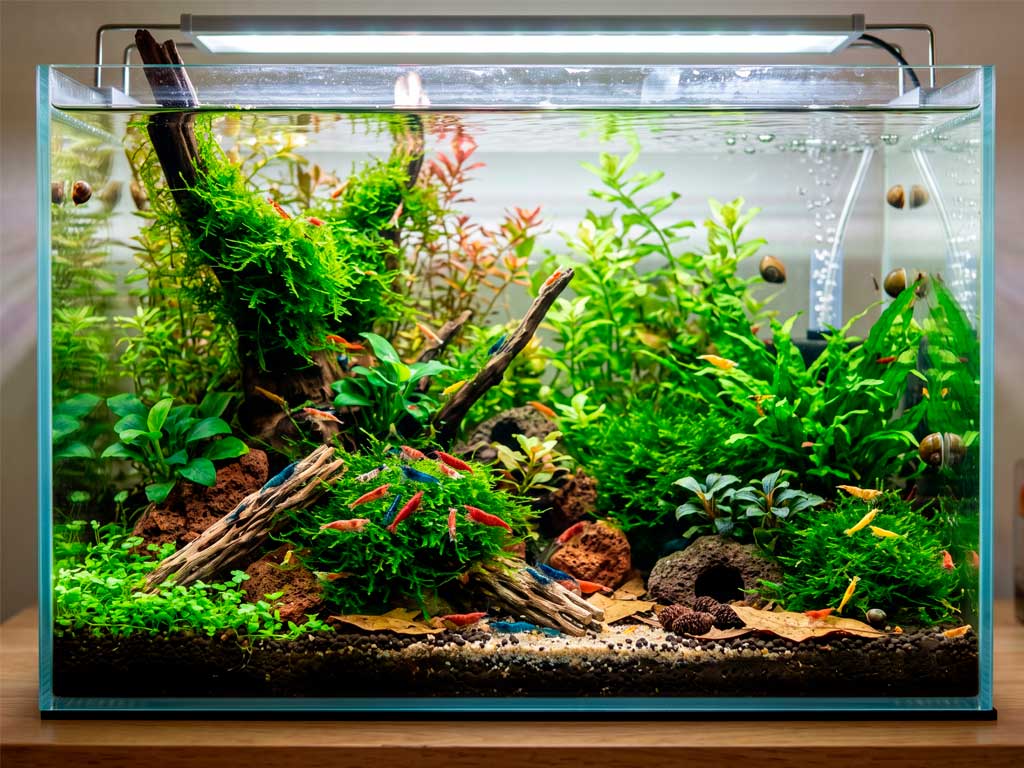
Shrimp Tanks (Perfect Match)
This is where these leaves shine. Shrimp naturally live in acidic, tannic-rich water, the same conditions covered in our shrimp-safe aquarium guide. The leaves provide:
- Slightly acidic pH (shrimp love 6.0–6.8)
- Natural food source
- Microfauna production
- Stress reduction
Use case: 1 leaf per 50 liters for shrimp-only tanks (less bioload means slower decomposition).
Breeding Tanks (Essential Tool)
For breeding barbs, tetras, discus, rainbows, cichlids: these leaves are non-negotiable.
- Protect eggs from fungal death
- Provide infusoria for shrimplets
- Create calm spawning environment
- Stabilize pH for species-specific breeding
Use case: 1 leaf per 20 liters to ensure consistent antifungal coverage.
Community Tanks (Flexible Use)
If your community mix needs slightly acidic water and you like the natural look, add them. If you need high pH or crystal clarity, skip them.
Test your specific community’s pH needs first.
Hospital/Isolation Tanks (Supportive Role)
Combine one leaf with proper medication for bacterial or fungal infections. The leaf enhances treatment without competing with medicine.
Common Mistakes Aquarists Make
Mistake #1: Ignoring water hardness
You’re trying to lower pH in hard water (high KH). The leaf won’t cut it alone. Your water buffers itself back to high pH. Add leaves but also increase water changes with RO water if acidification is critical.
Mistake #2: Not monitoring decomposition
You add a leaf and forget it. Two weeks later, the skeleton is still there, rotting and spiking ammonia. Set a phone reminder. Remove skeletons after 10–14 days.
Mistake #3: Using quantity to “power” your results
Adding 5 leaves to a 50-liter tank doesn’t give you 5x benefits. It gives you tea soup, algae problems from excess organics, and pH crash.
Start conservative, adjust based on observation.
Mistake #4: Buying the wrong species
Generic “almond leaves” aren’t Terminalia catappa. Verify the scientific name before buying. Some sellers use unrelated species with zero proven benefit.
FAQs
Why Indian Almond Leaves Are Worth Your Time
You’ve now seen the full picture: antifungal protection, antibacterial support, natural pH reduction, stress relief, and microfauna production all from a single dried leaf.
The drawbacks exist, but they’re manageable. Water tinting is aesthetic preference, not a flaw. Decomposition happens in controlled, predictable ways. Cost is negligible compared to medication you’d otherwise need.
If you’re serious about fish breeding, keeping shrimp, or building a natural-looking aquarium, these leaves belong in your toolkit.
Here’s what to do next:
- Test your tank’s current pH and hardness
- Determine if your fish/shrimp benefit from slightly acidic water
- Buy Terminalia catappa leaves from a trusted supplier (check the scientific name)
- Start with one medium leaf per 10-15 liters
- Monitor pH and water tint for 3 days
- Adjust quantity based on your results
The best aquariums aren’t built on expensive equipment they’re built on understanding what your fish need and providing it naturally. Indian almond leaves are proof that sometimes the simplest solution is the most powerful one.
Good luck with your aquarium!