Glowlight Tetra Care: 9 Essentials for a Healthy Shoal
Glowlight tetra care comes down to a short list of numbers: water at 75 to 82 °F (24 to 28 °C), a tank at least 24 inches (60 cm) long, and a shoal of six or more.
Hemigrammus erythrozonus reaches about 3 cm (1.2 in) and lives roughly four years. Its orange-red stripe shows best in a dim tank with dark surfaces.
Those numbers cover the basics. What follows explains why each one matters, which ones the fish bends without harm, and where the published sources disagree with each other.
There are also six tank mates that suit it, plus a full spawning sequence and a buying checklist that catches the two lookalikes sold under similar names.
| Care requirement | |
|---|---|
| Adult size | 3-4 cm (1.2-1.6 in) |
| Minimum tank | 68 L (18 gal) |
| Temperature | 24-28 °C (75-82 °F) |
| pH range | 5.5-7.5 |
| Lifespan | 4-5 years |
| Minimum group | 6 or more |
| Diet | Omnivore |
| Swim level | Middle |
| Bioload | 1/10 |
| Hardness | 2-15 dGH |
What is a glowlight tetra?
A glowlight tetra is a small characin from the Essequibo River basin in Guyana. The species has been in the hobby since the 1930s, and every fish for sale today is farm-bred, with most UK stock arriving from Eastern Europe (Seriously Fish).
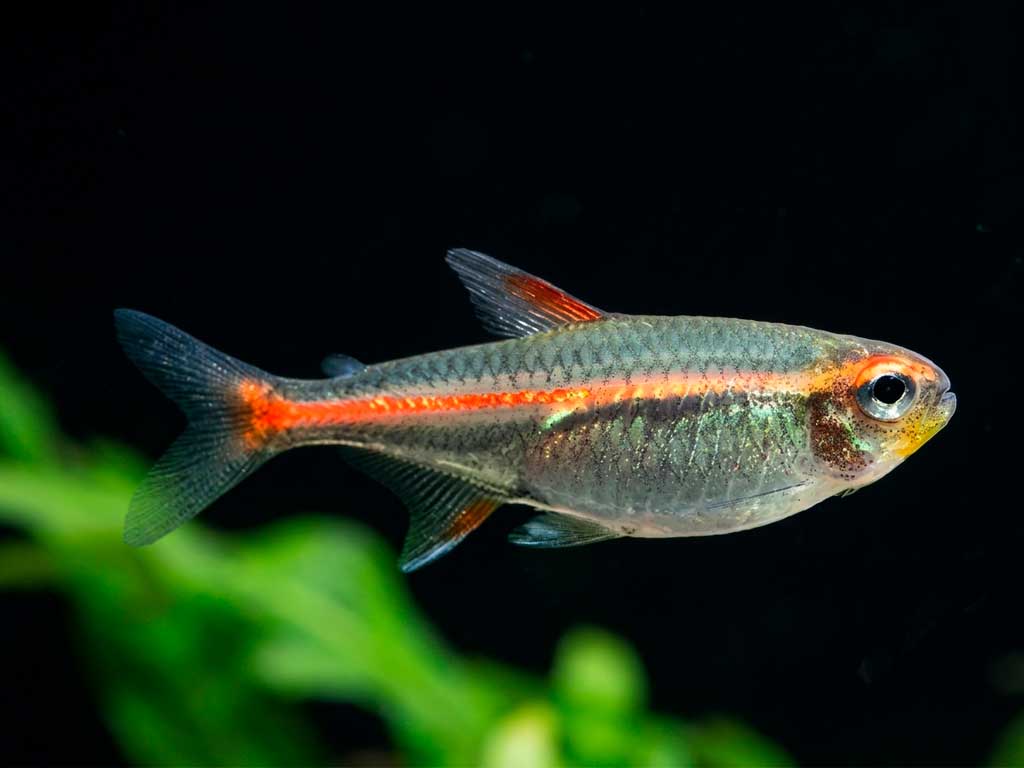
Silver covers most of the body, with a copper tone that shifts as the fish turns. One band of orange to red runs from the eye to the base of the tail, and a shorter streak of the same color marks the front of the dorsal fin.
That stripe is where the common name comes from. Against dark plants under low light it reads almost fluorescent, and against pale gravel it fades into the silver body. Everything else about the fish is close to transparent.
Taxonomy is the part of that table worth a footnote. FishBase places the species in Acestrorhamphidae, inside the subfamily Pristellinae, while most aquarium references still file it under Characidae. Most experts expect a full revision to move many of its species into other genera.
Its conservation listing says less than you might think. The IUCN Red List classes the glowlight tetra as Least Concern, assessed in November 2020, and the fish in the shops come from farms rather than rivers.
Two other names get confused with glowlight tetra, and neither one describes the same animal.
- A neon tetra carries a blue stripe above a red belly, and its care is close enough that shops often keep the two side by side.
- The name “glo tetra” or “glowing tetra” usually points to a fluorescent GloFish line, bred from a different species and sold under a brand name, with a heavier body and color across the whole flank.
If a shop lists a “glowlight neon tetra”, ask which species is in the bag before you pay.
Where do glowlight tetras come from?
The Essequibo is the longest river in Guyana, and the species lives in forested tributaries off the main channel. Tannins from decaying leaves stain the water the color of weak tea, minerals are scarce, and the pH sits well below neutral. Leaf litter covers the bottom while the canopy keeps the light low.
That habitat explains two preferences you will see in any aquarium: dim light and dark backgrounds. It does not mean a blackwater setup is required.
Almost every glowlight tetra on sale is farm-bred, and the fish in the bag is not a blackwater animal anymore. Its tolerance of neutral tap water runs well beyond what the collection data suggests, and that gap is where a lot of conflicting advice starts.
1. How big should a glowlight tetra tank be?
A 24 inch (60 cm) tank is the practical floor, and a 20 gallon long (about 75 liters) is a better target for a group of ten. Seriously Fish puts a comfortable group in a 60 × 38 × 30 cm tank, which works out to roughly 68 liters or 18 US gallons, and FishBase lists 60 cm as the minimum length for the species.
Length matters more than height. These fish swim through the middle of the water column and barely use the top or bottom third of a tall tank, and a long footprint also gives you more surface area for gas exchange.
A 10 gallon tank will hold six fish. The group will look cramped within a year, and the water changes pile up faster than a small filter can keep pace with.
2. What water parameters do glowlight tetras need?
Temperature is the parameter to hold steady first, and the other numbers have more room than most care sheets suggest. Published ranges differ slightly between references, so the table below shows the overlap.
| Parameter | Target |
|---|---|
| Temperature | 75 to 82 °F (24 to 28 °C) |
| pH | 5.5 to 7.5 |
| Hardness | 2 to 15 dGH |
| Ammonia and nitrite | Zero at all times |
| Nitrate | Low, held down by water changes |
| Flow | Gentle across the tank |
The spread is wider than it looks. FishBase gives pH 6.0 to 8.0 and 5 to 12 dGH, while Seriously Fish gives 5.5 to 7.5 and 2 to 15 dGH. A tank at pH 7.2 and 8 dGH sits inside both sets of figures.
Color is where the chemistry shows up. The species is more colorful in acidic conditions, and a glowlight tetra kept in hard, alkaline tap water tends to read silver-gray instead of copper.
Do not chase a number, though. A stable 7.4 is better for the fish than a pH that swings between 6.4 and 7.6 across the week, and liquid pH adjusters produce exactly that swing. If your tap water is hard, stock the tank with fish that suit it and leave the chemistry alone.
Flow sits in the same category, and it is the part most kits get wrong. Aim for a filter that turns the tank volume over four to five times an hour, which on an 18 gallon tank means roughly 70 to 90 US gallons per hour.
A sponge filter or a baffled hang-on filter moves that water without pushing a 3 cm fish around. But the rating on the box measures flow with no media fitted, so watch the fish instead: a group that spends the day pressed into one corner is telling you the current is too strong.
Heaters for that volume run around 100 to 125 W in a room at 68 °F (20 °C).
Aquarium Supplies
Tetra LED 20 Gallon Complete Fish Tank Kit for Freshwater Fish
Aquarium Kit Includes LED Light, 20 Gallon Glass Tank With Hinged Hood, Filter, Filter Cartridge, Décor, For Freshwater Fish
Shop on Amazon
TetraMin Tropical Flakes Fish Food, 7.06 oz
Complete Daily Diet For Top-And-Mid Feeding Tropical Fish, Protein For Growth & Prebiotics for Digestion, Clear Water Formula.
Shop on Amazon
Tetra SafeStart Plus for New Freshwater Aquariums
Establishes Healthy Bacteria In New Fish Tanks, Reduces Ammonia & Nitrite, Starts Working Immediately
Shop on Amazon
Aqua Natural Sugar White Sand Bio-Substrate 5lb for Freshwater Aquariums
Freshwater aquarium sand pre-seeded with live nitrifying bacteria to jump-start your tank’s nitrogen cycle from day one.
Shop on AmazonAs an Amazon Associate, Happy Pet Zone earns from qualifying purchases, at no extra cost to you.
3. How should a glowlight tetra tank be set up?
A dark substrate and cover overhead do most of the work, and wood or leaves that release tannins add the rest. Everything else on the shelf is optional.
- A dark sand or fine gravel substrate gives the stripe something to sit against, while pale gravel tends to wash the fish out.
- Floating plants or tall stems break up the light and give a nervous group somewhere to retreat.
- Driftwood and dried leaves add cover at the bottom and tint the water as they break down.
Lighting needs less than most people expect. A bright white LED at full power flattens the color of the stripe, and the same fixture dimmed to half output, or filtered through floating plants, brings it back. In practice, most of the color you get comes from the substrate and the light, not from a bottle of tonic.
A simple biotope is easy to run: river sand, two or three branches, a handful of dried leaves, and dim light. Replace the leaves every few weeks so they do not rot and foul the water.
4. What do glowlight tetras eat?
They are omnivores that take almost anything small enough to fit in their mouths, and variety keeps the stripe sharp. FishBase lists worms, small crustaceans and plant matter in the wild diet.
- Crushed flake or a micro granule works as the staple, and crushing matters because the mouth is tiny.
- Frozen bloodworm once or twice a week adds protein and color.
- Daphnia and brine shrimp come close to the natural diet, and the fish chase them across the tank.
- Live food is the standard conditioning step before a spawning attempt.
Most keepers feed once or twice a day and stop when the group loses interest, which takes about two minutes for a shoal of ten. Leftover food is the more common mistake, since a small fish with a small stomach produces very little waste and the tank has no use for the rest.
These tetras feed in midwater and are slow to notice anything that reaches the substrate. A new group that ignores sinking pellets is still settling in more often than it is sick.
5. How many glowlight tetras should you keep?
Six is the minimum and ten is better. Fifteen look like a different fish altogether. FishBase recommends groups of five or more, and Seriously Fish advises at least six and preferably ten or more.
The reason is behavioral. A larger shoal splits the work of watching for movement, so each fish spends less time hiding and more time feeding in the open.
In a group of three or four, glowlight tetras scatter and spend the day behind the filter. Ten or more produce the tight, coordinated swimming that makes the species worth keeping.
Light levels change the same behavior. The fish school more tightly in dim light and drift apart under a bright fixture, which is one more reason to plant the tank heavily and run the light lower than a plant-only setup would need.
6. Which tank mates suit a glowlight tetra?
Any peaceful fish of similar size and the same temperature range will work, and the six below cause the fewest problems. None of them is large enough to eat a glowlight tetra, and none of them nips fins. The pairings are drawn from species with full care guides in our freshwater fish section, which is the place to check requirements before you buy.
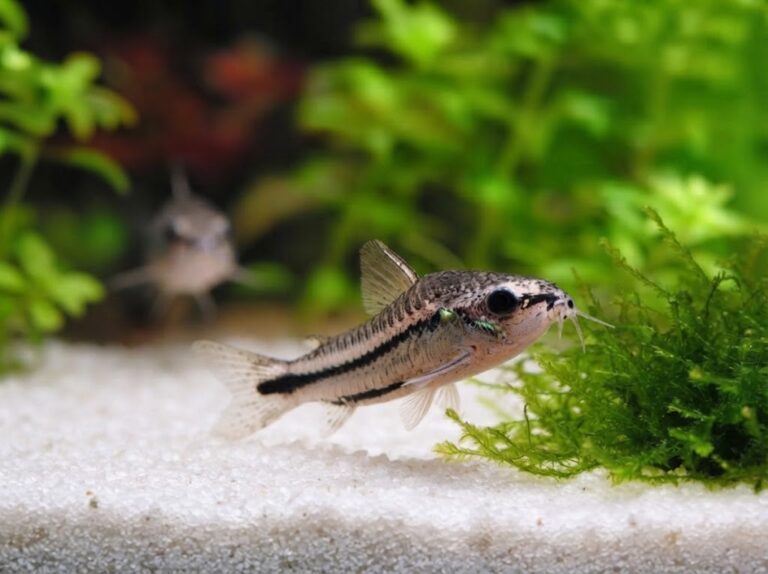
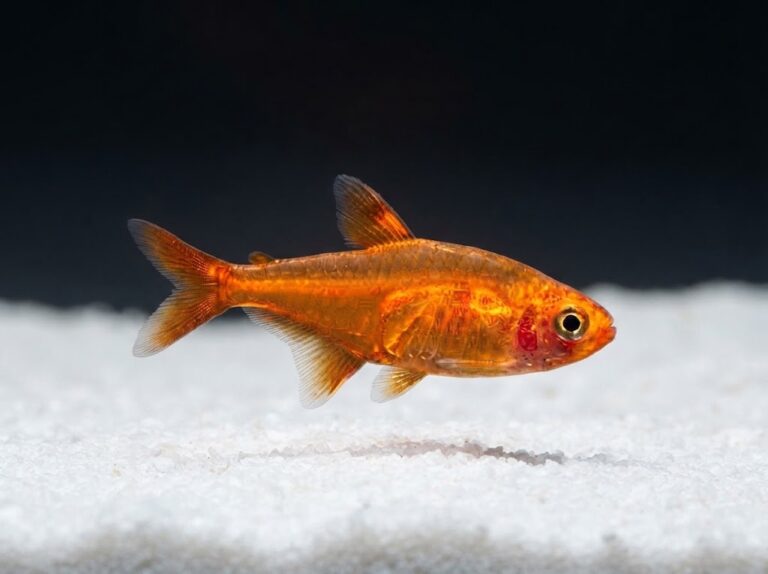
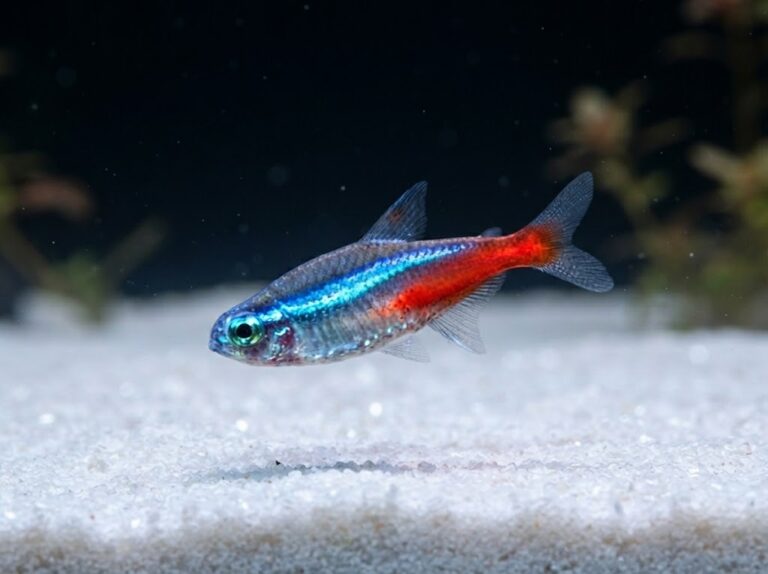
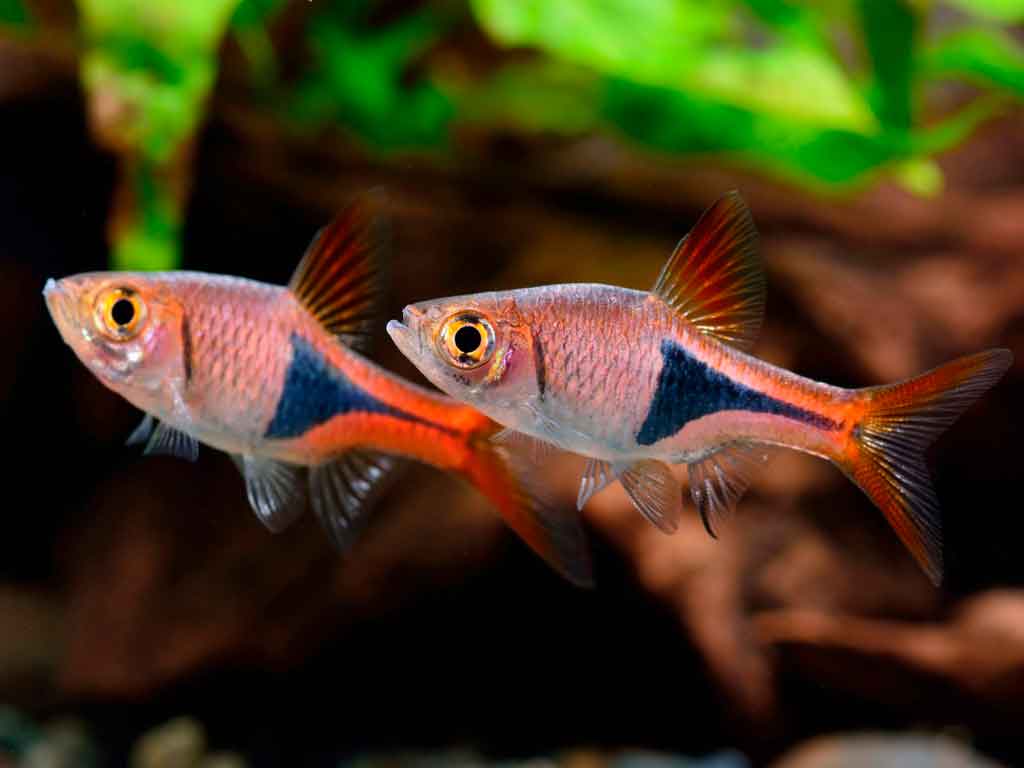
| Tank mate | Why it works |
|---|---|
| Neon tetra | Identical size and water needs, and its blue and red stripe reads beside the orange one without competing. |
| Ember tetra | Smaller and calmer, with a muted orange that holds up in the same dim light. |
| Harlequin rasbora | A midwater shoaler on the same temperature range that ignores the tetras. |
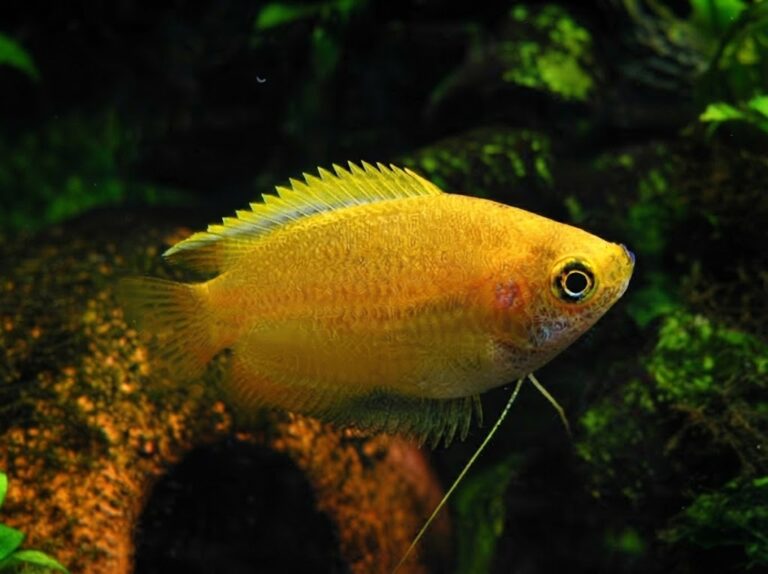
| Honey gourami | A centerpiece calm enough to leave fish this small alone. |
| Pygmy corydoras | Works the substrate for missed food and never competes for midwater space. |
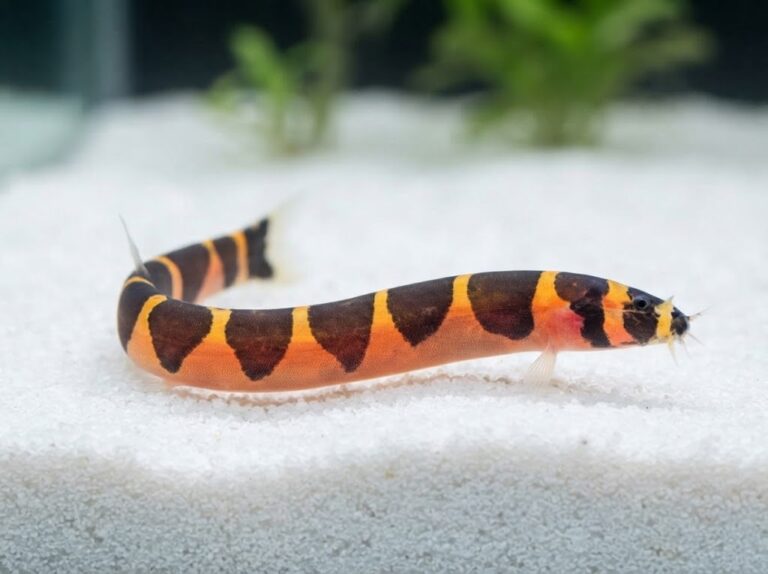
| Kuhli loach | Nocturnal and shy, sifting sand after the lights go out. |
Tank mates to avoid
Angelfish, discus and other large cichlids can swallow a 3 cm fish once they put on size, and a peaceful reputation does not protect a tetra from a mouth that fits around it. Tiger barbs and other fin nippers harass slow shoalers. Goldfish need cooler water and produce far more waste than a small tropical tank can process.
A betta is a gamble rather than a rule. Plenty of keepers run the two together in a planted 20 gallon, and the arrangement fails just as often when the betta turns territorial. Add the tetras first, give the betta cover at both ends of the tank, and keep a spare tank or a return option open.
Adult cherry shrimp are safe with glowlight tetras. Shrimplets are not, and a tank with dense moss gives them somewhere to grow up.
7. How do you breed glowlight tetras?
Spawning is the easy part, and raising the fry is where the work sits. The breeding account on Seriously Fish calls the species quite easily bred, provided you set up a separate tank and keep the light low.
- Condition the adults for one to two weeks on live and frozen food until the females are visibly full of eggs.
- Set up a spawning tank around 18 × 10 × 10 inches (45 × 25 × 25 cm), dimly lit, with clumps of Java moss, a spawning mop, or a mesh base the eggs can fall through.
- Fill it with soft, acidic water at pH 5.5 to 6.5, 1 to 5 dGH, and 80 to 84 °F (26.5 to 29 °C), and run only a gentle sponge filter.
- Add a pair in the evening, or spawn a group of about six of each sex.
- Remove the adults as soon as eggs appear, because they will eat them.
- Keep the tank dark, since eggs and fry are light sensitive in the first days.
| Stage | Timing |
|---|---|
| Spawning | Usually the morning after the pair goes in |
| Hatch | 24 to 36 hours |
| Free swimming | 3 to 4 days |
| First food | Infusoria, then microworm or brine shrimp nauplii |
A female scatters 120 to 150 eggs on average, and the pair often turns upside down at the moment of spawning. Both details come from the same Seriously Fish account. Feed the fry infusoria for the first few days, then move to microworm or brine shrimp nauplii once they can take the size.
Male or female?
Mature females are rounder in the belly and slightly larger, and comparing fish side by side in the shop tank makes the difference obvious. A single fish on its own rarely shows the shape clearly.
Glowlight tetras do not become pregnant. The female carries eggs, scatters them among plants, and the male fertilizes them outside her body.
That rounded belly is a sign of eggs, which is normal and not an illness. A fish that stops eating and sits on the bottom with a swollen belly has a different problem, and that one belongs in the next section.
8. Which health problems should you watch for?
The species is hardy, and the first sign of trouble is usually the stripe. A fish that fades to gray has a stressor somewhere: temperature, water quality, a group that is too small, or a new arrival carrying something.
- White spots the size of salt grains, plus flashing against plants, point to ich, which often follows a cold snap or an unquarantined fish.
- A curved spine and a fish that leaves the shoal and hides can indicate neon tetra disease, which has no reliable cure.
- Frayed or whitish fin edges usually trace back to water quality rather than to an infection that arrived on its own.
- Rapid gill movement and hanging at the surface point to oxygen or ammonia before they point to an infection.
Treat ich only after you are sure of the diagnosis, and confirm the approach before dosing, because the right choice depends on the other species in the tank. Quarantine new fish for two to four weeks; it is the cheapest health insurance in the hobby and the surest way to keep a problem out of a planted display.
Even so, the first month is where problems usually appear, and an uncycled filter explains more of them than any infection does.
Test ammonia and nitrite first whenever several fish fade at the same time. If the group is still off after a water change and stable readings, an aquatic veterinarian is the next call. This section describes what you are likely to see; it does not diagnose a fish for you.
9. What should you check before you buy?
Buy from a tank where the group looks like a group, and leave any fish that sits apart. A single fish pressed into a corner is telling you something about the tank it came from.
- A tight shoal that moves together rather than scattered singles.
- Fish that come toward the glass when food goes in.
- Clear fins and a rounded belly line, with no white spots anywhere on the body.
- No dead fish in the same tank or in the system beside it.
- A shop willing to bag the whole group from one tank.
Availability is rarely the problem. The species is farm-bred in large numbers, so most shops can order a group within a week, and judging the fish by its tank tells you more than the price on the label. Ask how long the group has been in the shop, since fish that arrived two days ago are still stressed from the bag and the move.
Frequently Asked Questions
Where to start
Set the heater to 78 °F (25.5 °C), plant the back and one side, and buy eight glowlight tetras rather than four. Then leave the tank alone for a month apart from water changes and feeding, and watch the stripe. Color is the cheapest test kit you own.