Paradise Fish (Macropodus Opercularis): Care Guide for This Aggressive Gourami
Paradise fish helped kickstart the entire tropical aquarium hobby, arriving in Europe in 1869 as one of the very first exotic fish species kept by Western aquarists.
In practice, this historic status comes paired with a temperament that a lot of modern care sheets soften more than they should: this is a genuinely aggressive gourami, not the mild-mannered community fish its relatives tend to be.
This guide covers real tank setup, honest behavior expectations, and how to avoid confusing this species with two genuinely distinct relatives that share its common name.
Quick Identity Card
| Trait | Detail |
| Scientific name | Macropodus opercularis (Linnaeus, 1758) |
| Common names | Paradise Fish, Paradise Gourami, Blue Paradise Fish |
| Family / Order | Osphronemidae, Anabantiformes |
| Origin | East Asia: Korea, China, Taiwan, northern Vietnam |
| Adult size | Males up to 10 cm; females smaller, around 7 cm |
| Diet | Omnivore, flake, frozen, live foods, effective snail eater |
| Temperament | Genuinely aggressive, not a standard community fish |
| Water temperature | 10 to 30°C (50 to 86°F), unusually tolerant |
| pH | 6.0 to 8.5 |
| GH (hardness) | 5 to 19 dGH, tolerant of soft or hard water |
| Minimum tank | 80 x 30 cm for a single fish; more for a pair |
| Lifespan | Up to 10 years |
| Breeding | Bubble-nest builder, easy to spawn |
| IUCN status | Least Concern |
Origin and Aquarium History
Macropodus opercularis holds a genuinely unique place in aquarium history. In 1869, a French soldier named Gerault shipped 100 specimens to Europe, 22 of which survived the journey. Parisian aquarist Pierre Carbonnier successfully bred them that same year, making this species one of the very first ornamental fish ever imported to the West, arriving not long after the goldfish itself.
That early success traces directly to this species’ biology rather than luck. As a labyrinth fish tolerant of cool water and low oxygen, paradise fish survived transport and captivity in an era when most other tropical species simply died en route.
Origin and Natural Habitat
This species ranges across Korea, China, Taiwan, and northern Vietnam, favoring stagnant, oxygen-poor marshes, irrigation ditches, and slow-moving rice paddies, along with swampy areas more broadly. That adaptability to harsh, low-oxygen water is exactly what its labyrinth organ evolved to handle.
Identification
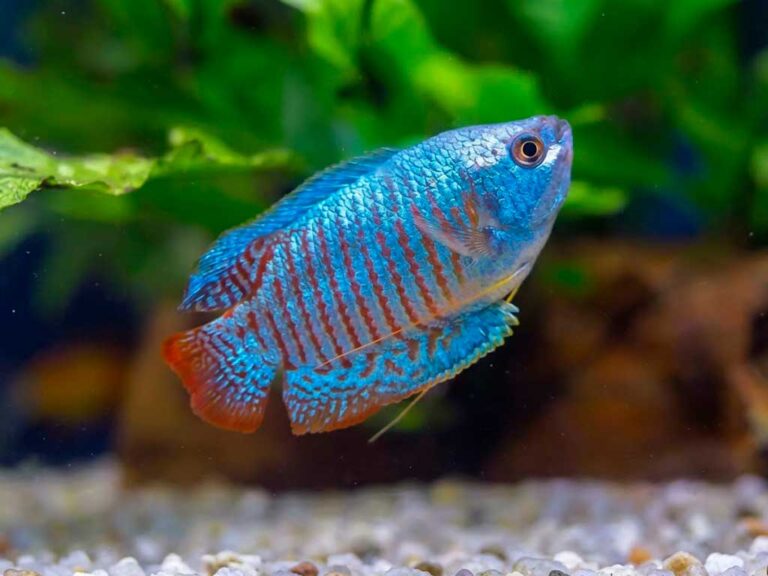
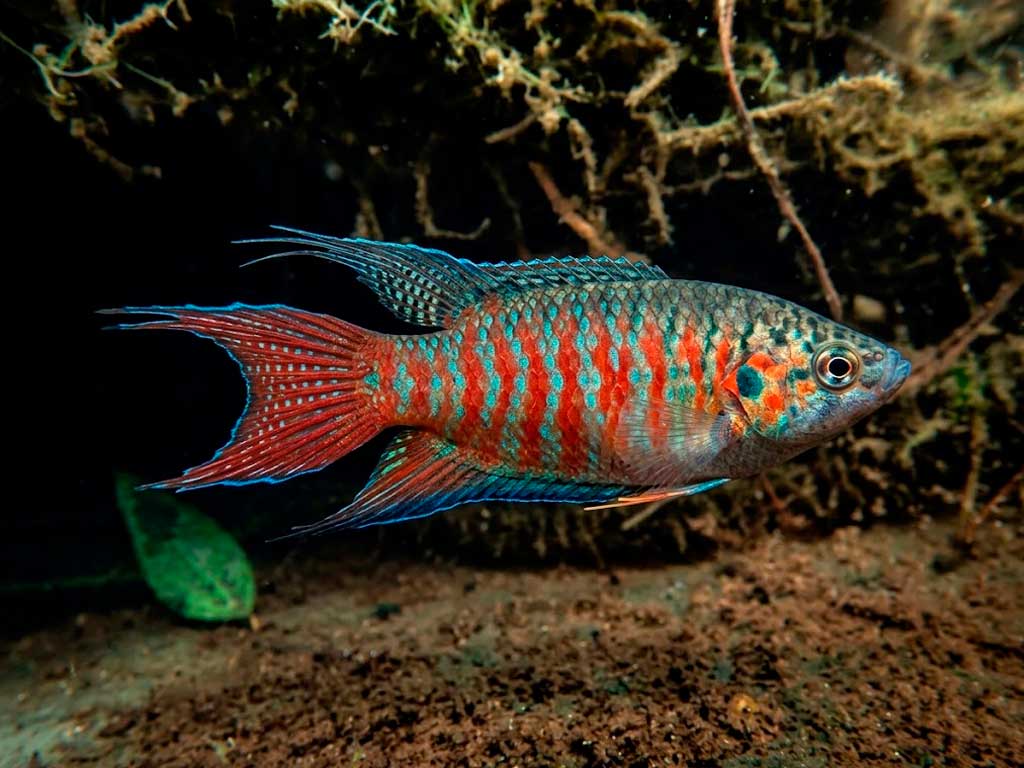
The body carries vivid vertical blue stripes against a reddish-brown base, with long, pointed dorsal and anal fins on mature males giving the species its dramatic finnage. Females run noticeably paler and smaller, with a fuller body when carrying eggs.
One striking trait: this species can actively change its coloration, running lighter or darker in response to stimuli, most dramatically during aggressive encounters, when dark blue lateral lines intensify, fins extend fully, and the gill covers (opercula) flare outward.
Behavior and Temperament: An Honest Warning
Here’s what actually matters more than anything else in this guide: paradise fish are genuinely aggressive, more so than the three-spot gourami and most other commonly kept Osphronemidae, though somewhat less combative than the rarely kept combtail. Males fight viciously with each other, and this species will harass, injure, or outright kill small fish sharing its tank, including small fancy goldfish specifically.
Two adult males should never share a tank smaller than a genuinely massive, heavily planted system, and even then, expect ongoing conflict. A single fish or a properly bonded, sexed pair is the realistic approach. Suitable tankmates need to be fast-swimming, robust, and definitely not long-finned or delicate, ruling out guppies and similar fish outright. Larger hardy barbs, danios, loaches, and flagfish tend to work better. Interestingly, some sources suggest aggression may soften somewhat the further a captive lineage sits from its native Asian range, though this remains more anecdotal than firmly established.
Diet and Feeding
This species accepts flake, frozen, and live foods without any real fuss, and it’s a genuinely effective natural predator of snails, useful for anyone managing a snail population elsewhere in the fishroom. In the wild, it preys on insects, invertebrates, and fish fry, a diet that lines up with its captive feeding habits.
The feeding guide for ornamental fish covers building a varied rotation, though this species isn’t a fussy eater by any measure.
Tank Requirements and Water Parameters
A single paradise fish fits comfortably in a tank around 45 to 60 cm (18 to 24 in) long, though a pair needs meaningfully more space, generally at least 80 x 30 cm or a 100-liter volume. Dense planting matters for reducing aggression, and floating plants are essential, both for cover and as an anchor point for the male’s bubble nest.
Water tolerance runs genuinely wide: temperature between 10 and 30°C (50 to 86°F), making this species suitable for an unheated indoor aquarium at normal room temperature, pH from 6.0 to 8.5, and general hardness anywhere from 5 to 19 dGH, tolerant of both softer and harder water than that range suggests. The water chemistry guide covers the basics, though this species demands far less precision than most fish on this site.
Breeding
Paradise fish are bubble-nest builders, a straightforward and genuinely easy species to breed given a properly conditioned pair. The male constructs a foam nest anchored to floating plants, courts the female, and guards the resulting eggs and fry afterward, consistent with the broader labyrinth fish pattern covered elsewhere on this site.
Given how easily this species breeds and how tolerant it stays of a wide range of conditions, it’s a reasonable candidate for a first breeding project, provided the aggression covered above gets managed with adequate space and planting.
How It Differs From Other “Paradise Fish”
The common name “paradise fish” covers genuine taxonomic confusion worth untangling. The round-tailed paradise fish, correctly known as Macropodus ocellatus, is a smaller, distinct species (up to 8.6 cm) found further north across Korea, China, and Japan, cold-tolerant enough to stay active under ice in winter. For decades, hobbyists called this species “Macropodus chinensis,” believing it represented the original wild form of the ornamental paradise fish. That assumption held until 1989, when researcher Paepke demonstrated that the original Chinese specimen used to describe M. chinensis was simply an M. opercularis with a damaged tail fin, not a genuinely round-tailed species at all.
The black paradise fish adds a second layer of confusion. Long identified in scientific literature as Macropodus concolor, a solid dark-colored relative lacking the vertical banding of true opercularis, this fish is now more properly known as Macropodus spechti in most current sources. To complicate things further, a population in Hong Kong long assumed to be M. concolor turned out to be an entirely separate, previously undescribed species, Macropodus hongkongensis, described only in 2002 and now considered endangered given ongoing habitat loss in Hong Kong’s wetlands.
Conservation Status
The IUCN Red List classifies Macropodus opercularis as Least Concern, reflecting its wide native range and adaptable nature across East Asia. That contrasts sharply with some of its more range-restricted relatives, including the Hong Kong-endemic M. hongkongensis discussed above.