Platy Fish (Xiphophorus Maculatus): Care Guide, Colors & Breeding
Platy fish show up in more beginner tanks than almost any other tropical species, and the reason comes down to one simple fact: they’re nearly impossible to get wrong. In practice, this livebearer forgives beginner mistakes, breeds without any real effort from the keeper, and comes in more colors than most aquarists ever get around to trying.
This guide covers real tank requirements, the color varieties actually worth knowing, what to expect once breeding starts, and how platies differ from their closest, constantly-confused relative.
Quick Identity Card
| Trait | Detail |
| Scientific name | Xiphophorus maculatus (Günther, 1866) |
| Common names | Platy, Southern Platyfish, Moonfish |
| Family / Order | Poeciliidae, Cyprinodontiformes |
| Origin | Atlantic slope of Mexico, Belize, Guatemala, Honduras |
| Adult size | Males around 4 cm, females up to 6 to 7 cm |
| Diet | Omnivore, genuinely easy feeder |
| Temperament | Peaceful, community-friendly |
| Water temperature | 20 to 26°C (68 to 79°F) |
| pH | 7.0 to 8.5 |
| GH (hardness) | 10 to 28 dGH, prefers harder water |
| Minimum tank | Around 38 L (10 US gal) for a small group |
| Lifespan | 3 to 5 years |
| Breeding | Livebearer, easy and frequent |
| IUCN status | Data Deficient |
Origin and Natural Habitat
Xiphophorus maculatus comes from the Atlantic slope of Central America, native to Mexico, Belize, Guatemala, and Honduras. In the wild it favors slow-moving warm springs, canals, swamps, and vegetation-rich creeks, the kind of still, planted water that’s easy to recreate at home.
Wild-type coloration runs genuinely modest: an olive-brown back with bluish flanks and two to five transverse stripes, nothing like the rainbow of forms sold today.
Nearly every platy in the hobby traces back to selective breeding that began in the early 20th century, when a handful of naturally occurring color variants (locally known by names like “pulchra,” “rubra,” “nigra,” and “cyanellus”) got bred into the foundation of modern varieties.
Identification
The body runs laterally compressed and stocky, with a fan-shaped caudal fin and a mouth positioned slightly upward, built for feeding near the surface. Males stay noticeably smaller than females and carry a more pointed caudal fin, along with a gonopodium, a modified anal fin used for reproduction.
Females run larger and fuller-bodied, with a fan-shaped anal fin instead. That size difference becomes especially obvious once a female is carrying fry, when her belly rounds out considerably.
Platy Color Varieties: From Wagtail to Mickey Mouse
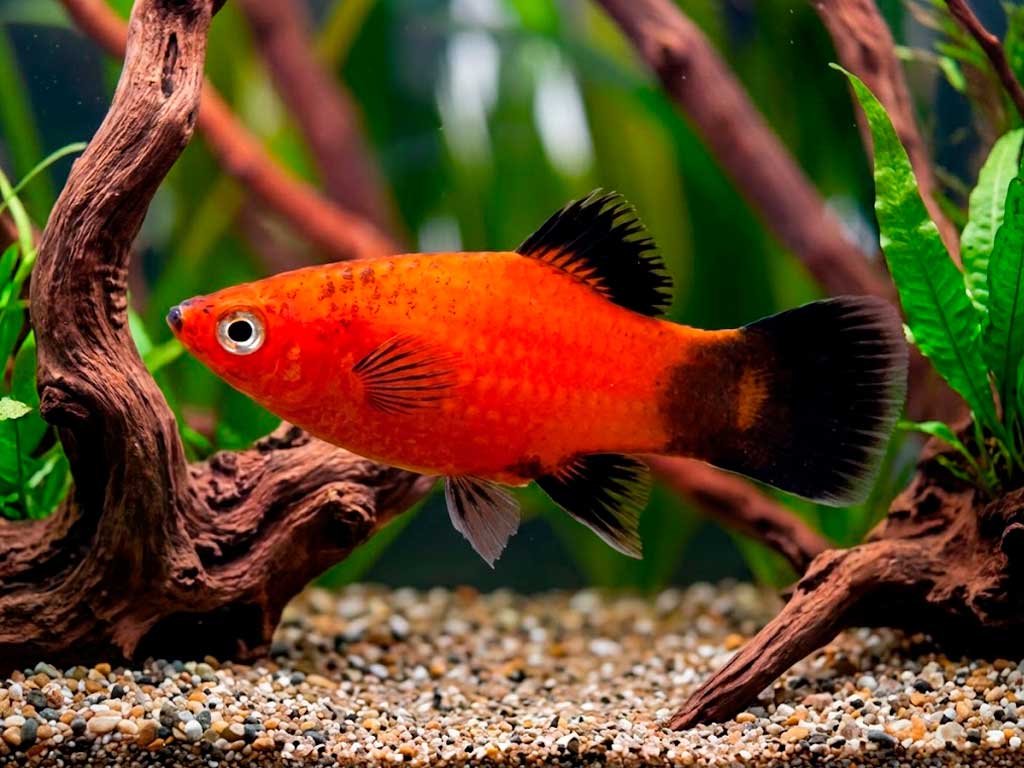
Here’s what actually matters for anyone shopping for platies: the “species” sold in stores is really a huge range of selectively bred color and pattern varieties, not a single look. Wagtail platies carry black fins against a bright body color.
Mickey Mouse platies show a distinctive dark blotch pattern near the tail base that resembles the cartoon silhouette. Coral, sunset, and tiger platies lean into intense orange-red gradients, while dalmatian platies carry irregular black spotting over a white or pale body.
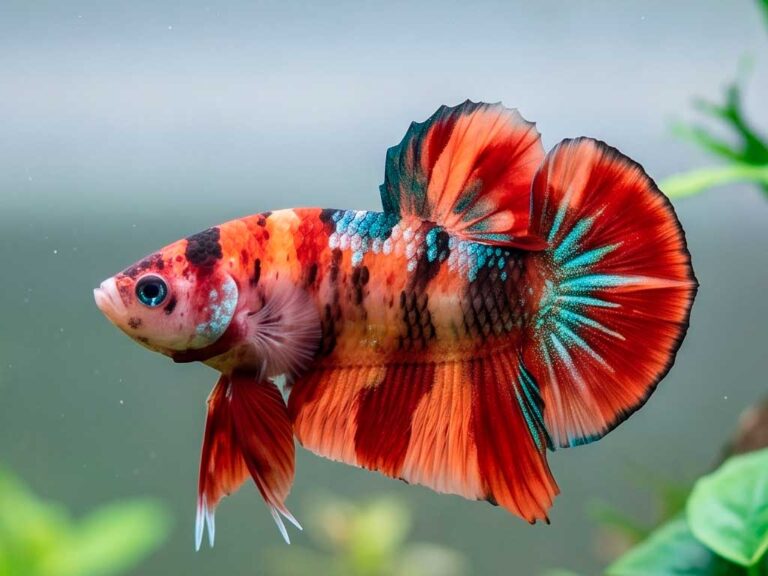
Other common forms include koi platies (mottled orange, white, and black patterning echoing actual koi carp), tuxedo platies (a dark rear half against a lighter front), bumblebee platies (bold yellow and black banding), salt and pepper platies (fine dark speckling), and hi-fin varieties with exaggerated dorsal fins.
Solid colors like red, gold, blue, and black round out the range, and calico or panda patterns add even more variety for anyone building a mixed-color group.
Behavior and Temperament
Platies read as genuinely peaceful and make excellent community fish. They’re not technically a schooling species, but they do enjoy the company of their own kind and other Xiphophorus, so small groups shoal together loosely rather than scattering.
One practical note worth knowing: adults will sometimes eat their own fry, a common livebearer trait rather than anything unusual to this species specifically. Dense planting or floating vegetation gives new fry somewhere to hide if letting a colony grow naturally is the goal.
Diet and Feeding
Platies rank among the easiest fish in the hobby to feed. A varied diet of flakes, small pellets, and occasional live or frozen foods like brine shrimp or insect larvae covers their needs completely, and they’ll happily graze on algae growth in the tank as a supplement.
The feeding guide for ornamental fish covers the broader principles of building a balanced rotation, though platies genuinely aren’t a fussy species to plan around.
Tank Requirements and Water Parameters
A tank of around 38 liters (10 US gallons) with roughly 51 cm (20 inches) of length works for a small group, though anyone planning to let a colony breed naturally should budget for more space over time. Well-planted areas or floating plants give both adults and fry cover.
Water chemistry runs on the harder, more alkaline side compared to most of the soft-water species covered elsewhere in this series: temperature between 20 and 26°C (68 to 79°F), pH from 7.0 up to 8.5, and general hardness anywhere from 10 to 28 dGH.
Trust me on this one: if a platy seems to be struggling for no obvious reason, check that the pH hasn’t drifted below 7.0 before anything else. The water chemistry guide covers testing and adjusting hardness and pH toward that harder end of the scale.
Tankmates and Compatibility
Platies pair naturally with other livebearers that share similar hard-water preferences, including guppies and mollies, along with peaceful tetras tolerant of harder, more alkaline water, corydoras, and loricariid catfish. Community setups built around this general profile tend to work smoothly.
Given how readily platies breed, mixing them with guppies or mollies in the same tank is common practice among hobbyists, though anyone hoping to keep bloodlines distinct should watch for accidental Xiphophorus crossbreeding between platies and other Xiphophorus species specifically, not the unrelated genera.
Breeding and Pregnancy: What to Expect
Platies are livebearers, meaning females give birth to free-swimming fry rather than laying eggs. Sexual maturity arrives around four months old, and a single mating can result in multiple broods over time since females can store sperm.
Gestation runs roughly four to six weeks, and a gravid female typically produces anywhere from 20 to 80 fry per brood, with some sources reporting broods as often as monthly under good conditions.
The clearest pregnancy sign is a visibly rounding, boxy-looking belly, especially noticeable near the anal fin as the due date approaches. Isolating a heavily pregnant female in a breeding box or heavily planted tank section, and separating fry from adults afterward, meaningfully improves fry survival, since platies will eat their own young given the chance.
Platy vs. Variatus: How to Tell Them Apart
Here’s an honest complication worth knowing upfront: Xiphophorus maculatus and Xiphophorus variatus (the variatus platy) have been interbred so extensively that most platies sold in stores today are genetically a mix of both species.
Several popular varieties, including hi-fin and sunset forms, trace their influence specifically to variatus ancestry.
Where the two can still be told apart, body shape offers the clearest clue: true maculatus runs shorter and stockier, while variatus stays slimmer and more elongated, with a back that arches slightly more.
Wild-type variatus also shows black marbling or spotting near the caudal peduncle and blackish blotches on the dorsal fin in large males, markings not typical of wild maculatus. Structurally, variatus lacks a claw at the tip ray present in some other Xiphophorus species and shows well-developed serrae on the fourth pectoral ray.
In practice, for anything already selectively bred and sold under a color-variety name, treating it as a maculatus-variatus hybrid is usually the most accurate assumption.
Conservation Status
The IUCN Red List classifies Xiphophorus maculatus as Data Deficient. That’s a genuinely striking gap given how commercially ubiquitous this species is. Millions of platies get bred and sold worldwide every year, yet formal data on the health of its actual wild populations across Mexico, Belize, Guatemala, and Honduras remains insufficient for a full assessment.