Molly Fish (Poecilia Sphenops): Care Guide, Types & Breeding
Molly fish complete a lineup that most aquarists build without ever planning to: platy, swordtail, molly, three closely related livebearers that all show up in the same beginner shopping cart.
In practice, mollies bring something the other two don’t quite match: a genuine tolerance for brackish and even marine water, real individuality in temperament, and a scientific name that taxonomists themselves haven’t fully settled.
This guide covers what that name confusion actually means, the color varieties worth knowing, and how mollies stack up against their two closest relatives.
Quick Identity Card
| Trait | Detail |
| Scientific name | Poecilia sphenops (Valenciennes, 1846) |
| Common names | Molly, Common Molly, Short-finned Molly, Mexican Molly |
| Family / Order | Poeciliidae, Cyprinodontiformes |
| Origin | Mexico, Guatemala, Honduras (narrower than historically assumed) |
| Adult size | Males around 8 cm, females up to 12 cm |
| Diet | Omnivore, grazes algae plus needs real vegetable matter |
| Temperament | Peaceful overall; males mildly to moderately aggressive |
| Water temperature | 22 to 28°C (71.5 to 82.5°F) |
| pH | 7.5 to 8.5 |
| GH (hardness) | 10 to 30 dGH |
| Minimum tank | Around 90 cm (35 in), roughly 114 L (30 US gal) for adults |
| Breeding | Livebearer, 20 to 150 fry, 28-day gestation |
| IUCN status | Least Concern |
Origin and the Species Complex Problem
Here’s what actually matters before anything else: the name on the label is less settled than it looks. Poecilia sphenops was once treated as a single widespread species ranging all the way from Mexico to Venezuela, but that picture has changed.
Most of those regional populations are now recognized as distinct species within what taxonomists call the P. sphenops complex, and true sphenops is currently understood to be native only to Mexico, Guatemala, and Honduras.
To make things messier, this species gets confused constantly with Poecilia mexicana, both in wild population records and in trade.
Add in more than 40 recorded synonyms and centuries of crossbreeding with relatives like the sailfin molly, and the honest answer is that a fish sold simply as “molly” could genuinely be several different things.
Identification
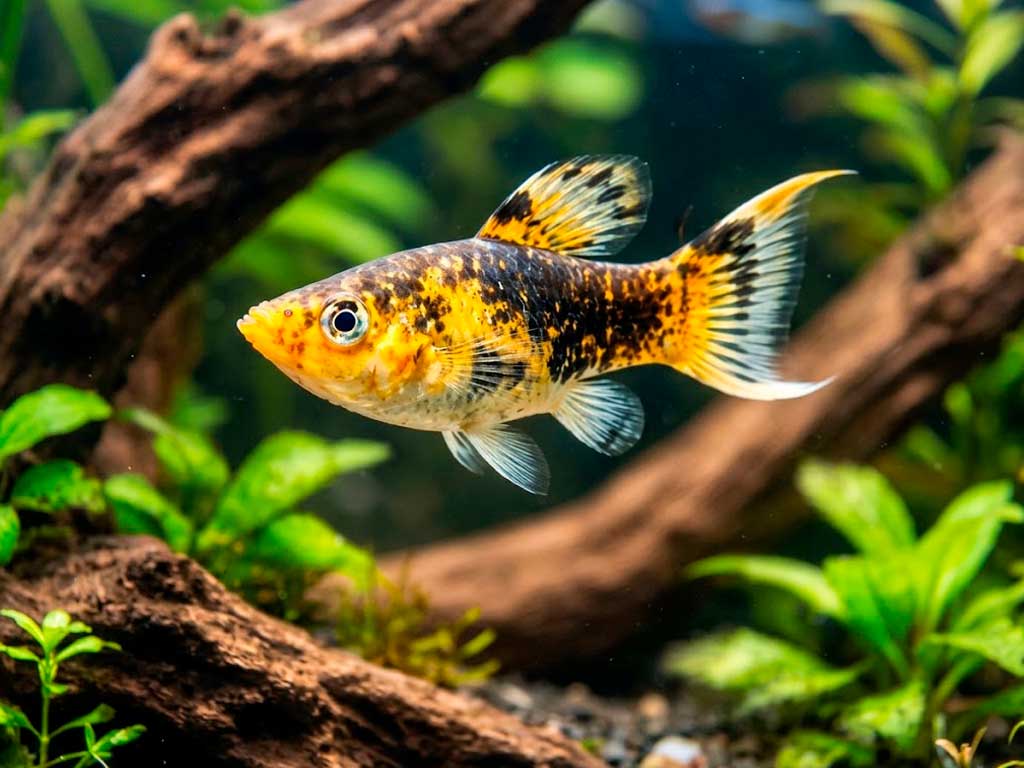
Wild-type coloration runs modest and easy to overlook: an olive-green back, bluish flanks marked with orange spots, an orange-tinted belly, a blue iris, and brownish fins. Almost nobody keeps this wild form today. Virtually every molly in the hobby traces back to captive-bred strains selected over generations for color and pattern.
The body itself runs elongated and laterally compressed, with a pointed snout and a fan-shaped caudal fin. Males stay noticeably smaller than females and, like other livebearers in this family, carry a gonopodium rather than a standard fan-shaped anal fin.
Molly Color Varieties
The black molly, a fully melanistic form, remains the single most recognizable and widely marketed variety worldwide. Dalmatian mollies carry silver-and-white speckling, gold dust mollies run yellow to orange, and chocolate mollies show warm brown tones instead.
Body shape varies too. Lyretail mollies carry an elongated, lyre-shaped tail, while balloon mollies have been bred with a shortened, rounded body, a form that draws real debate in the hobby over the spinal curvature involved.
Many of today’s fancier varieties, including larger-finned forms, trace their ancestry to crossbreeding with the sailfin molly (Poecilia latipinna) rather than pure sphenops lines.
Behavior and Temperament
Mollies read as peaceful overall but noticeably more individualistic than platies, and males show real mild-to-moderate aggression, both toward each other and occasionally toward females during breeding attempts. That’s a genuine behavioral step up from the platy’s generally milder temperament.
They do well in a community built around other livebearers and peaceful, similarly hardy fish. As with the rest of this trio, keeping more females than males helps reduce the stress that comes from persistent male mating attempts.
Diet and Feeding
Mollies graze on algae and biofilm readily, which sometimes gets them mistaken for a tank cleanup solution. They aren’t one. A diet needs real vegetable matter and prepared foods alongside whatever grazing they do naturally, plus occasional worms, crustaceans, or insects to round things out.
The feeding guide for ornamental fish covers the broader principles of building that kind of balanced rotation, which matters more for mollies than it does for a species that will thrive on flake alone.
Tank Requirements and Water Parameters
A tank around 90 cm (35 in) in length, roughly 114 liters (30 US gallons), suits adult mollies well, though younger fish can start in something smaller. A planted setup is genuinely preferable here.
Water needs to run firmly on the hard, alkaline side: temperature between 22 and 28°C (71.5 to 82.5°F), pH from 7.5 up to 8.5, and general hardness anywhere from 10 to 30 dGH. That profile lines up closely with platy fish and swordtail fish, which is exactly why all three share tanks so easily.
One genuine point of difference: mollies tolerate brackish and even marine conditions far better than either relative, making a brackish biotope tank a realistic option specifically with this species. The water chemistry guide covers testing and adjusting toward that harder end of the range.
Tankmates and Compatibility
Mollies pair naturally with platies and swordtails, given the shared water chemistry and generally overlapping temperaments, and mixed livebearer community tanks built around all three species are genuinely common in the hobby.
Peaceful tetras tolerant of harder water, corydoras, and other bottom-dwelling catfish round out a solid community list.
Given the mild aggression some male mollies show, avoid pairing them with small, delicate, or slow-moving fish that can’t hold their own in an active community tank.
Breeding
Like platies and swordtails, mollies are livebearers, giving birth to free-swimming fry rather than laying eggs. Gestation runs about 28 days, and a single brood can range from 20 to 150 fry, sitting between the platy’s smaller broods and the swordtail’s wider upper range.
Fry need cover immediately after birth, since adult mollies will eat their own young without floating plants or dense vegetation to hide in.
Worth knowing honestly: mollies also rank among the most commonly used feeder fish in the trade, a direct consequence of the same fast growth and high reproduction rate that makes them so easy to breed at home.
Molly vs. Platy vs. Swordtail: The Livebearer Trio
All three species share the family Poeciliidae, near-identical hard-alkaline water requirements, and genuinely compatible temperaments, which is exactly why they get kept together so often. The differences matter more for planning a tank than for basic care.
Platies stay the smallest of the three, mature the fastest at around 4 months, and run the mildest in temperament. Swordtails grow larger, take considerably longer to mature at 8 to 12 months, and show real male-to-male aggression that requires careful stocking ratios.
Mollies sit in between on size and maturity timing but bring their own behavioral edge, plus a tolerance for brackish water the other two simply don’t share.
Conservation Status
The IUCN Red List classifies Poecilia sphenops as Least Concern, assessed in 2018. Its popularity in the aquarium trade has led to established feral or introduced populations in several countries outside its native range, including the United States, Japan, and Singapore, so the same release caution that applies to swordtails applies here too.