Acanthocobitis Zonalternans: Care Guide for the Zona Loach
Acanthocobitis zonalternans does something almost none of its close relatives manage: it breeds in captivity, reliably enough that hobbyists have documented actual spawns rather than just hoping for one. In practice, that single trait sets this species apart from nearly everything else covered in this loach series so far.
This guide covers what makes it different, the real water and tank requirements, and why its breeding success matters more than it might first appear.
Quick Identity Card
| Trait | Detail |
| Scientific name | Acanthocobitis zonalternans (Blyth, 1860), now Paracanthocobitis zonalternans |
| Common names | Zona Loach, Alternating Loach, Dwarf Zipper Loach |
| Family / Order | Nemacheilidae, Cypriniformes |
| Origin | Manipur (India) through Myanmar into western/peninsular Thailand |
| Adult size | Around 7.8 cm SL typical; some formal records list up to 12.2 cm |
| Diet | Micropredator, insect larvae and invertebrates |
| Temperament | Peaceful, genuinely community-friendly |
| Water temperature | 18 to 26°C (64 to 79°F) depending on source |
| pH | 6.0 to 7.8 |
| GH (hardness) | 2 to 18 dGH, soft to moderately hard |
| Minimum tank | 60 x 30 cm base, ideally 35 US gal or more |
| Breeding | Documented captive success, up to 300 eggs per spawn |
| IUCN status | Least Concern |
Origin and Natural Habitat
Acanthocobitis zonalternans covers real ground across South and Southeast Asia, recorded from Manipur in northeastern India, south through Myanmar, and into western and peninsular Thailand, with a possible extension into Peninsular Malaysia.
Confirmed river systems include the Brahmaputra, Meghna, Irrawaddy, Sittang, Salween, and Mae Klong basins, though it’s notably absent from the Chao Phraya basin. Its type locality is a small stream, Huai Mae Charno, in the Salween basin of Tak Province, Thailand.
It favors shallow riffles over pebble, gravel, or sand-and-stone substrate in clear, flowing hillstreams, generally sticking to reaches with complex structure from rocks and roots while avoiding the steepest mountain torrents. That’s cool-to-mild, well-oxygenated running water rather than warm, still blackwater.
Identification
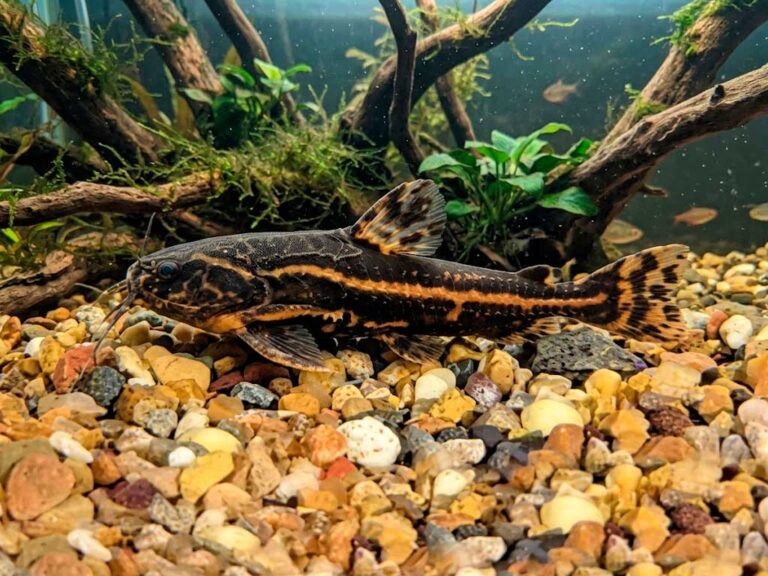
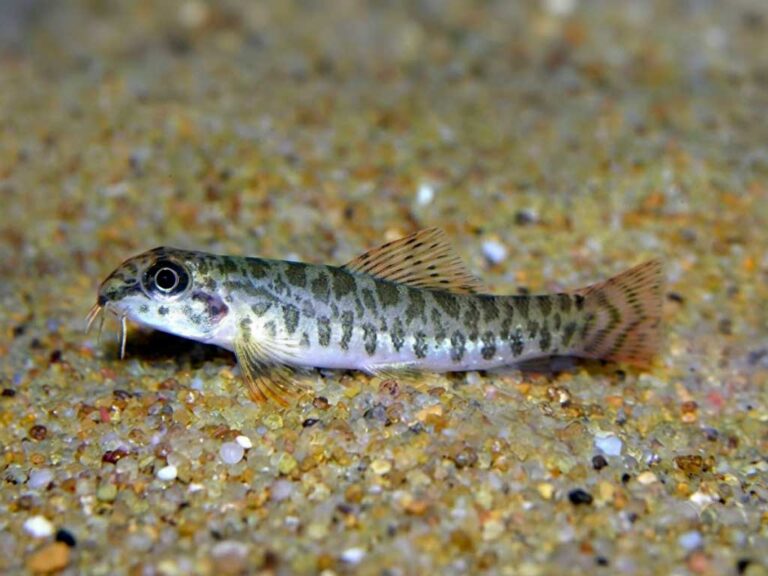
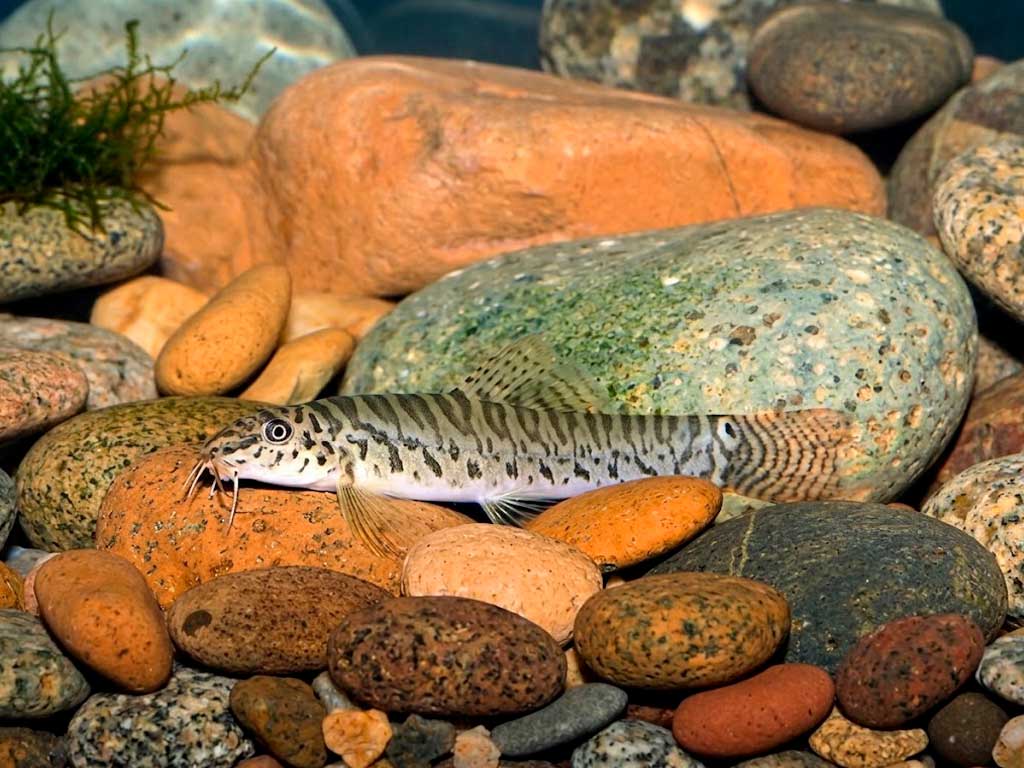
The common name gives away the key field mark directly: alternating dark saddle-like bars or blotches running along the flank over a pale-to-olive base color, giving a broken, zoned look rather than one continuous stripe.
A circular black spot sits on the upper margin of the caudal-fin base, and black pigment extends from the lateral markings onto the base of the pectoral fin.
Size records diverge depending on the source, worth flagging honestly: most references put the maximum around 7.8 cm standard length, while at least one formal record lists specimens reaching 12.2 cm and just over 21 grams. Most individuals in the hobby stay on the smaller end of that range.
Behavior and Temperament
This ranks among the more approachable stone loaches in the trade. It associates well with peaceful schooling cyprinids and other current-loving loaches from genera like Gastromyzon, Pseudogastromyzon, Beaufortia, and Sewellia, alongside less territorial nemacheilids.
Sexual dimorphism is genuinely usable here, unlike several relatives covered earlier in this series. Males develop brighter fin coloration, especially on the dorsal fin, and show some aggression toward rival males. Females grow larger and heavier-bodied, particularly when carrying eggs.
Diet and Feeding
In the wild, this species works the substrate as a bottom-foraging micropredator, picking insect larvae and small invertebrates from among riffle stones, with some incidental detritus feeding along the way.
In the aquarium it’s an easy feeder: sinking pellets, wafers, bloodworm, brine shrimp, and Daphnia, live or frozen, all get accepted readily. Food needs to actually reach the bottom, since this species largely ignores anything staying in the water column, and flake alone makes a poor match for its natural feeding style.
The feeding guide for ornamental fish covers the broader principles behind building that kind of bottom-focused rotation.
Tank Requirements and Water Parameters
A base of 60 x 30 cm covers this species at minimum, though a tank of 35 US gallons or more with strong flow suits it noticeably better. Smooth gravel and pebbles, driftwood, and rockwork recreate the riffle habitat this species actually needs.
Water parameters show some spread across sources, worth noting rather than picking one figure and moving on: temperature somewhere between 18 and 26°C (64 to 79°F), pH from 6.0 up to 7.8, and general hardness anywhere from soft to moderately hard, roughly 2 to 18 dGH depending on the reference. One practical warning matters more than the exact numbers: like other true loaches, this species is thin-skinned and essentially scaleless, making it sensitive to copper-based medications.
Any treatment should run at reduced dosing with close observation. The water chemistry guide covers testing and holding parameters steady within that range.
Tankmates and Compatibility
Unlike the bolder, occasionally territorial temperament documented for Acanthocobitis pictilis, this species reads as genuinely peaceful and community-friendly. It fits comfortably alongside small, stream-dwelling fish without the compatibility caveats attached to some of its relatives.
The broader tankmate logic tracks closely with Acanthocobitis botia and Acanthocobitis urophthalmus: fast-current, similarly-sized fish from the same general region make the most natural fit.
Breeding
Here’s what actually matters most about this species: it’s an egg-scatterer with no parental care, the standard stone loach pattern, but unlike nearly every other Nemacheilidae species, it has genuinely spawned successfully in home aquaria.
Reported spawns have produced up to 300 eggs at once, with eggs hatching in roughly 24 to 36 hours and fry reaching free-swimming stage within about three days.
One of the earliest documented captive spawns came from a Manchester-based fishkeeper in 2008, reported at the time as probably the first recorded breeding of the species. That said, deliberately triggering a spawn isn’t a standardized process in the hobby.
Reported successes seem to follow from simply keeping healthy adults in stable, well-oxygenated water rather than any specific induced protocol, so results aren’t guaranteed, but breeding this species is a realistic goal in a way that genuinely isn’t true for most of its relatives.
How It Compares to the Rest of the Genus
Across the four classic Acanthocobitis species covered in this series, conservation status and breeding record vary sharply despite their shared taxonomic history.
| Species | IUCN status | Captive breeding |
| A. zonalternans | Least Concern | Documented successful spawns |
| A. botia | Least Concern | None confirmed |
| A. urophthalmus | Endangered, commercially traded | None reported |
| A. pictilis | Not Evaluated | Unrecorded |
That contrast is worth sitting with. Among four genuinely similar-looking loaches from the same taxonomic complex, only one has a real track record of captive reproduction, and it happens to be the one carrying the least conservation concern.
Conservation Status
The IUCN Red List classifies Acanthocobitis zonalternans as Least Concern, reflecting its genuinely wide distribution across multiple river systems in India, Myanmar, and Thailand. It doesn’t face the acute, single-stream endemism pressures threatening several of its Nemacheilidae relatives.
Wild collection for the aquarium trade likely contributes to supply alongside any captive breeding, though no specific trade-driven population decline has been documented.
The broader long-term concern for this species, as with most hillstream loaches, is habitat degradation from damming, siltation, and agricultural or urban development pressure across its range.