Acanthodoras Cataphractus: Care Guide for the Chocolate Talking Catfish
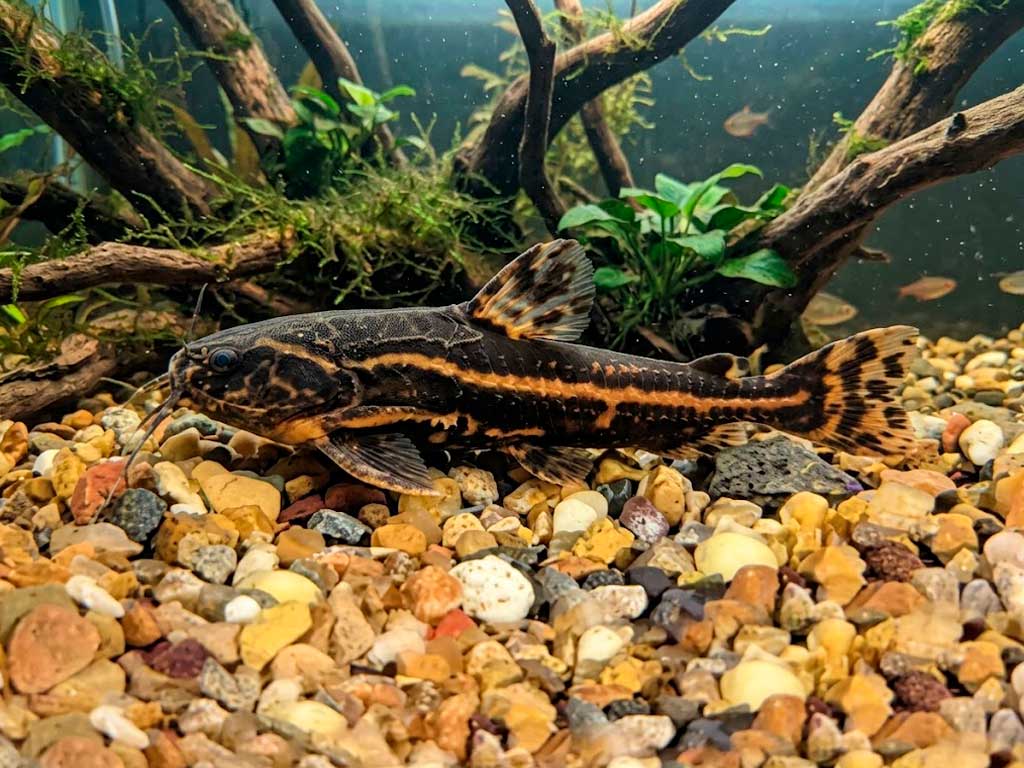
Acanthodoras cataphractus can actually make noise, a genuinely rare trait that gave its entire family the nickname “talking catfish.” In practice, most keepers who own this species didn’t shop for it specifically.
It usually arrives as an accidental extra in a shipment of a more common relative, which means plenty of people end up owning one without ever having looked it up.
This guide covers what it actually needs, how it produces sound, and one real safety detail worth knowing before handling it.
Quick Identity Card
| Trait | Detail |
| Scientific name | Acanthodoras cataphractus (Linnaeus, 1758) |
| Common names | Spiny Catfish, Chocolate Talking Catfish, Chocolate Raphael, Milky Catfish |
| Family / Order | Doradidae, Siluriformes |
| Synonyms | Silurus cataphractus, Cataphractus americanus, Doras blochii |
| Origin | Northern Amazon basin plus coastal drainages of Guyana, Suriname, French Guiana |
| Adult size | 11.5 cm SL formal record; reports of up to 20 cm TL in the wild |
| Diet | Omnivorous generalist, digs through sediment for food |
| Temperament | Non-aggressive, gregarious, mostly nocturnal |
| Water temperature | 22 to 26°C (72 to 79°F) |
| pH | 6.0 to 7.5 |
| GH (hardness) | 4 to 25 dGH |
| Minimum tank | 120 x 30 cm base, roughly 108 L (29 US gal) |
| Breeding | Conflicting reports; details below |
| IUCN status | Least Concern (assessed 2020) |
Origin and Natural Habitat
Acanthodoras cataphractus spreads across a genuinely wide stretch of northern South America: Bolivia, Brazil, Peru, and Colombia within the Amazon basin, plus the Atlantic coastal drainages of Guyana, Suriname, and French Guiana.
Its precise type locality was never recorded, listed only as “America” in the original 1758 description.
It favors slow-moving or standing water: tributaries, backwaters, freshwater swamps, and coastal mangroves. During the day it shelters among roots or submerged vegetation, emerging at night to forage, and it often turns up in large mixed aggregations alongside other doradids like Platydoras armatulus and Agamyxis pectinifrons.
Identification
The species name explains its whole look: cataphractus comes from Greek for “clad in armour,” referring to a heavily ossified nuchal shield, a bony spine-like humeral process, sturdy serrated pectoral-fin spines, and deep bony thorn-bearing plates running along the body from behind the head to the base of the tail.
This species can be genuinely hard to tell apart from its only congener, Acanthodoras spinosissimus. The most reliable external difference sits on the dorsal surface between the dorsal and caudal fins: pale blotches mark spinosissimus, while cataphractus shows only pale lines or no markings at all there.
Behavior and Temperament
This species runs non-aggressive and gregarious, doing best in a group of at least four. It groups naturally with similarly-shaped relatives too, including Platydoras armatulus, Agamyxis pectinifrons, and Amblydoras hancockii, so mixed doradid groupings work well in a large enough tank.
One caveat worth knowing: adults have enough of a mouth to swallow very small fish whole, so tankmate sizing matters even though the species itself isn’t aggressive by nature. Activity peaks at night, consistent with its habit of hiding among roots and vegetation during the day.
Sound Production
Here’s what actually matters for the “talking catfish” name: this species produces audible sound through stridulation, rubbing its pectoral spines against their sockets. Each basic sound unit lasts roughly 100 to 200 milliseconds at a frequency of 170 to 250 Hertz, and the pelvic girdle likely plays a role in projecting the resulting noise outward.
A second mechanism, the “elastic-spring apparatus,” also contributes. This specialized structure combines the fourth vertebrae, the swim bladder, and associated muscles and ligaments into a genuine sound-producing system, a trait shared across much of the Doradidae family.
Diet and Feeding
As an omnivorous generalist, this species accepts most commonly available prepared and frozen foods without fuss. It actively digs through sediment to forage, mirroring its natural feeding style.
A solid rotation includes quality dried sinking pellets or tablets, supplemented with live or frozen bloodworm, tubifex, and mosquito larvae, plus the occasional whole or chopped earthworm for extra protein. The feeding guide for ornamental fish covers the broader principles behind building that kind of varied rotation.
Tank Requirements and Water Parameters
A base of 120 x 30 cm marks the recommended minimum, working out to roughly 108 liters (29 US gallons). A dimly-lit setup with a soft, sandy substrate and plenty of cover from aquatic vegetation, driftwood tangles, or artificial caves suits this nocturnal species well.
Water parameters stay manageable: temperature between 22 and 26°C (72 to 79°F), pH from 6.0 to 7.5, and general hardness anywhere from 4 to 25 dGH, a genuinely wide tolerance. The water chemistry guide covers holding those parameters steady, and given the tank size involved, the filtration systems guide is worth checking before stocking.
A Real Handling Warning
Trust me on this one: take care when netting this species. The pectoral fin spines and body scutes catch easily in standard aquarium net mesh, and those same spines can break human skin during handling. This isn’t a rare or exaggerated warning. It’s a routine part of keeping any doradid, and it’s worth knowing before the first tank maintenance session rather than after.
Breeding
This is a case where sources genuinely disagree, and the honest answer is to say so rather than pick one version. Some accounts describe this species forming pair bonds, with both male and female excavating a shallow pit for eggs, followed by post-spawning brood care and defense, with incubation running 4 to 5 days. Other tracking sources report no confirmed breeding record in the aquarium hobby at all.
Given how little solid documentation exists either way, anyone attempting to breed this species should treat it as genuinely unexplored territory rather than following an established protocol.
Conservation Status
The IUCN Red List classifies Acanthodoras cataphractus as Least Concern, last assessed in 2020. Its wide distribution across multiple river basins and coastal drainages gives it real resilience compared to more narrowly distributed catfish species.