Acanthocobitis Pictilis: Care Guide for the Cherry-fin Loach
Acanthocobitis pictilis only got a name in 2012, and before that, every specimen sold under the name “Cherry-fin Loach” in the hobby was actually being mislabeled.
In practice, this species exists on paper specifically because someone finally checked whether the fish in the trade matched the fish the name was supposed to describe, and they didn’t.
This guide covers what pictilis actually is, why its own name kept splitting even after 2012, and how to set up a tank for a species that needs real current to thrive.
Quick Identity Card
| Trait | Detail |
| Scientific name | Acanthocobitis pictilis (Kottelat, 2012), now Paracanthocobitis pictilis |
| Common name | Cherry-fin Loach |
| Family / Order | Nemacheilidae, Cypriniformes |
| Origin | Ataran River, upper Salween basin, Thailand into Myanmar |
| Adult size | Up to 9.1 cm SL (3.6 in) |
| Diet | Micropredator, insect larvae in the wild |
| Temperament | Bold, not the most peaceful in its genus |
| Water temperature | 21 to 26°C (70 to 79°F) |
| pH | 6.5 to 7.5 |
| GH (hardness) | 1 to 8 dGH |
| Minimum tank | 90 x 30 cm base, roughly 81 L (21 US gal) |
| Breeding | Unrecorded |
| IUCN status | Not Evaluated |
Origin and the Naming History
Here’s what actually matters before anything else: this species used to be sold under a name that didn’t belong to it. Every fish traded as “Acanthocobitis rubidipinnis” before 2012 was, in reality, an undescribed species, since true A. rubidipinnis turned out to be endemic to the lower Irrawaddy basin in Myanmar and has never actually appeared in the aquarium hobby.
Kottelat’s 2012 description fixed that by giving the trade fish its own valid name, Acanthocobitis pictilis, originally covering both the Ataran River (an upper Salween tributary flowing from Thailand into Myanmar) and the Mae Khlong watershed in western Thailand. That didn’t hold either.
Singer and Page’s 2015 revision split the Mae Khlong population into yet another new species, Paracanthocobitis maekhlongensis, narrowing true pictilis down to the Ataran River alone. A third river system, the Hanthayaw, likely holds pictilis too, though that hasn’t been formally confirmed.
Identification
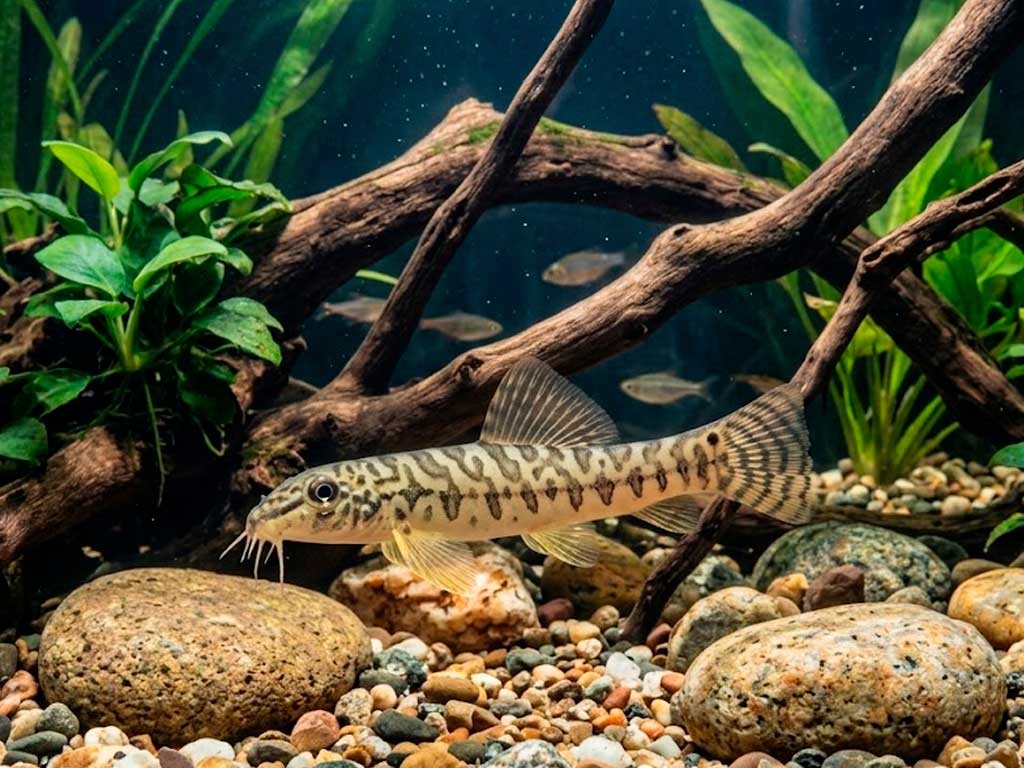
The color pattern is the clearest field mark: dark brown, triangular saddle-shaped markings across the body, strongly slanted toward the front and straightening out further back. Unlike several of its close relatives, pictilis lacks large dark spots, blotches, or bars along the sides.
A small, vertical or crescent-shaped black blotch sits near the dorsal margin of the caudal peduncle, distinct from the round spot seen in some related species. Males carry 12.5 to 13.5 branched dorsal-fin rays and 8 pelvic-fin rays, technical details that matter mainly for confirming identification against its several close relatives.
Behavior and Temperament
This species doesn’t share the mild reputation of some other zipper loaches. It runs bold, and reports describe individual males becoming excessively territorial or aggressive when kept alone or in very small numbers.
The fix is straightforward: a mixed-sex group of at least six gives subdominant fish somewhere to retreat and keeps dominant males focused on each other rather than on tankmates. Sexual dimorphism shows up clearly too. Males develop a deep suborbital slit and thickened, tubercle-covered pectoral-fin rays, while nuptial males flush reddish across the snout and fins. Gravid females run noticeably deeper-bodied.
Diet and Feeding
In the wild, this species works as a micropredator, and stomach content studies during the 2015 taxonomic revision found larval chironomids and mayflies (ephemeropterans) as the main prey items.
In the aquarium, sinking dried foods form a reasonable base, but regular meals of live or frozen fare like Daphnia, Artemia, and bloodworm matter for long-term health. The feeding guide for ornamental fish covers the broader principles of building that kind of varied rotation.
Tank Requirements and Water Parameters
A base of 90 x 30 cm marks the real minimum, working out to roughly 81 liters (21 US gallons). That’s a genuinely manageable size compared to some of the giants covered elsewhere on this site, but the water quality demands are strict.
Water needs to run clean and well-oxygenated: temperature between 21 and 26°C (70 to 79°F), pH from 6.5 to 7.5, and general hardness on the soft side at 1 to 8 dGH. This species is intolerant of accumulated organic waste and needs spotless water at all times, which means it should never go into a biologically immature tank. Strong current and high dissolved oxygen matter as much as the numbers themselves.
The water chemistry guide covers testing and holding those parameters steady, and the water pump guide breaks down building the kind of flow this species actually needs.
Tankmates and Compatibility
Given the bold, occasionally territorial temperament, tankmates need to hold their own. Similarly-sized, active, schooling or shoaling cyprinids work well, and robust loaches from genera like Schistura, Nemacheilus, Botia, and Yasuhikotakia make suitable companions too, along with many Garra species.
This isn’t rated as a community fish in the gentle sense. It pairs best with fish that can match its energy rather than delicate or slow-moving species that would get bullied or outcompeted.
Breeding
Reproduction remains completely unrecorded for this species. Given how recently it was even formally described, that gap isn’t surprising, and anyone who successfully breeds it would be contributing genuinely new information to the hobby.
How It Differs From Its Close Relatives
The genus split this species belongs to produced several genuinely similar-looking loaches, and telling them apart comes down to a handful of specific traits rather than general appearance.
| Species | Caudal spot | Dorsal-fin rays | Distinguishing note |
| P. pictilis | Vertical or crescent-shaped | 12.5 to 13.5 | No large spots or bars on body sides |
| P. maekhlongensis | Round | Similar range | Mae Khlong population, split from pictilis in 2015 |
| P. mandalayensis | Vertical or crescent-shaped | 10.5 to 11.5 | Fewer dorsal-fin rays than pictilis |
| P. canicula | Round | Similar range | Only 5 to 7 dark bands on the caudal fin |
| P. rubidipinnis (true) | N/A | 13.5 to 15.5 | Suborbital flap in males, not a groove; never in the trade |
The suborbital feature offers the fastest practical check: pictilis males show a groove, while true rubidipinnis males show a flap. Since rubidipinnis has never turned up in the aquarium hobby, any zipper loach actually available for sale under either name is almost certainly pictilis.
Conservation Status
Acanthocobitis pictilis carries no IUCN assessment at all, listed as Not Evaluated. That’s a direct consequence of how recently the species was described and how narrowly its confirmed range has since been drawn. A single-river endemic this newly recognized simply hasn’t gone through formal conservation review yet.