Kenyi Cichlid (Maylandia Lombardoi): Care Guide & Color Change
The kenyi cichlid is sold to beginners as a cute, blue-and-white striped juvenile, and it grows into one of the most aggressive mbuna in Lake Malawi.
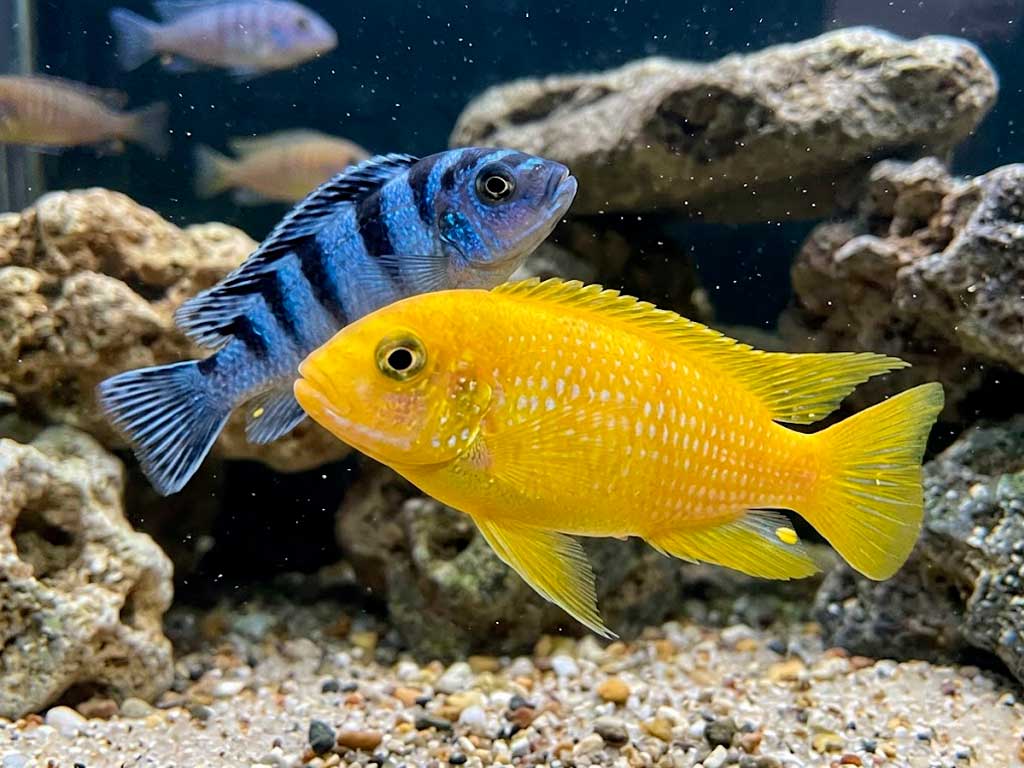
In practice, the original 1977 description already flagged the trait that makes the species so recognizable: reversed sexual coloration, with adult males turning bright yellow while females stay blue and barred.
This guide covers why the colors change, what tank and stocking plan the species really needs, how two wild populations differ, and why three different genus names show up on labels.
Quick Identity Card
| Trait | Detail |
| Scientific name | Maylandia lombardoi (Burgess, 1977) |
| Common names | Kenyi Cichlid, Kennyi, Golden Zebra, Lombardoi |
| Family | Cichlidae (mbuna, Lake Malawi) |
| Origin | Mbenji Island and Nkhomo Reef, Lake Malawi |
| Adult size | Males about 12 to 13 cm (5 in), some reach 15 cm; females about two thirds of that |
| Diet | Algae grazer, herbivore-leaning |
| Temperament | Highly aggressive, not for novices |
| Water temperature | 24 to 26°C (75 to 79°F); 23 to 28°C reported |
| pH | 7.5 to 8.5 |
| GH (hardness) | Hard, up to 25 dGH reported |
| Minimum tank | Sources range from about 190 L (50 US gal) to 300 L (80 US gal) |
| Breeding | Maternal mouthbrooder, 16 to 22 fry per brood reported |
| IUCN status | Least Concern (2018) |
Why Juveniles Look Like Females and Adult Males Break the Rule
In many mbuna, males carry the bold blue while females look plainer. Kenyi cichlids reverse that. Females and juvenile males are pale white-blue with several blue-black vertical bars that extend into the dorsal fin, while adult males turn bright yellow, sometimes orange, with faint brown bars, plain yellow fins, and egg spots on the anal fin.
That pattern has a practical consequence. A shop tank of juveniles all looks alike, so buyers can’t tell how many males they are taking home, and the males only reveal themselves as they mature.
Adult females darken until their blue looks almost black, and one source describes them in shades of purple. A brooding female takes on male-like coloration and defends a small territory, which can confuse anyone trying to sort the sexes by color alone.
The reversal echoes the color story in the Melanochromis auratus guide, though the two species do it differently: auratus males go dark, while kenyi males go yellow.
Origin and Two Wild Populations
The kenyi cichlid is endemic to Lake Malawi, where it lives at Mbenji Island and Nkhomo Reef. It is most abundant at about 10 meters (33 ft), in the rock-and-sand transition zone where rocky and sediment-rich areas meet. It has also been introduced to Namalenji Island, and Eschmeyer’s Catalog of Fishes lists an introduced population in Hong Kong.
Specialists note that fish from Mbenji Island grow much larger than those from Nkhomo Reef, and that the Mbenji stock is aggressive and territorial enough to need larger tanks. Size figures in care sheets range from roughly 10 cm to 15 cm, and the difference between these two populations may be one reason.
A Name With Three Genus Labels
Burgess described the species in 1977 as Pseudotropheus lombardoi, naming it for John Lombardo, an exotic fish dealer. Since then the genus has moved around. Konings and Stauffer used Metriaclima in 2016, the IUCN followed by treating the species as Metriaclima in 2017, and Eschmeyer’s Catalog of Fishes currently lists Maylandia lombardoi as the valid name. Wikipedia notes that a minority of cichlid researchers do not consider Maylandia valid at all.
Trade names add another layer. Kenyi and kennyi are older hobby names with no scientific standing, and Pseudotropheus lilancinius, a label used especially in Europe, is simply incorrect. In practice, searching under Maylandia, Metriaclima, Pseudotropheus, and kenyi covers every label.
Kenyi Cichlid Behavior: An Honest Warning
Here’s what actually matters before buying: specialists rank this among the most aggressive mbuna, and males are usually highly intolerant of each other.
Fishkeeper calls the species very aggressive and best kept crowded in a well-maintained tank with plenty of rockwork. One hobbyist review describes returning a lone male to the store after an hour, because he harassed every fish in the tank regardless of species or sex.
The stocking advice fits the other aggressive mbuna in this series. Fishipedia recommends at least four fish in 300 L, with three females per male and never several males together. Given how males behave, one male with several females is the safer starting point.
The species also digs in sand and can uproot or destroy plants, so a planted tank is a poor fit. Fishipedia adds that mixing several species of the same genus risks hybrids.
Diet and Feeding
In the wild the kenyi cichlid brushes algae (aufwuchs) off rocks and takes some plankton, so the aquarium diet should lean plant-based. Spirulina flake, granules, cichlid pellets, and frozen foods make up the standard menu. The feeding guide for ornamental fish covers building a balanced rotation in more depth.
Tank Requirements and Water Parameters
Recommended volumes run from about 190 L (50 US gallons) in retail care sheets to 300 L (80 US gallons) in Fishipedia, and one hobbyist source suggests at least 75 gallons for anyone keeping more than one. Given the aggression, the larger figures are the safer reading. Stack rock into caves and separate territories over sand, and use the African cichlid tank setup guide as the blueprint.
Water needs to stay hard and alkaline like the rest of Lake Malawi: temperature between 24 and 26°C (75 to 79°F), with 23 to 28°C reported as tolerable, pH from 7.5 to 8.5, and general hardness up to 25 dGH. Fishipedia adds a practical tip: limestone-type rock such as travertine supports the alkaline chemistry.
Tankmates and Compatibility
Care sheets list a Malawi cichlid community as the right company, which in practice means other robust mbuna in a large tank. The Tropical Tank recommends combining it with larger or more aggressive mbuna, and Fishipedia warns that keeping it with other territorial species in too little volume stresses its neighbors.
Gentle species are a poor match. The yellow lab in the Labidochromis caeruleus guide is also yellow but notably peaceful, so a gentle mbuna can be outmatched here.
Breeding
Kenyi cichlids are maternal mouthbrooders, and breeding in home aquaria is considered easy. Fishipedia gives ideal spawning conditions around 25°C and pH 8, and broods of 16 to 22 fry are reported. Dominant males are polygamous, which is one more reason to keep more females than males.
Conservation Status
The IUCN rates the species Least Concern, based on a 2018 assessment by Ad Konings. Konings explains that it was previously classified as Vulnerable, probably because it is restricted to a few small islands and a reef, but that it is fairly common in its habitat and also occurs on small reefs scattered between the Mbenji Islands and Nkhomo Reef. Several care sheets still cite the older Vulnerable rating.