Aborichthys Elongatus: Care Guide for the Red-Tailed Squirrel Loach
Aborichthys elongatus needs water moving hard enough to challenge a powerhead, and that single requirement rules it out for most standard community tanks before diet or tankmates even enter the conversation.
This loach comes from a genuinely narrow slice of the hobby: fast Himalayan foothill streams, cool water, and a body built to dig.
This guide covers where it actually lives, how to set up a tank that matches that, and why most fish sold under this name in the trade probably aren’t the real species at all.
Quick Identity Card
| Trait | Detail |
| Scientific name | Aborichthys elongatus (Hora, 1921) |
| Common names | Red-Tailed Squirrel Loach, Striped Sand Loach |
| Family / Order | Nemacheilidae, Cypriniformes |
| Synonym | Noemacheilus elongatus |
| Origin | Darjeeling District, West Bengal, India (Sivalik Hills streams, Teesta/Brahmaputra drainage) |
| Adult size | Up to 75 mm SL (3 in) |
| Diet | Carnivore, aggressive feeder |
| Temperament | Not aggressive toward other species, loosely sociable among its own |
| Water temperature | 15 to 21°C (59 to 70°F) |
| pH | 6.5 to 7.5 |
| GH (hardness) | 5 to 12 dGH |
| Minimum tank base | 60 x 30 cm (24 x 12 in), roughly 54 L / 14 US gal |
| Breeding | Unreported in aquaria |
| IUCN status | Least Concern |
Origin and Natural Habitat
Aborichthys elongatus comes from a specific corner of northeastern India: streams and minor rivers draining the Sivalik Hills in Darjeeling District, West Bengal, including the Relli, Chel, and Ghish rivers. These all feed into the Teesta River, part of the larger Brahmaputra drainage.
The habitat itself runs shallow and fast, often with a noticeable gradient, over rocks and cobbles with gravel and sand packed between them. No aquatic plants grow there, though a biofilm of algae and diatoms coats most submerged surfaces.
Fish that share this water include Pseudecheneis sulcata, two Nemacheilus species, and Schistura scaturigina, all specialists in the same fast-current niche.
Here’s what actually matters for sourcing: the type locality sits at high altitude and remains hard to access, which makes true A. elongatus genuinely rare in the trade.
Most fish sold under this name come from lower-altitude populations in neighboring Jalpaiguri District and likely represent a different, still-undescribed species entirely.
Identification
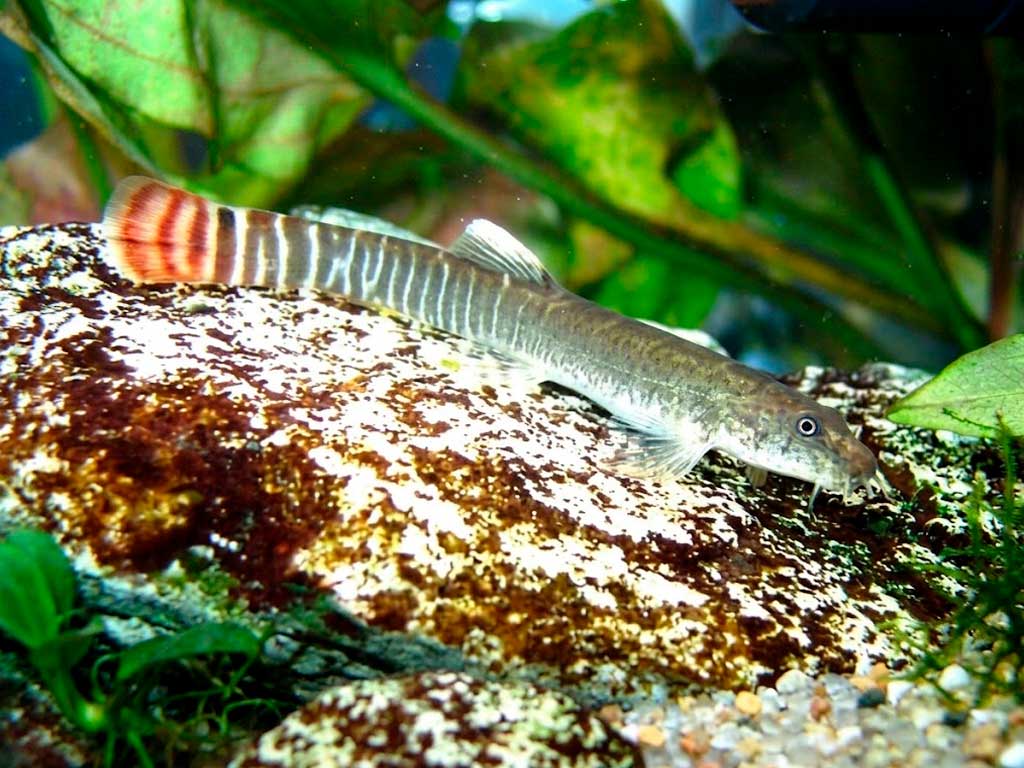
The body runs elongated and laterally compressed, a shape reflected directly in the species name (Latin elongatus, meaning prolonged).
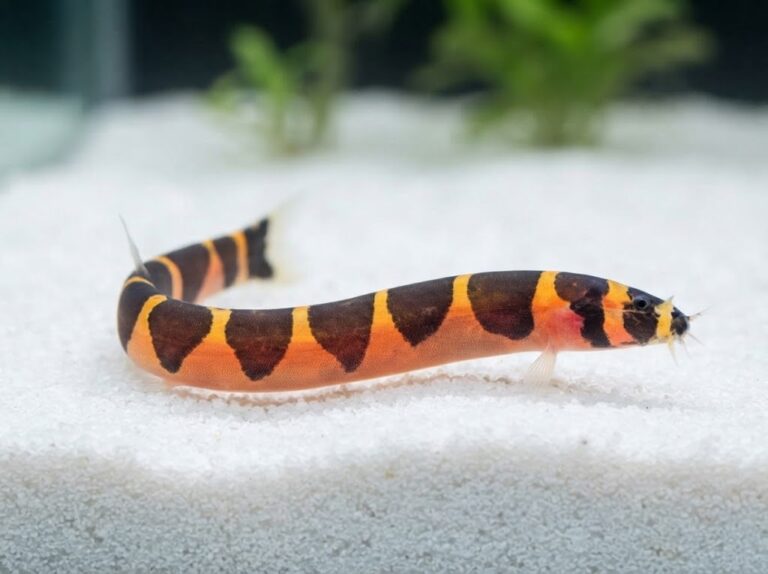
Coloration consists of oblique stripes angled downward and backward, concentrated mostly on the rear half of the body rather than running the full length.
A black spot marks the upper base of the caudal fin, and the tail itself carries a pattern of concentric rings, a detail that separates it at a glance from several lookalike congeners.
The caudal fin stays rounded rather than truncated, which distinguishes it from close relatives like A. waikhomi.
Females run noticeably plumper than males in well-fed specimens and typically show more body markings alongside fewer bands in the caudal fin.
Behavior and Temperament
This species can be both entertaining and frustrating to keep, and the reason comes down to one habit: it digs constantly.
Males in particular excavate holes under rockwork with real determination, and that digging can undermine an unstable rock stack enough to cause a collapse.
Feeding time turns into something close to a frenzy. The addition of food to the tank triggers a burst of frantic activity that can stress slower tankmates sharing the same space, even though this species isn’t genuinely aggressive by nature.
Among its own kind, the behavior reads as loosely sociable rather than schooling. A group of six or more shows the most natural interactions, and while occasional squabbles happen, they rarely escalate into a real problem in a well-structured tank.
Diet and Feeding
In the wild, the diet leans on insect larvae, worms, crustaceans, and other zooplankton picked out of the current. That carnivorous baseline carries over directly into aquarium care.
A rotation that works well combines dried foods the fish will accept readily with regular meals of live or frozen fare such as Daphnia, brine shrimp, and bloodworm.
The species has a highly developed sense of taste and an aggressive feeding response, so expect a noticeable burst of activity whenever food hits the water rather than a calm approach to the bowl.
Tank Requirements and Water Parameters
A minimum base of 60 x 30 cm (24 x 12 in) works for a small group, translating to roughly 54 liters (14 US gallons), though bigger always helps with a species this active. The tank needs to function more like a slice of stream than a standard aquarium.
Water chemistry runs cooler than most tropical setups: temperature between 15 and 21°C (59 to 70°F), pH at 6.5 to 7.5, and general hardness around 5 to 12 dGH. Substrate should combine variably sized rocks, sand, fine gravel, and a few large water-worn boulders, with driftwood arranged to create nooks and shaded spots.
Since this species digs constantly, secure every piece of decor directly onto the tank base before adding substrate, not on top of it.
Oxygenation and flow matter more here than in almost any other freshwater setup covered on this site. A powerful external filter or powerhead, or both, keeps dissolved oxygen high and water moving the way this species expects.
The aquarium water pump guide covers how to size that flow correctly, and the filtration systems guide walks through matching filter turnover to a tank this size. Trust me on this one: undersizing the flow is the single most common mistake with any stream-dwelling loach.
Tankmates and Compatibility
Slow-moving or long-finned species don’t belong in this setup. The current alone stresses them, and they’re likely to end up outcompeted at feeding time or with nipped fins from the general commotion.
Placid bottom-dwellers like Corydoras or Pangio species are also best avoided entirely. Better options include various Danio, Devario, Rasbora, and Garra species, plus gobies from genera such as Rhinogobius and Stiphodon, or catfish like Glyptothorax and Akysis. Many other Nemacheilidae and Balitoridae loaches work too, though squabbles with close relatives happen more often than with unrelated tankmates.
Breeding
Reproduction in captivity remains completely unreported. Nothing in the available literature or hobbyist records describes a successful spawn, which puts this species firmly in the category of “display and observe” rather than “breed and propagate” for now.
Anyone who does manage it would be contributing genuinely new information to the hobby, since this gap has stood unfilled for over a century since the species was first described.
How It Differs From Similar Aborichthys Species
At least eight species now sit in the genus Aborichthys, several of them found in the same general region of northeastern India, and misidentification runs common in the trade. The numbers don’t lie once the diagnostic features sit side by side.
| Species | Caudal fin | Key distinguishing feature |
| A. elongatus | Rounded, with 2 short whitish bands | Posterior body only marked with broad bands; complete lateral line |
| A. kempi | Rounded, 2 black concentric curves | 18 to 21 bands distinct on caudal peduncle; incomplete lateral line |
| A. waikhomi | Truncated, irregular black blotches | 12 to 16 bands from occiput to caudal base; barbels longer than eye diameter |
| A. tikaderi | Similar to congeners | Endemic to Namdapha Wildlife Sanctuary; IUCN Vulnerable; validity debated |
If a “red-tailed squirrel loach” shows up for sale without a confirmed collection locality, checking lateral line completeness and caudal fin shape against this table is the fastest way to sort out what’s actually being offered.
Conservation Status
The IUCN Red List classifies Aborichthys elongatus as Least Concern. That said, the genus as a whole shows real conservation variance: close relative A. tikaderi carries a Vulnerable rating, restricted to a single wildlife sanctuary and threatened by deforestation and dam construction.
For a species already this narrow in its natural range, sourcing matters. Fish genuinely collected as A. elongatus come from a small, remote area, and supporting collectors who document locality data honestly does more for the species long-term than buying whatever gets labeled with the name at a local shop.