Frontosa Cichlid Care: The Complete Guide to the King of Lake Tanganyika
Frontosa cichlid care is more demanding than most freshwater fish — but the payoff is unlike anything else in the hobby.
This is the fish that stops visitors in their tracks. A mature group of frontosas gliding through a large aquarium is one of the most commanding displays in freshwater fishkeeping. We have kept African cichlids for years, and nothing rivals the slow, dignified presence of a fully grown Cyphotilapia frontosa with a well-developed nuchal hump.
In this complete guide, you will learn exactly what tank size to use, which water parameters are non-negotiable, which variants to look for, and what to feed them. Plus, you get an expert tip to reveal the secret electric blue color that most aquarists never see.
Frontosa Cichlid: Quick-Reference Species Overview
| Feature | Details |
|---|---|
| Scientific name | Cyphotilapia frontosa / Cyphotilapia gibberosa |
| Common names | Frontosa, Humphead Cichlid, Front Cichlid |
| Origin | Lake Tanganyika, East Africa |
| Adult size | 12-14 inches (30-35 cm) males; 10 inches females |
| Lifespan | 15-25 years |
| Temperament | Semi-aggressive |
| Diet | Carnivore / piscivore |
| Minimum tank size | 125 gallons (group of 6) |
| Water temperature | 74-80°F (23-26°C) |
| pH | 7.8-9.0 |
| GH | 10-20 dGH |
| KH | 10-20 dKH |
| Care level | Moderate to advanced |
| Breeding | Maternal mouthbrooder |
History and Natural Habitat
The frontosa cichlid is endemic to Lake Tanganyika, one of Africa’s Great Rift Valley lakes. Endemic means it exists nowhere else on Earth naturally.
Unlike most cichlids that live in shallow water, frontosas are true deep-water dwellers. They inhabit rocky zones at depths of 30 to 100 meters (100 to 330 feet), where light is dim and the water is extremely stable. At these depths, they form enormous colonies — sometimes numbering in the hundreds.
Their hunting strategy is built for the dark. Frontosas rise from the depths at dawn and dusk to ambush smaller sleeping fish, then retreat to the rocky substrate below. This predatory behavior directly influences how you feed and house them in captivity.
Scientists currently recognize two closely related species: Cyphotilapia frontosa (found in the north of the lake) and Cyphotilapia gibberosa (found in the south). Their care requirements are identical. The differences between them are subtle, involving scale counts and body proportions that only specialists can reliably distinguish.
Physical Characteristics and Variants
The Nuchal Hump
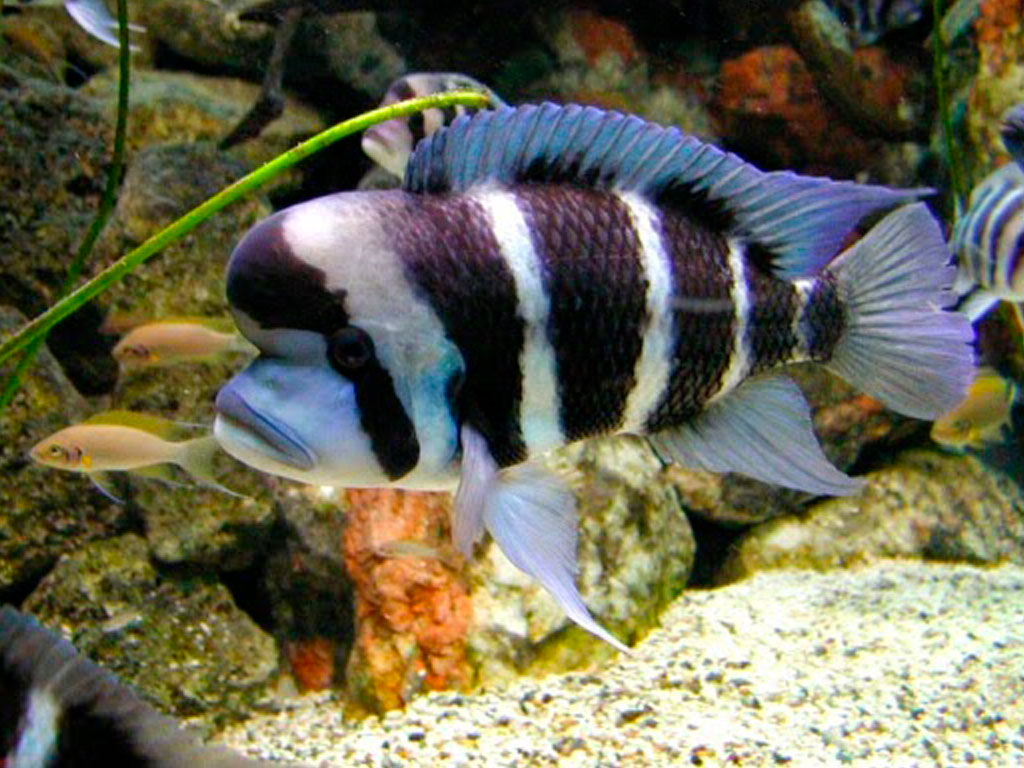
The frontosa’s most recognizable feature is the large fatty hump on the forehead. This protrusion, called a nuchal hump or gibbosity, develops in adult males as a sign of dominance and maturity.
Both sexes grow the hump, but dominant males develop far larger ones. The hump takes years to fully develop — do not expect impressive growth in your first year or two.
Coloration and Body
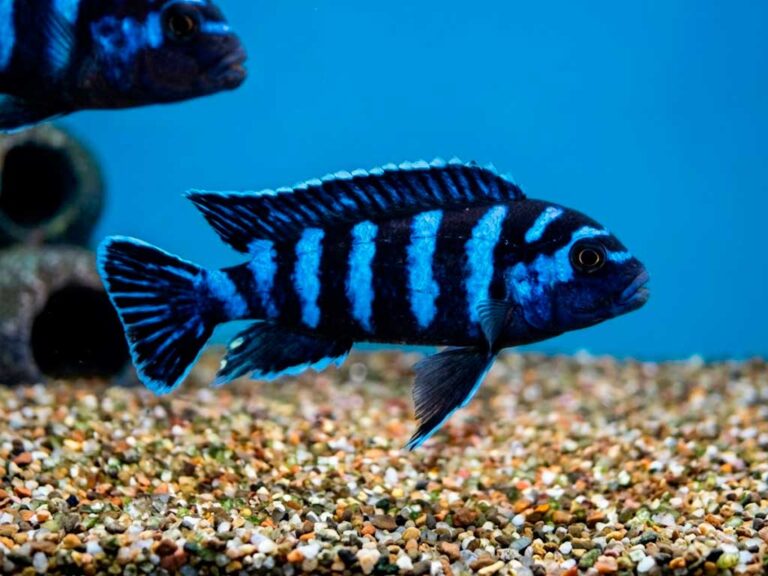
The body is robust and tall, white to pale blue in base color, crossed by 5 to 7 thick vertical black or dark blue stripes. The fins are a beautiful light blue. Males grow noticeably larger than females and develop longer pelvic, anal, and dorsal fins with age.
A key detail: the body color reflects mood and dominance. Dominant males in breeding condition display the most intense blue. Stressed or subordinate fish will appear darker and muted.
Popular Frontosa Variants
Different geographic populations of Lake Tanganyika have developed distinct color forms. These are the most sought-after:
- Burundi Six-Stripe Frontosa: The most common variety in the hobby. Classic black and white pattern with moderate blue on the fins.
- Blue Zaire Frontosa: Stunning deep blue coloration, almost purple in dominant males. This is the showpiece variant that serious collectors seek.
- Mpimbwe Frontosa: Known for exceptional blue intensity. Pairs beautifully with actinic lighting (see the lighting tip below).
- Zambian Blue Frontosa (Blue Face): A striking variant with blue-tinted facial markings.
- Red Frontosa: A line-bred variety from Taiwan with reddish-brown vertical stripes and a notably longer lifespan of up to 25 years.
- Tanzanian 7-Stripe Frontosa: Characterized by an extra black stripe compared to the standard six-stripe forms.
If your goal is maximum blue color, prioritize the Zaire or Mpimbwe variants and combine them with the lighting technique described in the tank setup section.
Frontosa Cichlid Tank Size: The Non-Negotiable
This is the single most common mistake new frontosa keepers make. A 75-gallon tank is not enough for a group.
Frontosas grow to 12-14 inches. They live 15-25 years. They thrive in groups of 6-8. A proper setup demands a long, spacious aquarium with horizontal swimming room.
Here are the practical minimums:
- Solo frontosa or pair: 75 gallons (not recommended long-term)
- Group of 4-6: 125 gallons minimum
- Ideal long-term group of 6-8: 150-200 gallons
The footprint matters more than the height. A long, six-foot tank with a wide base allows natural territory definition and natural swimming patterns. These are midwater fish that patrol horizontally.
Plan for the adult size from day one. Frontosas in an undersized tank show stunted growth, increased aggression, and shortened lifespans.
Frontosa Cichlid Care: Water Parameters
Frontosas come from one of the most stable lakes on Earth. Lake Tanganyika has not experienced significant chemical changes in millions of years. That stability is what this fish expects in your aquarium.
Required water parameters:
- Temperature: 74-80°F (23-26°C)
- pH: 7.8-9.0 (aim for 8.0-8.5 for most tank-bred specimens)
- GH: 10-20 dGH
- KH: 10-20 dKH
If your tap water is soft and acidic, you must buffer every water change. Use crushed coral or aragonite substrate to help maintain alkalinity naturally. Rift lake mineral supplements are also effective for achieving the correct hardness profile.
Filtration and Water Changes
Frontosas produce considerable waste for their size. Strong mechanical and biological filtration is essential. An external canister filter is the minimum recommendation. Many serious keepers run a canister filter combined with a sump system.
Perform weekly water changes of 20-30%. The new water must match the tank’s temperature and pH before adding it. Sudden parameter shifts stress these fish severely and can trigger disease.
Reduce flow rate inside the tank. Frontosas live in still, deep water and are not built for strong currents. Aim the outflow toward the water surface to oxygenate without creating turbulence at the substrate level.
The Expert Tip: Actinic Lighting to Reveal Hidden Blue Color
Here is something most guides skip.
A frontosa under standard white LED lighting looks black and white. Impressive, but not spectacular. However, in their natural habitat 50+ meters down, the light spectrum is entirely different. Virtually all red and yellow wavelengths are filtered out by the water column, leaving primarily blue light.
To replicate this and reveal your fish’s true color potential, do the following:
- Remove your standard white LED tube or fixture.
- Install an actinic blue light, the same type used in marine/reef aquariums.
- Observe within 24 hours.
Frontosa variants with genetic blue potential, especially Mpimbwe and Blue Zaire specimens, will undergo a visible transformation. The white of their body takes on electric iridescent blue tones. The fins glow. This effect is completely lost under white light and is one of the most astonishing sights in freshwater fishkeeping.
Diet and Feeding
In the wild, frontosas are piscivores that hunt sleeping fish at dawn and dusk. In the aquarium, live feeder fish are unnecessary and potentially harmful due to disease risk.
A well-balanced captive diet includes:
- High-quality carnivore cichlid pellets: This should be 60-70% of their diet. Look for pellets with fish meal or krill as the first ingredient.
- Frozen krill: Highly palatable and excellent for conditioning breeding adults.
- Frozen mysis shrimp: A nutritious staple that most frontosas accept eagerly.
- Frozen or fresh mussel meat: Rich in protein and trace minerals.
- White fish fillets: Tilapia or white fish chunks, offered occasionally as a treat.
Avoid bloodworms as a staple food. Overfeeding bloodworms has been linked to intestinal inflammation and bloat in large cichlids. Feed them sparingly, if at all.
Feed twice daily in small amounts rather than one large meal. Frontosas are slow eaters. Uneaten food left on the substrate degrades water quality rapidly, which these sensitive fish cannot tolerate.
Frontosa Tank Mates: A Practical Compatibility Guide
Selecting tank mates for frontosas requires balancing two factors: large enough not to be eaten, and calm enough not to stress your frontosas.
The Three Rules for Frontosa Tank Mate Selection
- Size threshold: Any fish small enough to fit in a frontosa’s mouth is food. Tank mates must be at least 5-6 inches at the time of introduction.
- Temperament: Avoid hyperactive or aggressive species. Mbuna cichlids from Lake Malawi are a common and costly mistake. Their frantic energy stresses frontosas into hiding permanently.
- Water chemistry compatibility: Only choose species that thrive in hard, alkaline water with a pH above 7.8. This rules out most tetras, discus, and soft-water fish entirely.
Best Frontosa Tank Mates
These species are the most reliable choices:
- Altolamprologus calvus and compressiceps: Flat-bodied Tanganyikan cichlids that are naturally peaceful and share identical water requirements.
- Synodontis multipunctatus (Cuckoo Catfish): Armored, peaceful, and active enough to add movement without threatening your frontosas. Also native to Tanganyika.
- Cyprichromis leptosoma: Open-water swimmers that stay near the upper column. Their natural movement encourages frontosas to come out of hiding.
- Large Plecos (Pterygoplichthys species): Tough, nocturnal, and completely ignored by frontosas. They also help clean up leftover food.
- Blue Dolphin Cichlid (Cyrtocara moorii): A large, peaceful Malawi cichlid that tolerates similar water parameters.
Fish to Avoid
- Small community fish of any kind (tetras, guppies, danios, rasboras)
- Mbuna cichlids from Lake Malawi
- Goldfish (wrong water temperature and chemistry)
- Aggressive South American cichlids like Oscars or Jaguars
Frontosa Cichlid Diseases
Frontosas are relatively hardy once established in stable, correct water conditions. However, they are vulnerable to the same diseases that affect other large cichlids.
Ich (White Spot Disease)
The most common freshwater disease and the one frontosa keepers encounter most often. Caused by the parasite Ichthyophthirius multifiliis, it appears as white salt-like specks on the body and fins.
Symptoms include scratching against rocks, rapid gill movement, and visible white spots. Treat with a commercial ich medication at the correct dosage for the tank volume. Slightly raising the temperature to 82°F for 3-5 days accelerates the parasite’s lifecycle and makes treatment more effective. Remove carbon from the filter during treatment.
Malawi Bloat (Cichlid Bloat)
Despite the name, this condition affects many African cichlids including frontosas. It presents as abdominal swelling, loss of appetite, and rapid breathing. Primary causes are internal parasites, bacterial infection, or feeding inappropriate foods like mammal meat or excessive bloodworms.
Treatment requires metronidazole-based medication. This condition is serious and often fatal if not caught early. Remove the affected fish to a hospital tank immediately.
Skin Flukes and External Parasites
Skin flukes (Gyrodactylus species) cause irritation, excess mucus production, and frantic flashing behavior. Treat with praziquantel or fenbendazole-based medications. These parasites are often introduced via new fish that have not been quarantined.
Quarantine all new fish for a minimum of 4 weeks before adding them to your frontosa tank. This single habit prevents the majority of disease outbreaks.
Bacterial and Fungal Infections
Open wounds from territorial disputes can become infected. Keep water quality impeccable and treat localized infections with API Melafix or a broad-spectrum antibiotic if the infection spreads.
Breeding Frontosa Cichlids
Frontosa breeding is genuinely rewarding, but it requires patience measured in years, not weeks.
Getting a Breeding Group
Young frontosas cannot be reliably sexed. For this reason, the standard approach is to purchase a group of 8-12 juveniles and let them pair naturally as they mature. This takes 3-4 years, as frontosas do not reach sexual maturity quickly.
The ideal ratio for a breeding group is one dominant male to 4-6 females. Multiple dominant males in one tank will fight continuously unless the aquarium is very large (200+ gallons).
The Spawning Process
Frontosas are maternal mouthbrooders. Here is how the process unfolds:
- The dominant male courts a female with lateral displays and fin spreading over several days.
- The female lays eggs on a flat surface or in a cave depression. Clutch size ranges from 10 to 50 eggs, but the eggs themselves are unusually large.
- The male fertilizes the eggs immediately.
- The female collects all fertilized eggs in her buccal pouch (mouth) within minutes.
- The female holds the eggs for 28-35 days without eating. Do not stress a holding female, as stress causes her to spit or swallow the eggs.
- Released fry are fully formed miniature frontosas, already 1-1.5 cm long, capable of eating crushed high-protein flake and baby brine shrimp immediately.
Breeding Tips
Perform smaller water changes (10-15% rather than 25-30%) during the breeding period to reduce stress. Slightly increase the temperature to 79-80°F as a spawning trigger. Feed the group more frequently in the two weeks before attempting to breed to ensure females are in peak condition.
Is the Frontosa Cichlid Right for You?
Be honest with yourself before purchasing these fish. Here is a straightforward checklist:
Frontosas are right for you if:
- You have space for a 125-200 gallon aquarium
- You think in years, not months — this fish takes 3-5 years to show its full potential
- You can commit to weekly water changes and precise water chemistry
- You want a showpiece species that commands attention
Frontosas are not right for you if:
- Your current largest tank is under 75 gallons
- You want a beginner-friendly fish
- You keep small community fish you cannot move
- You cannot afford or access the right water chemistry for Tanganyika conditions
The frontosa is not difficult so much as it is demanding. The fish that rewards you with 20 years of prehistoric beauty is the same fish that will suffer in the wrong setup. Get the conditions right first, then get the fish.
Frequently Asked Questions
The first step is getting the tank size right. If you cannot commit to at least 125 gallons for a group, start with a different species and upgrade when the time comes. When you are ready, explore our guide to setting up an African cichlid tank for the complete step-by-step process.
Since Tanganyika cichlids demand unusually stable hardness, understanding how carbonate hardness buffers your pH will save you from unexpected crashes.