Abactochromis Labrosus: Care Guide for This Rare Mbuna
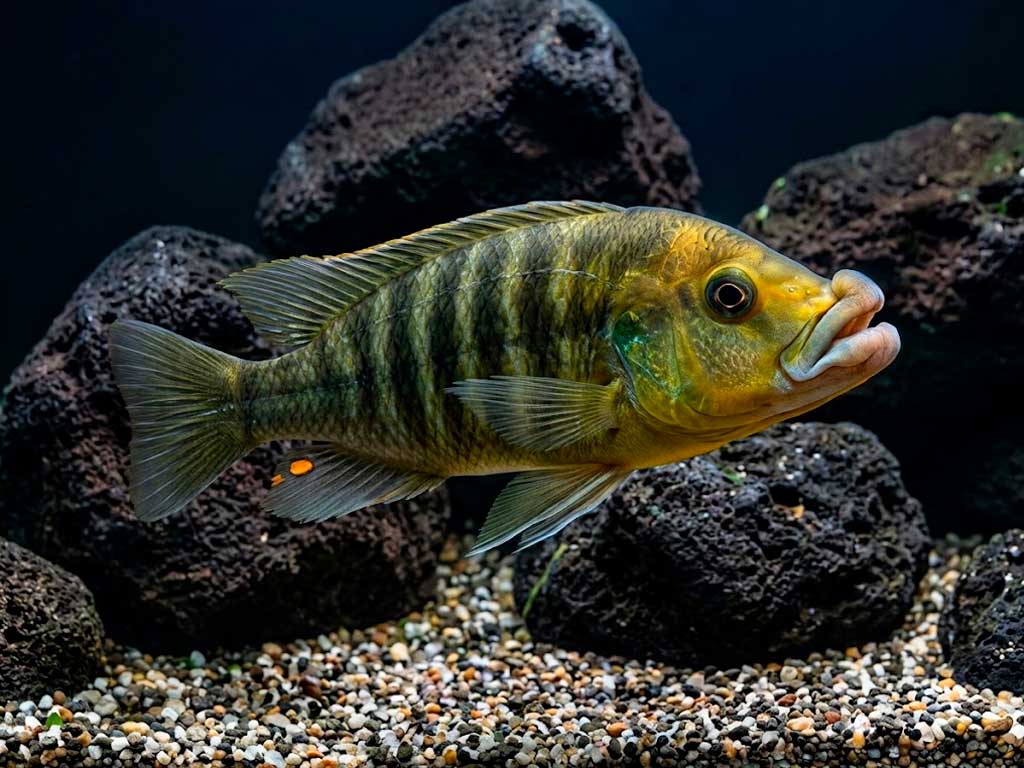
Abactochromis labrosus carries the largest, most swollen lips of any mbuna in Lake Malawi, and that single feature earned it its own genus. In practice, most hobbyists never see this fish outside a handful of specialist import lists, since it stays rare even in its native rocky habitat.
This guide covers its origin, identification, tank requirements, diet, and how it differs from three other big-lipped Malawi cichlids that get confused with it constantly.
Quick Identity Card
| Trait | Detail |
| Scientific name | Abactochromis labrosus (Trewavas, 1935) |
| Family / Tribe | Cichlidae, Haplochromini |
| Synonyms | Melanochromis labrosus, Haplochromis labrosus, Cyrtocara labrosa |
| Origin | Lake Malawi, endemic (type locality: Deep Bay) |
| Adult size | Up to 15 cm (6 in) males, around 12 cm (4.7 in) females |
| Diet | Carnivore, mollusk and crustacean specialist |
| Temperament | Solitary, non-territorial, aggressive toward its own kind |
| Water temperature | 23 to 26°C (73 to 79°F) |
| pH | 7.0 to 8.5 |
| GH (hardness) | 10 to 15 dGH |
| Minimum tank length | 150 cm (59 in) |
| Breeding | Maternal mouthbrooder, rarely documented in captivity |
| IUCN status | Least Concern (assessed 2018), but genuinely rare in the wild |
Origin and Natural Habitat
Abactochromis labrosus lives only in Lake Malawi, the deep rift lake that borders Malawi, Mozambique, and Tanzania. Its type locality is Deep Bay, and confirmed sightings come from rocky sites across the lake, including Mbenji Island, Likoma, Chisumulu, and several reefs along the Malawian shoreline.
The species sits in the demersal zone, meaning it stays close to the bottom rather than swimming in open water. It ranges from the surface down to about 30 meters, always over rocky substrate. That habitat preference explains almost everything about how it feeds and behaves, and it matters directly for how the tank gets set up.
Identification: The Lips Make the Fish
Strip away the taxonomy and one feature separates this species from every other mbuna: papillose, medially lobate lips so hypertrophied they can make up more than 40% of the head length in fish over 5 cm. No other member of the mbuna group carries lips this exaggerated, and the swelling only gets more pronounced with age.
Coloration runs dull by mbuna standards. It lacks the bold, alternating bars that define Melanochromis, the genus it spent 75 years misclassified under before Oliver and Arnegard split it into its own genus, Abactochromis, in 2010. That drab pattern was actually one of the clues that led researchers to question the original classification in the first place.
Body structure includes 15 to 17 dorsal spines, 3 anal spines, and 28 to 29 vertebrae, all standard reference points if a specimen needs to be confirmed against similar-looking Malawi haplochromines.
Behavior and Temperament
Here’s what actually matters for a keeper: Abactochromis labrosus does not behave like a typical mbuna. Most mbuna species defend a patch of rock aggressively against anything that swims near it.
This one wanders instead, moving through open rocky terrain without holding a fixed territory, which is where its genus name comes from (Latin abactus, meaning driven away or banished).
Solitary habits don’t mean peaceful ones. The species turns aggressive toward its own kind specifically, and two individuals rarely tolerate each other in the same tank. Trust me on this one: if you’re planning a species tank, budget for exactly one adult per aquarium unless you have serious extra volume and multiple rockwork zones to break sightlines.
Diet and Feeding
The lobate lips exist for one job: probing crevices and burrows in the bedrock to suck out prey that other mbuna can’t reach. In the wild, the diet leans heavily on small mollusks, shellfish, and occasionally smaller mbuna species pulled directly from rock cracks.
In the aquarium, this translates into a carnivore-leaning diet rather than the algae-heavy regimen typical of most mbuna. A rotation that works well leans on high-protein cichlid pellets formulated for carnivorous or omnivorous Rift Lake species, plus frozen or live shrimp, mysis, or krill offered a few times a week.
Occasional snails add both enrichment and a nod to the species’ natural feeding style. Skip flake foods heavy in plant matter, since they don’t match this species’ natural digestive profile.
Tank Requirements and Water Parameters
A minimum tank length of 150 cm (59 in) reflects both the fish’s adult size and its wandering, non-territorial movement pattern. Cramming it into a standard mbuna community tank undersells the space it actually uses day to day.
Water chemistry needs to mirror Lake Malawi closely: temperature between 23 and 26°C (73 to 79°F), pH firmly alkaline at 7.0 to 8.5, and general hardness around 10 to 15 dGH. Substrate and rockwork should combine fine sand with a real rocky aquascape full of crevices and burrows, not just piled rock, since the species actively probes gaps for food.
Keepers already running a Lake Malawi setup will recognize these numbers immediately. For the full tank-building process, from substrate choice to filtration sizing, the African cichlid tank setup guide covers it step by step, and the aquarium water chemistry guide breaks down how to hit and hold that alkaline range consistently.
Tankmates and Compatibility
Because it fights its own species on sight, a species-only tank rarely works past one adult. Mixed rocky-cichlid setups can work in a large enough system, but avoid pairing it with anything small enough to fit through those specialized lips.
For keepers already deep into demanding rift lake cichlids, the compatibility logic runs parallel to what’s covered in the Tropheus care guide: plenty of rockwork, careful stocking density, and no assumption that “cichlid-safe” tankmates from a generic list will actually work here.
Breeding
Abactochromis labrosus is classified as a maternal mouthbrooder, the standard reproductive strategy across Haplochromini. The female carries fertilized eggs and fry in her mouth for protection until they’re free-swimming.
That said, captive breeding reports stay thin. Some databases list no confirmed breeding record at all, while others document limited F1 (first-generation captive-bred) success. Anyone attempting it should treat every spawn as a genuine data point worth recording, since the hobby still has more questions than answers here.
How It Differs From Similar Big-Lipped Malawi Cichlids
Several other Lake Malawi haplochromines carry enlarged, lobate lips, which causes real misidentification in the trade. The numbers don’t lie once you compare them side by side.
| Species | Total vertebrae | Distinguishing feature |
| Abactochromis labrosus | 28 to 29 | Largest lip development; dull, non-banded color |
| Placidochromis milomo | 30 to 31 | Reaches ~19 cm SL, far larger; broad black vertical bars |
| Otopharynx pachycheilus | Similar range | Longer pectoral fins, lives 78 to 135 m deep; three lateral spots |
| Cheilochromis euchilus | 30 to 31 | Head and jaws not laterally compressed; 2 to 3 horizontal stripes |
| Chilotilapia rhoadesii | 31 | Blunt, grooved teeth built for crushing snail shells |
If a “big-lipped Malawi cichlid” shows up at a shop without a confirmed ID, checking depth range and vertebral count against this table settles most disputes faster than color alone.
Conservation Status
The IUCN Red List classifies Abactochromis labrosus as Least Concern, last assessed in June 2018. That rating reflects a stable overall population rather than abundance. Multiple sources independently describe it as genuinely rare within its own habitat, and collection for the aquarium trade gets flagged as an active pressure on wild populations even under a Least Concern label.
For anyone sourcing this species, that combination is worth sitting with for a second: captive-bred stock, where available, takes real pressure off a population that was never common to begin with.