Blue Dolphin Cichlid (Cyrtocara Moorii): Care Guide & Growth
Recommended tank sizes for the blue dolphin cichlid range from about 180 liters to 700 liters, and the gap says more about how buyers underestimate this fish than about any real disagreement.
In practice, a small juvenile from a shop grows into a 20 cm adult that one source says can reach 30 cm when overfed, and it takes years to get there.
This guide covers how the fish feeds, what it needs in a tank, why sexing it is harder than most care sheets admit, and how its conservation status slid from Least Concern to Vulnerable.
Quick Identity Card
| Trait | Detail |
| Scientific name | Cyrtocara moorii (Boulenger, 1902) |
| Common names | Blue Dolphin Cichlid, Malawi Blue Dolphin, Hump-head, Moorii |
| Family | Cichlidae (Lake Malawi haplochromine) |
| Origin | Lake Malawi and Lake Malombe |
| Adult size | Typically 19 to 25 cm (7.5 to 10 in); up to 30 cm reported when overfed |
| Diet | Omnivore with a carnivore tendency, sand-dwelling invertebrates |
| Temperament | Gentle; males territorial only around spawning |
| Water temperature | 24 to 26°C (75 to 79°F); 23 to 28°C reported |
| pH | 7.2 to 8.5 |
| GH (hardness) | Roughly 8 to 18 dGH |
| Minimum tank | Sources range from 180 L (48 US gal) to 700 L |
| Lifespan | Around 10 years |
| Breeding | Maternal mouthbrooder, about 17 to 21 days |
| IUCN status | Vulnerable (2018) |
A Dolphin Named for a Hump
Boulenger described the species in 1902 from fish discovered by the English biologist John Edmund Sharrock Moore, whom the species name honors. The genus name Cyrtocara means bent head in Greek, a reference to the forehead hump. The common name comes from the same feature, since the hump and the bill-like mouth resemble a dolphin’s head.
Cyrtocara has an odd taxonomic history. MalawiCichlids.com notes that for several years many Lake Malawi cichlids once placed in Haplochromis were temporarily classified as Cyrtocara, before the genus shrank to this single species. Older literature still uses Haplochromis moorii.
The fish reached the hobby in 1968, and its early reputation was rough. AquaInfo says it was soon called hard to keep, partly because of its behavior and partly because of high mortality, and credits larger tanks and regular water changes for the improvement since.
Origin and Natural Habitat
The species is endemic to Lake Malawi and Lake Malombe, which the Shire River links to the lake. It lives over sandy bottoms and in the transition zone between rock and sand, in water that sources place from about 3 to 15 meters deep.
AquaInfo describes it as usually solitary and present throughout the lake but never in large numbers, with no differences between fish from the north and the south. MalawiCichlids.com calls it widespread but not really common on sandy beaches with Vallisneria clumps.
One care sheet in circulation places the blue dolphin cichlid in Lake Tanganyika and recommends Tanganyikan tankmates. That is wrong. Every specialist source consulted here lists Lake Malawi and Lake Malombe.
How It Feeds: Following the Diggers
The feeding style is unusual. In the wild, the blue dolphin cichlid follows close behind sand-digging cichlids such as Fossorochromis rostratus, Mylochromis lateristriga, and Taeniolethrinops praeorbitalis, feeding on the small organisms and particles stirred up as they dig.
Cichlid-Forum calls it the only documented way the fish hunts in the lake, MalawiCichlids.com describes the relationship as commensal and says young fish are the ones that do it, and AquaInfo adds that the follower defends its host against other moorii and other followers.
In the aquarium it is an easy eater. AquaInfo recommends flake or granules alternated with frozen mysis and krill, and warns against tubifex and red mosquito larvae, which it advises avoiding for all Malawi cichlids.
Studio Scaped adds vegetable matter such as spirulina, while Fishipedia calls the diet omnivorous with a carnivore tendency, so a varied menu with a plant component is the safe reading. The feeding guide for ornamental fish covers building a balanced rotation.
Growth, Size, and Patience
Juveniles are silvery grey and start turning blue at around 4 cm. Cichlid-Forum notes that fry carry an orange-yellow anal fin that fades within a few months, and that it takes about one and a half to two years for fish to reach 4 to 5 inches (10 to 13 cm), at which point spawning begins.
Adult size figures cluster around 20 cm. FishBase records 20 cm total length, AquaInfo gives 20 to 22 cm, Fishipedia 19 to 20 cm, and Studio Scaped 20 to 25 cm, while one retailer lists 9 to 10 inches.
Cichlid-Forum gives typical lengths of about 20 cm for males and 16.5 cm for females. AquaInfo adds a warning that too much protein-rich food can push this species, especially males, up to 30 cm.
Identification, Color, and the Sexing Problem
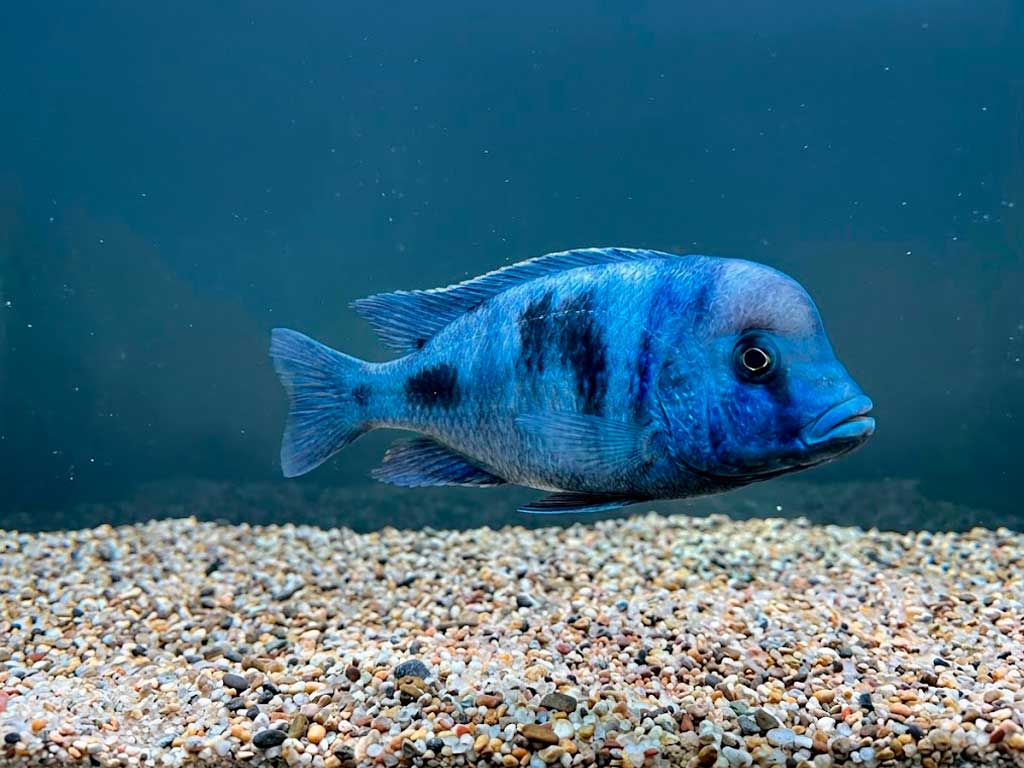
Young fish are greyish with crossbars. Adults are pale blue with three dark spots on the flank, and the shade shifts with mood from pale blue to bright blue, sometimes with the spots vanishing.
AquaInfo says dominant or mating males turn dark blue. Other marks include white lips, yellow eyes, and fins that are usually darker than the body. Fishipedia reports that stressed fish show marked black bars across the body.
Care sheets often say males are larger, brighter, and carry a bigger hump, and one wildlife profile repeats that. Others admit that sexing is hard, since both sexes carry the hump and any difference takes years to show. M. K. Oliver, who runs MalawiCichlids.com, dissected several dozen specimens and found no evident correlation between hump size and sex. The hump is a fatty, fibrous structure that grows with the fish, and its shape varies.
Because of that, retailers suggest starting with eight to ten juveniles and letting the group sort itself out, then keeping one male with several females once the sexes show.
Behavior and Temperament
The blue dolphin cichlid is gentle for a Malawi cichlid. Fishipedia rates it peaceful and not territorial, living in small groups with a clear hierarchy, and says it pays little attention to other species. AquaInfo adds that it normally doesn’t defend territory but makes a temporary exception for its chosen spawning spot.
Groups matter. Fishipedia says a lone fish stresses quickly and turns susceptible to disease, and recommends at least five. AquaInfo says several males and females can share a group, and that fine sand and a few rocks give females somewhere to escape the attention of males.
Tank Requirements and Water Parameters
Volume advice covers a huge spread. A hobby care sheet cited by Wikipedia gives a minimum of 48 US gallons (180 L) and says to increase it as the fish grows. Retailers and Studio Scaped say 75 gallons (280 L), and AquaInfo lists a minimum tank length of 200 cm.
MalawiCichlids.com suggests 180 gallons (680 L), and Fishipedia asks for 700 L for a group of five. For a 20 cm adult that lives around ten years, the larger figures are the ones to plan around.
Use fine sand with a few rocks. Fishipedia notes that the fish digs and can uproot plants or rearrange decor, and Studio Scaped suggests only tough plants such as Anubias or Java fern. The African cichlid tank setup guide covers the general Malawi build, and for this species open sand and swimming length matter more than rockwork.
Water needs to stay hard and alkaline: temperature between 24 and 26°C (75 to 79°F), with 23 to 28°C reported, pH from about 7.2 to 8.5, and general hardness of roughly 8 to 18 dGH. AquaInfo stresses regular water changes, Fishipedia suggests 20 to 30 percent monthly, and limestone-type rock such as travertine helps hold the chemistry.
Tankmates and Compatibility
Peaceful to moderately aggressive haps and peacocks are the natural companions. AquaInfo’s own care sheet for the flavescent peacock lists Cyrtocara moorii among workable tankmates, and the flavescent peacock guide covers that side of the pairing.
Avoid aggressive fish. Studio Scaped lists oscars, jaguar cichlids, and mbuna among the fish to skip, and the kenyi cichlid guide shows why mbuna make poor company for a gentle fish. Fishipedia adds that the species is incompatible with crustaceans.
Breeding
Breeding is rated easy to accessible, and no separate tank is needed. AquaInfo describes the male picking a spot and defending it temporarily, then circling with the female. She puts her nose near his anal fin, even though the male has no egg spots, lays a few eggs, and takes them into her mouth, repeating the sequence. Fishipedia gives ideal conditions around 25°C and pH 8.
The female doesn’t eat while brooding. AquaInfo says the fry stay in her mouth on the yolk sac and are released after about 17 or 18 days, though some mothers hold them until day 25, and Studio Scaped gives about three weeks. Broods often number 40 to 80 fry, and the mother takes them back into her mouth at night or when threatened.
Adult fish eat released fry quickly, so moving the female to a bare rearing tank around day 15 or 16 improves survival, with careful netting because not every female holds her eggs when caught.
Sources also disagree on ratios. Retailers suggest one male with three to six females, while Studio Scaped suggests one male with one or two.
Conservation Status: From Least Concern to Vulnerable
The IUCN assessed Cyrtocara moorii as Vulnerable in 2018 under criterion A2a, which covers an observed population reduction. That is a downgrade from Least Concern, the status recorded in 2006.
Ad Konings wrote on the Cichlid Room Companion that large-scale over-fishing during the previous two decades had wiped out most of the population from its usual habitat, and another profile says shore-net fishing for food and the trade is the main pressure.
Accounts of the trade differ. AquaInfo describes wild fish as hard to catch, since they are quick and stay away from fishermen, so they are mostly caught when wind or current cloud the water, and it says aquarium-bred fish are often available. Cichlid-Forum says most exports come from Lumbaulo and Lake Malombe. Either way, captive-bred fish are the right choice for a species that has already lost ground in the wild.