Filter Media in Aquariums
Aquarium filter media determines whether your filtration system actually works, or just moves dirty water through some foam and calls it done. In a lake or river, waste disperses across a huge volume and breaks down before it reaches dangerous levels; an aquarium doesn’t get that luxury. It’s a closed system with a fish population density nature never intended, so the filter media you choose, and the order you run it in, has to do the job water volume alone handles outdoors. This guide covers every major type of aquarium filter media and adds the reef-tank specifics a lot of general filtration guides skip.
Filtering keeps the chemical and biological balance of aquarium water intact. Filter media removes fish waste, leftover food, and decaying plant matter, which is what keeps water parameters stable and, by extension, keeps your animals healthy. Skip a proper filtration system and a tank turns toxic fast, often before anything looks visibly wrong on the surface.
Types of Filter Media
There are three main categories of aquarium filter media: mechanical, chemical (often labeled absorbent), and biological. Each does a specific job, and running them in the right sequence gets meaningfully more performance out of the same filter.
Media Order: The Sequence That Actually Matters
The order water passes through your filter media matters more than most hobbyists realize. Water should move through coarse mechanical media first, then finer mechanical media, then chemical or absorbent media, and biological media last. This exists for a reason: putting biological media last means the bacteria colonizing it deal with the cleanest water possible, since earlier stages have already stripped out debris that would otherwise clog pores and smother bacterial colonies.
Skipping straight to fine mechanical media without a coarse stage first just means the fine media clogs faster. If your filter has multiple baskets or trays, arrange them coarse to fine, then absorbent, then biological, and every stage lasts longer.
Mechanical Filter Media
Mechanical filter media is the first line of defense in the filtering process, made of synthetic fibers, foam, or fine mesh that physically trap dirt particles as water passes through. Depending on how dense the material is, it can be coarse or fine, and it pulls out detritus, uneaten food, plant fragments, and floating algae before any of that breaks down and raises the nutrient load. Clean or replace it regularly to keep it effective. A dedicated cut-to-size foam sponge pad works well here, since it can be sized precisely to your filter chamber for a tight fit that prevents water from bypassing the media untouched.
Filter Floss, Socks, and Micron Ratings
Not all mechanical media catches the same size particle; that’s measured in microns, where one micron equals roughly 1/1000 of a millimeter. The lower the number, the finer the material and the smaller the particle it stops. A loose 200-micron filter sock lets more debris through than a dense 50-micron felt pad, but it also clogs slower.
Filter floss and felt polishing pads sit at the fine end of that range and aren’t really reusable, since rinsing pulls the trapped fibers apart instead of releasing what they caught. Treat them as disposable in a heavily stocked tank. Coarse sponges and mesh filter socks handle a rinse-and-dry cycle fine and go straight back into the chamber.
Here’s a detail that trips up a lot of hobbyists: leaving mechanical media in too long doesn’t just stop working, it makes things worse, since trapped waste keeps decomposing right there and feeds ammonia and nitrate back into the water you’re trying to clean.
Chemical and Absorbent Filter Media
Chemical filter media, sometimes labeled absorbent media, is granular or resin-based material that binds specific dissolved substances rather than trapping physical particles. Its function depends on which active compound is packed into it, and most tanks only need one or two types running at a time.
Activated Carbon
Activated carbon is the broadest-spectrum chemical media available, and it’s the one most hobbyists reach for first. It pulls tannins, medication residue, chlorine, dyes, and odor-causing compounds out of the water through adsorption, meaning contaminants stick to its surface rather than dissolving into it. Fluval’s premium bituminous carbon inserts are a straightforward option if you’d rather not measure loose granules by hand.
Carbon has a shelf life inside the tank, not just on the shelf; once its pores fill with dissolved organics, it stops adsorbing anything new and can even leach back what it already captured. In a heavily stocked or saltwater tank, that exhaustion point often arrives within a week, while lighter freshwater tanks can stretch a batch out longer. Rinse it before use and run it in a media bag positioned in high flow, not a low-flow dead spot.
GFO and Phosphate Removers
Granular ferric oxide, shortened to GFO, targets phosphate specifically, and it’s what most reef keepers reach for once nuisance algae starts creeping across the rockwork. Phosphate is the byproduct left once bacteria finish breaking down waste, and it feeds algae faster than manual scrubbing keeps up with. Rowaphos and PhosBan both bind phosphate molecules the same basic way, so removing the media removes the phosphate with it.
GFO isn’t something to run continuously by default. Most reefers keep it on hand and deploy it once a phosphate test shows a rising number, rather than dosing it as insurance. It’s also denser than carbon, so a passive media bag barely exposes the granules to flow. A small fluidized reactor, where a gentle current keeps the granules tumbling, pulls far more phosphate out of the same amount of media than a filter basket does on its own.
Resin Media and All-In-One Blends
Resin media is the newest category, popular partly because a few products in it are rechargeable. Seachem Purigen is the best-known example: a synthetic resin that pulls dissolved organic waste out at a rate carbon can’t match, and once spent, it regenerates with a bleach soak instead of getting thrown away. Poly-Filter works similarly but changes color as it saturates, giving a visual cue for replacement most other media never offers.
All-in-one blends combine carbon, GFO, and resin in a single pouch, a reasonable shortcut for nano tanks without room for three separate media types, though each component exhausts at a different rate, so it’s rarely obvious which part is still working. A single targeted media usually outperforms a jack-of-all-trades pouch when one issue dominates.
Zeolite and Ammonia Removers
Zeolite-based media, sold under names like Marineland White Diamond, traps ammonia molecules directly through ion exchange, making it useful as a safety net during cycling or after a bioload jump. It’s not a substitute for biological filtration, though; it competes with beneficial bacteria for the same ammonia, so running it long-term in a cycled tank can slow bacterial colonization instead of helping it.
Black Peat Granules
Black peat granules serve a narrower purpose: softening water and nudging pH and KH down for species that need soft, slightly acidic conditions, like many South American tetras and dwarf cichlids. It works slowly and needs monitoring against a real test kit, since overdoing it can swing pH further than intended.
Biological Filter Media
Biological filter media replicates a process that happens naturally in rivers and lakes, where bacteria settle on substrate and plants to decompose waste. An aquarium’s substrate usually doesn’t offer enough surface area on its own, so biological filter media steps in to provide the colonization space those bacteria need. Live plants play a role too: from the moment they’re introduced, they form microorganism colonies across their surfaces and roots that contribute to waste decomposition and nutrient absorption, on top of whatever manufactured media the filter runs.
Biological media handles the decomposition of ammonia (NH3) into nitrite (NO2) and then into nitrate (NO3). To work well, it needs enough structure and porosity for bacteria to settle deep into the material, not just across its outer surface.
Surface Area: The Real Driver of Biological Filtration
Independent testing has consistently pointed to one conclusion: effective surface area, not marketing claims, determines how much bacteria a media can support. Open-cell foam, K1 fluidized media, and plastic pot scrubbers have tested well against ceramic rings and sintered glass, largely because bacteria colonize the surface film rather than deep inside microscopic pores that clog and go unused. Reputable manufacturers still make strong cases for porous ceramic and ring media too, so treat any single surface-area claim as one data point, not the final word, and judge results against your own water tests.
A related finding worth knowing: truly crystal-clear water takes considerably more effective surface area than simply reaching zero ammonia. A tank can test perfectly for ammonia and nitrite while still looking slightly hazy, since clarity depends on breaking down dissolved organic waste, a job that needs more biological surface area than ammonia oxidation alone.
Ceramic Rings vs. Bio Balls vs. K1
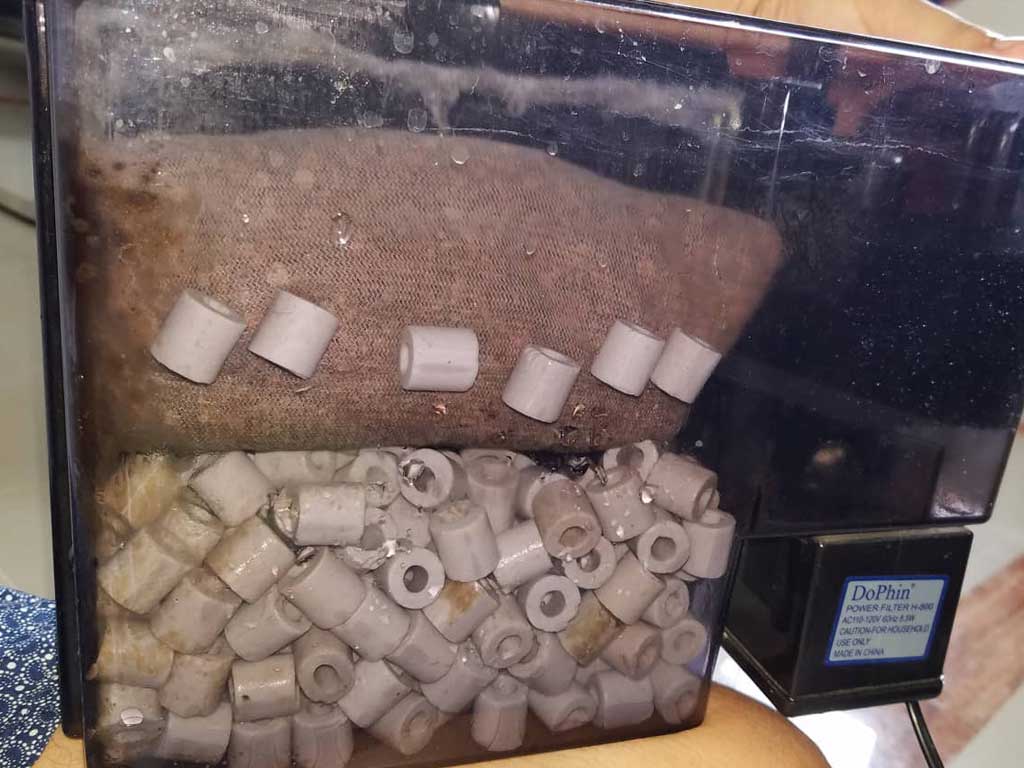
Ceramic rings dominate the biological media market for good reason: they’re inexpensive, widely available, and pack a lot of pore structure into a small volume. Bio balls came first historically, used in wet/dry trickle filters, where their open plastic structure let air reach the bacteria colony for extra oxygenation. They’ve fallen out of favor in fully submerged setups since their surface area per unit of volume runs lower than ceramic or foam.
K1 media, the small plastic chips used in moving bed filters, tumbles constantly in an air-driven or water-driven chamber instead of sitting still, keeping bacteria colonizing a fresh surface film rather than deep inside pores that clog over time. Testing generally favors open-cell foam and K1 over dense ceramic rings on a surface-area-per-dollar basis, though ceramic performs fine in a standard canister or hang-on-back basket.
For most home aquariums, any of these work once properly cycled, and the differences matter more in heavily stocked or commercial systems than in a 20-gallon community tank. Marine Pure blocks and Seachem Matrix sit in the same category, priced at a premium for a modest bump in surface area per ounce.
A Budget-Friendly Option: Pumice
Pumice deserves a specific mention as a low-cost biological media option. It’s a lightweight, naturally porous volcanic rock, and its rough, irregular surface gives bacteria plenty of texture to colonize without the cost of aquarium-branded ceramics. It’s chemically inert, so it won’t meaningfully shift pH or hardness, and its light weight makes it easy to work with in hang-on-back and canister baskets alike. It won’t outperform premium biological media gram for gram, but as a budget option that genuinely works, it’s hard to beat, especially for hobbyists stocking multiple tanks.
For a ready-made biological media without hunting down pumice yourself, Fluval BioMax offers a porous ceramic option sized for most canister and hang-on-back baskets.
Reef Tank Filter Media: What Changes in Saltwater
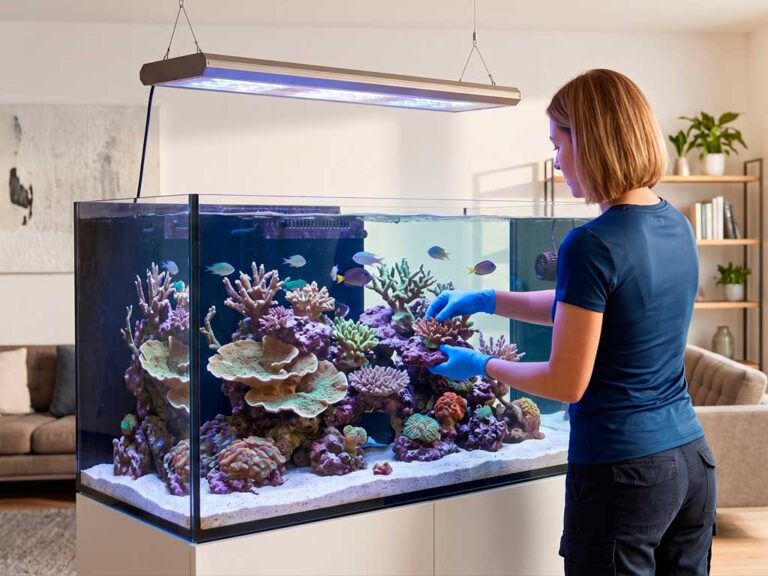
Saltwater setups lean on chemical filtration harder than most freshwater tanks, mostly because reef inhabitants tolerate a narrower water quality range and algae responds fast to any nutrient spike. A properly running reef tank typically runs mechanical media and activated carbon around the clock, with GFO added whenever phosphate creeps up.
Biopellets are the reef-specific aquarium filter media most freshwater guides never mention. They’re biodegradable plastic beads that feed a bacterial biofilm directly, and as that biofilm consumes nitrate and phosphate, it eventually needs exporting, usually by a protein skimmer pulling the spent film out before it breaks back down. Biopellets only work inside a dedicated reactor with enough flow to keep them tumbling; dropped into a passive bag, they mostly just sit there. Running biopellets alongside GFO means both compete for the same phosphate load, so most reefers dial one back. Live rock does a lot of this biological work passively too, and it’s worth understanding before deciding how much manufactured media you still need on top of it.
Carbon also exhausts faster in saltwater, mostly because of the higher bioload most reef tanks carry relative to their volume, so swapping it every five to seven days is standard practice rather than stretching a batch out for weeks. Media schedules only make sense alongside the rest of the routine, water changes and parameter testing included, covered in our saltwater aquarium maintenance checklist.
Using the right aquarium filter media is essential to a healthy tank free of contaminants. Mechanical, chemical, and biological media each play a distinct role, and running them in a logical order keeps the whole system balanced. For the bigger picture on filter types and how much media capacity your tank needs, see our complete aquarium filtration guide; if you haven’t settled on hardware yet, our hang-on-back filter comparison covers where most of this media actually sits.
Final Recommendations
- Regular Cleaning: Keep mechanical filter media clean to prevent debris buildup, and don’t let fine floss sit past its useful life.
- Parameter Monitoring: Test phosphate, ammonia, and other harmful substances to decide when chemical media is actually needed, rather than running everything preventively.
- Promotion of Natural Biology: Use appropriate biological media and natural plants, and give new media two to four weeks to cycle before judging performance.
- Avoid Over-Cleaning: Rinse biological media in removed tank water rather than tap water when possible, and never clean more than 80 to 90% of it at once; over-cleaning is a common cause of ammonia spikes. See our guide on why aquariums stop cycling for more.
- Match Media to Your System: Reef tanks lean harder on GFO, faster carbon turnover, and biopellets than freshwater setups need, so treat chemical media as tank-specific, not universal.
Heavily stocked tanks, like the ones covered in our African Cichlid tank setup guide, benefit especially from getting aquarium filter media order and surface area right.
Frequently Asked Questions
What order should filter media go in?
Coarse mechanical first, then fine mechanical, then chemical or absorbent media, and biological media last, so bacteria receive the cleanest water possible.
Is pumice good for aquarium filters?
Yes. Pumice is inert, lightweight, and porous enough to host bacteria effectively, making it a reliable, inexpensive biological media choice.
Do I need chemical or absorbent filter media?
Not always. Carbon and ammonia removers help with specific problems like odors, medication residue, or a bioload spike, but many stable tanks run fine without them.
How often should I replace biological filter media?
Rarely, if ever. Clean it gently and occasionally rather than replacing it, since replacement removes the bacteria colony already built up.
Can I mix different types of biological media?
Yes, though it adds complexity: cleaning schedules differ, and disturbing one type to clean it can mean unnecessarily disturbing others packed alongside it.
Does more filter media always mean better filtration?
Not necessarily. Effective surface area and proper media order matter more than sheer volume. A well organized filter often outperforms an overstuffed one.
What is GFO and do I need it?
GFO removes phosphate specifically, and most tanks only need it once a phosphate test shows a rising number. Reef tanks reach for it more often, since phosphate spikes trigger nuisance algae faster in saltwater.
Ceramic rings or bio balls: which is better?
Ceramic rings generally edge out bio balls on surface area per unit of volume in fully submerged filters. Bio balls still hold their own in wet/dry trickle systems, where the extra airflow matters.
Is Poly-Filter worth using?
For hobbyists who want a visual cue, yes. It changes color as it absorbs contaminants, so replacement is a matter of looking rather than guessing.