Dwarf Gourami (Trichogaster Lalius): Care Guide & Iridovirus Warning
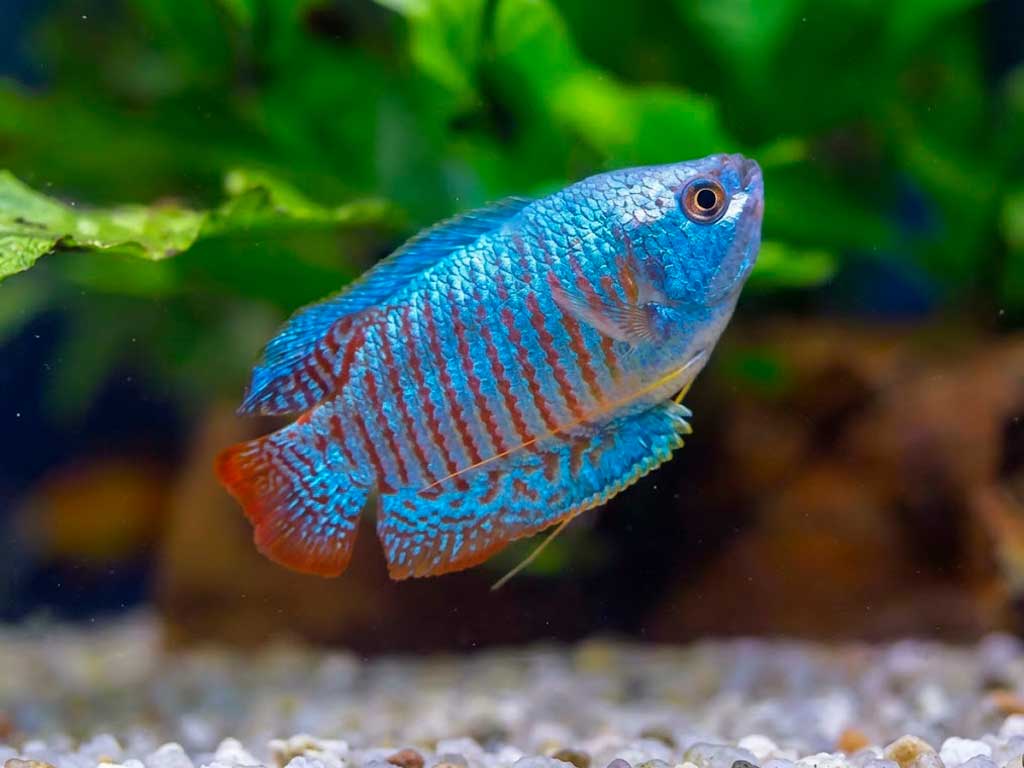
Dwarf gouramis are hardy, colorful, and easy to care for on paper, yet a genuinely serious disease specific to commercially farmed stock makes sourcing this species more important than it looks.
In practice, this small labyrinth fish breathes air at the surface, builds a floating bubble nest to raise its young, and carries a name that’s bounced between two different scientific genera for decades.
This guide covers real tank setup, breeding, and the one health risk worth understanding before buying.
Quick Identity Card
| Trait | Detail |
| Scientific name | Trichogaster lalius (F. Hamilton, 1822) |
| Common names | Dwarf Gourami |
| Family / Order | Osphronemidae, Anabantiformes |
| Origin | Pakistan, India, Bangladesh (Ganges and Brahmaputra basins) |
| Adult size | Up to 8.8 cm (3.5 in), usually smaller |
| Diet | Omnivore, algae-based foods plus meaty foods |
| Temperament | Peaceful but can be territorial, especially males |
| Water temperature | 25 to 28°C (77 to 82°F) |
| pH | 6.0 to 8.0 |
| GH (hardness) | 4 to 10 dGH |
| Minimum tank | 60 L (about 15 US gal) |
| Lifespan | 3 to 6 years |
| Breeding | Bubble-nest builder, easy to spawn |
| IUCN status | Least Concern |
Origin and Natural Habitat
Trichogaster lalius is native to Pakistan, India, and Bangladesh, inhabiting slow-moving rivers, streams, lakes, and floodplains rich in vegetation, including the weedy waters of the Ganges and Brahmaputra river systems. Rice paddies and similarly still, plant-choked water bodies also support wild populations across this range.
That habitat, warm and often low in dissolved oxygen, connects directly to one of this species’ defining features.
Identification and a Confusing Taxonomic History
The scientific name on this fish has genuinely shifted back and forth over the decades. Originally described as Trichopodus lalius, it later moved to the genus Colisa, then back to Trichogaster, where it currently remains as the sole species carrying that older Colisa lineage. Even the closely related honey gourami went through its own genus change, now classified as Trichogaster chuna rather than Colisa chuna.
Wild males display diagonal stripes alternating between blue and red-orange, while females run a plainer silvery color. Beyond coloration, the dorsal fin settles any doubt: pointed in males, rounded or curved in females. Store-bought fish sold as powder blue, flame red, or neon varieties are simply captive-bred color morphs of this same species, not separate types.
The Confusion With Related Gouramis
Young dwarf gouramis get confused, and sometimes sold interchangeably, with juvenile thick-lipped gouramis, a closely related species that looks similar before maturing into a noticeably different adult form. The reddest dwarf gourami variety, sold as “flame red,” also gets mixed up with the red color form of the honey gourami, its closest relative in the genus.
Behavior and Temperament
This species breathes atmospheric air using a labyrinth organ, an adaptation shared with bettas and other gouramis that lets it survive in warm, oxygen-poor shallow water. That same trait means a tank needs a covered top, keeping the air just above the water’s surface warm and humid enough for comfortable breathing.
Despite a generally peaceful reputation, dwarf gourami males can be genuinely territorial toward each other and toward other gourami species, sometimes enough that keeping one male per tank works better than a group. They’re also fairly timid at feeding time around faster surface swimmers like guppies, so spreading food across a wider area helps this species get its fair share.
Diet and Feeding
A varied diet matters more here than for many community fish, given this species’ natural preference for both algae-based foods and meaty options. High-quality flake formulated with algae content works as a solid base, supplemented with live or frozen foods like brine shrimp or bloodworm.
The feeding guide for ornamental fish covers building that kind of balanced rotation in more depth.
Tank Requirements and Water Parameters
A tank of at least 60 liters (roughly 15 US gallons) suits this species well, with dense planting and floating plants both appreciated, partly for cover and partly because floating vegetation gives males material to anchor a bubble nest against. Strong current should be avoided, since this species prefers calm, still water matching its natural habitat.
Water chemistry runs comfortably moderate: temperature between 25 and 28°C (77 to 82°F), pH from 6.0 to 8.0, and general hardness around 4 to 10 dGH. A dark substrate helps set off this species’ coloration visually, though it has no bearing on actual water chemistry. The water chemistry guide covers holding these parameters steady.
Breeding
Dwarf gouramis are bubble-nest builders, a behavior shared with bettas and several other labyrinth fish. Males construct a foam nest at the water’s surface, typically anchored against floating plants, then court a female and guide her beneath it to release and fertilize eggs.
Once spawning finishes, the male typically drives the female away and takes over guarding the nest and fry alone, a pattern common across foam-nest-building species. Breeding is considered genuinely easy to achieve given the right conditions, making this a reasonable first attempt for anyone new to fish breeding.
An Important Health Warning
Here’s what actually matters most before buying this species: dwarf gouramis raised commercially for the aquarium trade, particularly stock farmed in Singapore, can carry dwarf gourami iridovirus, a serious and often fatal disease. Research examining Singapore-farmed stock found roughly 22% of sampled fish carrying this virus.
This isn’t a rare or theoretical risk. Given how much of the global aquarium trade in this species traces back to large-scale commercial farming, buying from a source that can speak to fish health and quarantine practices matters more here than it does for most community fish. Watching new arrivals closely during an extended quarantine period before introducing them to an established tank is a reasonable precaution given this specific, documented risk.
Conservation Status
The IUCN Red List classifies Trichogaster lalius as Least Concern, reflecting a wide native range across Pakistan, India, and Bangladesh along with a long-established, successful presence in the aquarium trade.