African Grey Parrot Care Guide: What to Know Before You Get One
Good African Grey parrot care starts with recalibrating expectations, because this bird is often described as the closest thing to raising a toddler that will still be around in fifty years.
African Greys are widely considered the most intelligent parrot species, and that intelligence cuts both ways: it makes them extraordinary companions and, without enough stimulation, some of the most prone to stress and self-destructive behavior of any pet bird.
This guide covers the two African Grey types, what housing and diet actually require, the behavioral realities that trip up new owners, and what the bird costs beyond the price tag. Compare it against other large parrots first in our types of pet parrots guide if you haven’t settled on a species yet.
Congo vs. Timneh: Which African Grey Should You Get?
There are only two recognized African Grey species, and until 2007 the Timneh was classified as a subspecies of the Congo rather than its own bird.
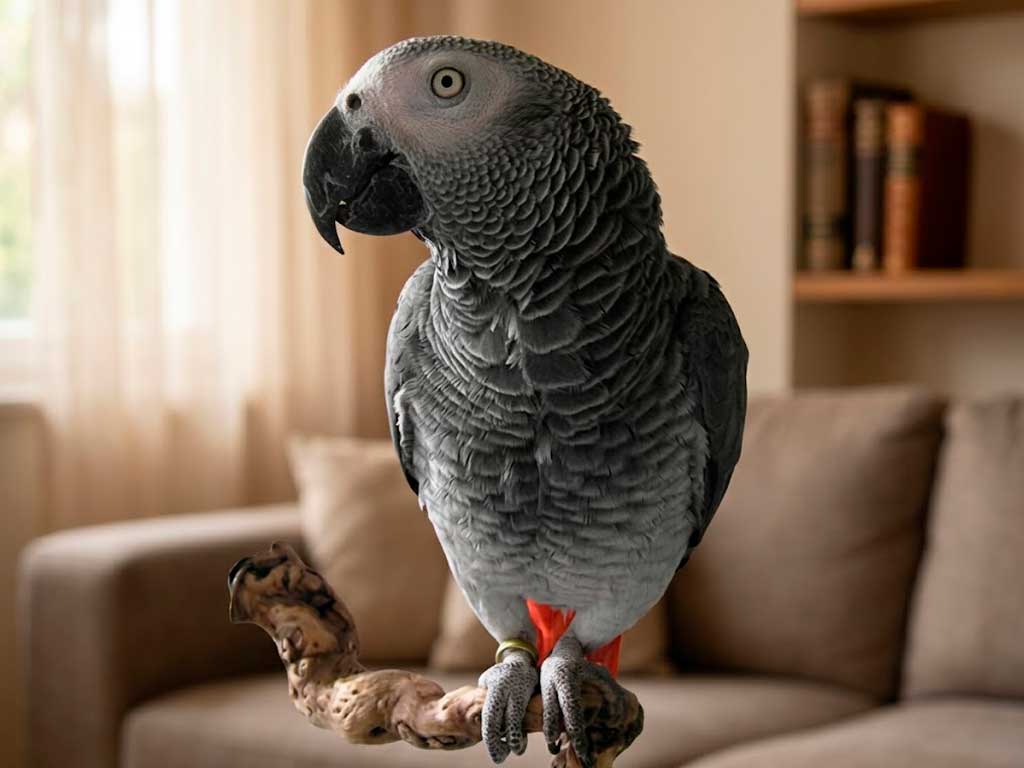
- Congo African Greys are the larger, more familiar type: light silvery-grey feathers, a solid black beak, and a bright red tail. They typically weigh 400 to 600 grams and reach about 13 inches long.
- Timneh African Greys run smaller, with darker charcoal-grey plumage, a maroon (not red) tail, and a beak that’s partly horn-colored rather than solid black. Timnehs also mature and start talking a bit earlier than Congos, and many owners find them slightly less nervous, though both types are sensitive birds at heart.
Either way, the intelligence and care needs are nearly identical. The choice usually comes down to size preference and which coloring you’re drawn to.
Housing: Cage Size and Setup
Aim for a cage at least 35 inches long, 24 inches deep, and 47 inches tall, with bar spacing around 3/4 to 1 inch, tighter for a Timneh than a Congo. Horizontal bars on at least one side give the bird something to climb, which African Greys genuinely enjoy.
Placement matters more for this species than most. An African Grey feels safest with its cage in a corner, where it can’t be approached from every side, rather than out in the open middle of a room. Keep it away from drafts, direct sunlight, and the kitchen, and skip a spot right next to a heating vent.
Perches should vary in width and texture, and a concrete or rough-surfaced perch helps keep nails naturally worn down. Never place a perch directly over food or water, since droppings will contaminate both.
Offer fresh branches from safe woods like apple or willow at least weekly once a Grey is weaned. Chewing bark isn’t just entertainment. It keeps the beak at a healthy length naturally, and Greys introduced to branches early tend to stay comfortable with new wooden toys later, rather than treating them with suspicion.
Diet: What African Greys Eat
Calcium and vitamin A deficiency is the single most common dietary failure in this species, and it’s a serious one. Left uncorrected, low calcium leads to seizures and can shorten a Grey’s life dramatically, sometimes fatally before age 20.
Build the diet around a high-quality pellet, roughly 75 percent of daily intake. Fill out the rest with foods genuinely rich in calcium and vitamin A: red bell peppers, cooked carrots, apricots, dandelion greens, kale, and other dark leafy greens. A vet-formulated calcium supplement, added to a favorite food rather than the water bowl, rounds this out. Cuttlebone alone isn’t enough, since calcium can’t be absorbed without vitamin D3 or real sunlight exposure.
Seeds aren’t off-limits, but a seed-heavy diet is nutritionally hollow and something Greys can become fixated on if allowed to fill up on it. Keep seeds and nuts as a minority treat, not a staple.
Feeding time doubles as enrichment opportunity for this species. Hiding pellets and vegetable pieces inside foraging toys, rather than serving everything in an open bowl, taps into the same foraging instinct wild Greys use to search dense forest for fruit and nuts, and it goes a long way toward preventing the boredom that drives so many behavioral problems in this species.
Temperament, Intelligence, and the Alex Legacy
No pet bird’s intelligence has been documented as thoroughly as the African Grey’s, largely thanks to one bird. Alex, a Congo African Grey studied by Dr. Irene Pepperberg for over 30 years, learned to identify colors, shapes, and materials, count small quantities, and use words in context rather than just repeating them. He understood the concept of zero.
Alex died in 2007 at just 31, young for the species, but his research reshaped how scientists think about avian cognition.
That same intelligence shows up in every pet African Grey, not just research subjects, and it demands a real commitment: most keepers recommend five or more hours of daily interaction and mental stimulation, plus several hours of out-of-cage time.
An under-stimulated Grey doesn’t just get bored. It tends to spiral into anxiety, and anxiety in this species usually shows up on the feathers.
African Greys also bond hard, often to one person over everyone else in the household, and they’re unusually attuned to that person’s moods and routines. Most don’t start mimicking speech until around ten months old, and vocabulary in well-socialized birds can pass 1,000 words, occasionally reaching 2,000 or more.
Feather Plucking and Wing-Clipping
Feather plucking is common enough in this species that it deserves its own section rather than a passing mention. The causes overlap: an environment that’s too dry or too hot, insufficient stimulation, stress, or an underlying medical issue that needs ruling out with an avian vet before anything else.
Wing-clipping deserves specific caution here. Avian experts increasingly discourage it in African Greys, since a clipped bird that still attempts to fly can develop a lasting fear of falling, and that fear frequently triggers feather-destructive behavior.
Clipping young birds too early can also stunt the wing muscle development they’d otherwise build through flight. If you’re unsure, talk to an avian vet about the tradeoffs before defaulting to a clip.
Daily bathing or misting helps prevent plucking tied to dry skin, and an outdoor aviary, even a small one with part of the roof open to the rain, gives a Grey a level of enrichment an indoor cage can’t match.
Common Health Issues
Hypocalcemia, the calcium deficiency mentioned above, remains the most preventable and most common serious health issue in this species. Beyond diet, African Greys are also susceptible to psittacine beak and feather disease (PBFD) and proventricular dilatation disease (PDD), both incurable, which is why testing new birds before introducing them to an existing flock matters. Respiratory and nasal issues can also develop from poor air quality or malnutrition.
An annual avian vet exam, ideally with bloodwork and a fecal check, catches most of this early enough to act on it.
How Much Does an African Grey Cost?
Expect to pay somewhere between $500 and $5,000 for the bird itself, depending on the source, the individual bird’s age and training, and whether it’s a Congo or the somewhat rarer Timneh.
Initial setup, cage, perches, toys, and dishes, typically runs another $75 to $300, and that’s before the recurring cost of pellets, fresh food, and annual vet visits.
Rescue, Adoption, and Choosing an Ethical Source
The Congo African Grey is listed as Endangered by the IUCN, and since October 2016 both Grey species have been listed under CITES Appendix I, the highest level of international trade protection there is.
A pet African Grey should always be captive-bred, never wild-caught, and a legitimate breeder will be transparent about a chick’s parentage and history without hesitation.
Rescue centers are, by most accounts, full of African Greys whose owners underestimated the time commitment. Adopting one skips the unpredictable early bonding period and often means taking home a bird whose personality and needs are already well understood.