Macaw Care Guide: Everything to Know Before You Get One
A good macaw care guide has to start with a warning most sellers skip: this is one of the biggest commitments in the pet world, not just because of the price tag but because a healthy macaw can easily outlive the person who bought it. These are the largest parrots kept as pets, and their size, volume, and intelligence all scale together.
Get the setup right and a macaw becomes one of the most rewarding companion birds there is. Miss the mark, though, and you’re looking at a bird that screams, plucks its own feathers, or ends up in a rescue within a few years.
This guide walks through the real differences between macaw species, what housing and diet actually require, the health issues to watch for, and what the bird costs once the sticker price is behind you. If you haven’t settled on a macaw yet, our types of pet parrots guide compares them against other companion species too.
Types of Macaws: Which Species Should You Get?
Macaws aren’t one bird. There are 17 recognized species plus a handful of hybrids, and picking the right one matters more than most first-time buyers realize.
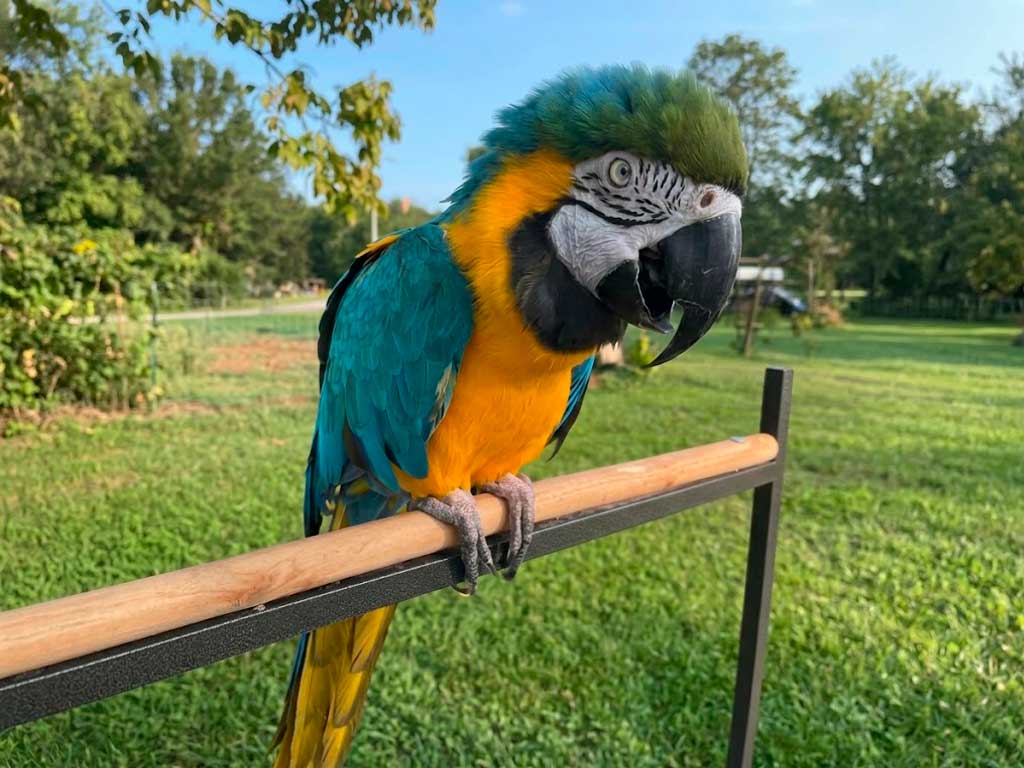
Blue-and-gold macaws are the most common pet macaw and, by most keepers’ accounts, the most even-tempered of the large species. They’re also the ones you’ll see most often at breeders and rescues, which makes finding a well-socialized bird easier than with rarer species.
Scarlet macaws run a bit more intense. They’re gorgeous, red-bodied birds, but many owners describe a stronger streak of independence and a lower tolerance for handling than the blue-and-gold.
Hyacinth macaws are the giants of the parrot world, cobalt blue and up to 40 inches long. Their price and space requirements sit well above the other species here, and their beak is strong enough to crack macadamia nuts and palm seeds whole.
Green-winged macaws (also sold as red-and-green macaws) are close in size to the hyacinth and known for being a touch calmer, though still firmly in experienced-owner territory.
Military macaws are less flashy, mostly olive-green, and tend to be quieter than the big color species, which makes them worth a look for someone set on a large macaw but nervous about noise.
For anyone unsure they’re ready for a full-sized bird, the mini macaws are worth considering first. Hahn’s macaws and severe macaws top out under 20 inches, need a smaller cage, and still pack real personality and a decent shot at talking.
A few hybrids show up in the pet trade too, bred by crossing species: the Catalina (blue-and-gold x scarlet), Camelot (scarlet x green-wing), and harlequin (blue-and-gold x green-wing). They’re striking birds, but responsible breeders are transparent about hybrid origin rather than passing them off as a rare pure species.
One species worth knowing even though it isn’t for sale: the Spix’s macaw, made famous by the movie Rio, was declared extinct in the wild in 2000 after decades of trapping and habitat loss. A small managed population survives in captivity, and reintroduction efforts are ongoing in Brazil. It’s a sobering reminder of what unregulated wild capture can do to a species.
Housing: Cage Size and Setup
Undersized housing is the most common mistake new macaw owners make, and it’s also the hardest one to fix after the fact. Good macaw care starts here, before the bird ever comes home.
For large macaws (blue-and-gold, scarlet, green-winged, hyacinth), aim for a cage with at least a 30 by 48 inch floor and 60 to 72 inches of height, with bar spacing between 1 and 1.25 inches. Mini macaws like Hahn’s and severe can work with a smaller footprint, roughly 30 by 20 inches, but still need real height to climb.
A macaw’s wingspan can stretch past three feet, so the cage needs to let the bird fully extend its wings without touching the bars on either side. Budget for a separate play stand too. Macaws need two to four hours of out-of-cage time daily, and a stand outside the cage gives them somewhere to land that isn’t your shoulder.
Skip standard powder-coated cages if the budget allows it. Macaw beaks chew through weaker materials over time, and stainless steel holds up far better long-term. Whatever the cage, check every latch: macaws are smart enough to learn how to open a standard clasp, and it usually doesn’t take them long.
Diet: What Macaws Eat
A macaw’s diet should run roughly 60 to 70 percent high-quality pelleted feed formulated for large parrots, not a seed mix. Seeds are fine as an occasional treat, but a seed-heavy diet is one of the fastest routes to obesity and vitamin deficiency in this species.
Fill out the rest of the diet with fresh vegetables and fruit daily: sweet potato, carrots, leafy greens, bell pepper, apple, and mango all work well. Macaws tolerate more fat than most parrots, so unsalted walnuts, almonds, and macadamias make good occasional treats and double as enrichment, since cracking them takes real effort.
Never feed avocado, chocolate, caffeine, onion, or anything salty. Fresh food left in the cage more than a couple of hours should be removed before it spoils.
Temperament, Noise, and Handling
Macaws are loud, and no amount of training changes that fact. Their contact calls carry for blocks, and a bored or under-socialized macaw will scream far more than a content one. Anyone with close neighbors or thin walls should think hard before bringing one home.
Their beak is the other thing to respect. A macaw can exert enough bite force to seriously injure a finger, and while most well-socialized birds are gentle with people they trust, the potential is real. The safest habit is reading body language, watching for pinned eyes or raised feathers that signal agitation, and never assuming a calm bird will stay calm through a startling moment.
With consistent, patient handling from a young age, macaws become deeply affectionate. Many enjoy physical contact and will happily spend hours perched near their favorite person. Talking ability varies by individual, but blue-and-gold and green-winged macaws have a reputation as the chattier species, while mini macaws tend toward higher-pitched, less clear speech.
Common Health Issues
Feather-destructive behavior shows up often in macaws that don’t get enough mental stimulation, and it can be difficult to reverse once it becomes a habit. Daily enrichment and social time go a long way toward preventing it.
Two serious viral diseases are worth knowing about: proventricular dilatation disease (PDD), sometimes called macaw wasting disease, and psittacine beak and feather disease (PBFD). Both are incurable, which makes sourcing a bird from a breeder who tests their stock genuinely important. Heavy metal toxicity is another macaw-specific risk, since these birds chew constantly and zinc or lead in cheap cage hardware can poison them over time.
An annual exam with an avian vet catches most of this early, and it’s one habit that belongs in every macaw care routine from day one. Malnutrition and obesity are both common too, usually tied back to a seed-heavy diet rather than anything more complicated.
How Much Does a Macaw Cost?
The bird itself ranges enormously by species. A mini macaw like a Hahn’s might run $1,000 to $2,000, while a blue-and-gold typically lands between $1,000 and $3,000. Hyacinth macaws, the rarest and largest species, can run $10,000 to $15,000 or more.
That’s before the ongoing costs. Between pellets, fresh food, toys a macaw will destroy on a regular schedule, and annual vet visits, most owners spend somewhere between $2,000 and $4,000 a year. Toys alone can run $600 to $1,200 annually, since a macaw’s beak makes short work of anything not built for its size.
Rescue, Adoption, and Choosing an Ethical Source
A pet macaw should always be captive-bred. Every macaw species is protected under CITES, and buying a wild-caught bird, knowingly or not, supports a trade that has already pushed species like the Spix’s macaw to extinction in the wild.
A legitimate breeder will show you the parents, know the chick’s exact hatch date, and welcome a visit to see how the birds are kept. Walk away from anyone who can’t answer those questions or who prices a bird suspiciously low for its species.
Adoption is worth serious consideration too. Macaws’ long lifespan means a lot of healthy, hand-tame birds end up in rescues because an owner’s situation changed, not because anything is wrong with the bird. A rescue macaw often comes with a known history, which can make it an easier first large parrot than a young, unpredictable hand-raised chick.