White Cloud Mountain Minnow: Care, Tank Mates and Diet
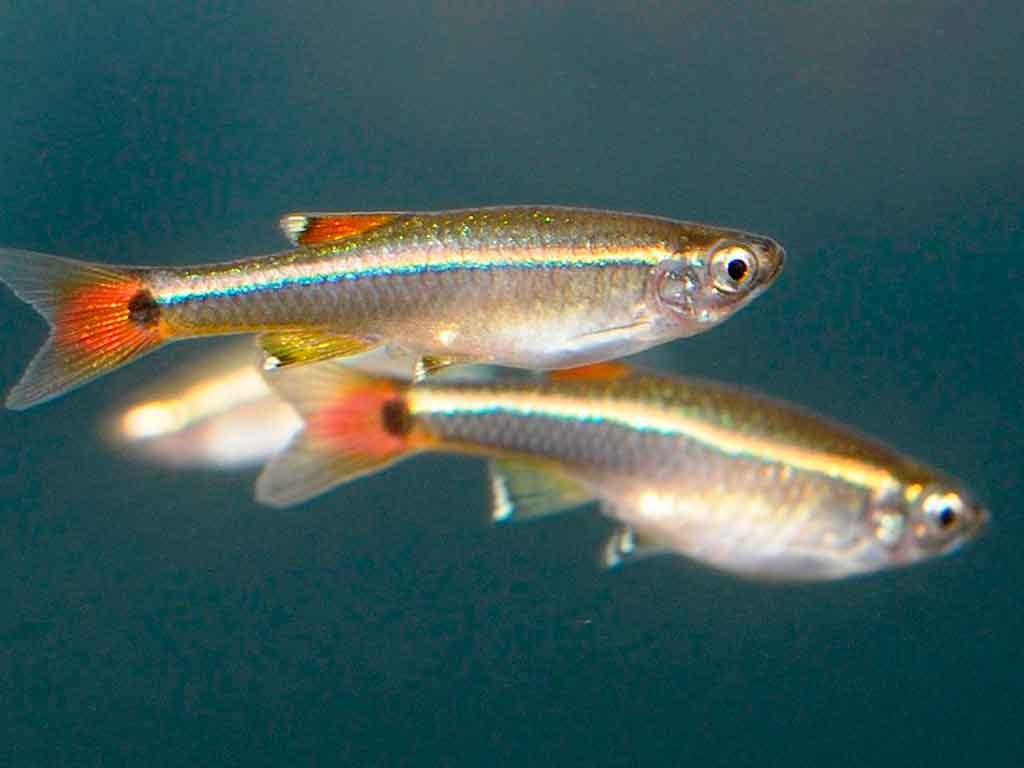
The White Cloud Mountain minnow is a hardy 4 cm cool-water fish for 14-22°C tanks. It is peaceful, active and ideal for an unheated aquarium. A group of six or more keeps it calm and colorful.
The species is Tanichthys albonubes, a Chinese cyprinid, not a tetra. It is sold as the Chinese neon fish, mountain minnow and white cloud. This guide covers the name confusion, temperature, size, tank size, food, tank mates, breeding and the neon tetra comparison.
White Cloud Mountain Minnow Fish: Quick Facts
The table below gives the working numbers. Later sections explain the exceptions.
| Fact | Detail |
|---|---|
| Scientific name | Tanichthys albonubes |
| Common names | White Cloud Mountain minnow, Chinese neon fish, mountain minnow, white cloud |
| Adult size | 4 cm (1.6 in) |
| Temperature | 14 to 22°C (57 to 72°F) |
| pH | 6.0 to 8.5 |
| Minimum tank | 54 L (14 US gal), 60 cm (24 in) long |
| Group size | 6 minimum, 10 or more better |
| Lifespan | About 3 to 5 years |
| IUCN status | Data Deficient |
White Cloud Mountain Minnow Temperature
This is a cool-water fish, not a tropical one. The working range is 14 to 22°C (57 to 72°F). It can survive colder and warmer spells, but permanent warmth shortens its life.
- Ideal: 18 to 22°C (64 to 72°F) for most home tanks.
- Cool end: 14 to 18°C (57 to 64°F) suits unheated rooms and ponds.
- Short-term tolerance: down to 5°C (41°F), but not for a permanent indoor setup.
- Avoid: a constant 26 to 28°C (79 to 82°F), which stresses the fish and shortens its life.
Mountain Minnow Fish: Name Check
“Mountain minnow fish” is a general label, not a species. In the trade it usually means the White Cloud Mountain minnow, but it can also mean other small Asian cyprinids. Ask for the scientific name if the label is vague.
Tanichthys albonubes belongs to the family Tanichthyidae, which some references still place within Cyprinidae. It is not a livebearer, not a tetra and not a danio, even though it is often grouped with them in stores.
Where Do White Cloud Minnows Come From?
The species comes from the Pearl River Delta in Guangdong and Hainan, southern China. It lives in clear, slow-moving hill streams and pools with gravel, rocks and plants. The type locality is White Cloud Mountain near Guangzhou, now a popular tourist area.
Wild populations crashed because of pollution, habitat loss and collection. The fish was considered extinct in the wild for decades, then rediscovered in small numbers. It is endangered in China and Data Deficient on the IUCN Red List. Every aquarium fish is captive-bred.
Golden Mountain Minnow and Gold White Cloud Fish
The Golden Mountain Minnow is a color morph of the same species, not a separate fish. It has a yellow-orange body and red fins. The Gold White Cloud fish is the same morph under another trade name.
Other strains include albino, long-fin, “meteor” and “super red.” Care is identical. The main difference is color, and some long-fin strains are more prone to fin damage from nippy tank mates.
White Cloud Tetra? No.
“White cloud tetra” is a misnomer. The fish is a cyprinid, not a characin. It has no adipose fin and no tetra relatives. The name probably comes from its neon-like stripe as a juvenile, which fades with age.
If a store sells a “white cloud tetra,” check the scientific name. It may be this fish under a wrong label, or a different tetra entirely.
Is It Sarcocheilichthys parvus?
No. Sarcocheilichthys parvus is a different cyprinid, a small gudgeon-like fish from East Asia. It is not Tanichthys albonubes, and it does not share the same care or trade history.
The confusion comes from old Chinese fish lists and mistranslated labels. If a seller uses Sarcocheilichthys parvus for a white cloud, the name is wrong.
White Cloud Mountain Minnow vs Neon Tetra
The two fish are often compared because both are small, silver and sold as beginners. They are not interchangeable. The table below gives the practical differences.
| Aspect | Difference |
|---|---|
| Temperature | White cloud 14 to 22°C; neon 21 to 25°C |
| Hardiness | White cloud tolerates cooler, harder and more variable water |
| Color | Neon has a blue-red stripe; white cloud has a pale stripe and red fins |
| Group size | Both need six or more; white cloud does better with ten |
| Family | White cloud is a cyprinid; neon is a characin |
Choose the white cloud for an unheated or cool tank. The neon suits a warmer community that stays at 24 to 25°C. Keeping either one at the wrong temperature is the most common mistake.
White Cloud Mountain Minnow Size
Adults reach about 4 cm (1.6 in) total length, with males slimmer and more colorful. Females are rounder, especially when carrying eggs. A well-grown adult is small enough for a 60 cm tank, but the school still needs swimming room.
Tank Size and Setup
Seriously Fish gives a minimum base of 60 x 30 cm (24 x 12 in), about 54 L (14 US gal). A 75 cm (30 in) tank is better for a group of ten, and a 90 cm (36 in) tank is better again.
| Tank size | Recommendation |
|---|---|
| 38 L (10 US gal) | Too small for a proper group |
| 54 L (14 US gal), 60 cm (24 in) | Minimum for six adults |
| 75 L (20 US gal), 75 cm (30 in) | Better for 10 fish |
| 110 L (29 US gal), 90 cm (36 in) | Best for a large school and tank mates |
A 100 L tank holds about 100 kg (220 lb) of water before rock, sand and glass. Check the floor rating before you fill a large tank. Use a dark substrate, driftwood and plants to bring out the red fins, and leave open water in the middle.
Water Parameters
This species is adaptable, but stable water matters more than a perfect number. The table below gives the practical range.
| Parameter | Target |
|---|---|
| Temperature | 14 to 22°C (57 to 72°F) |
| pH | 6.0 to 8.5 |
| General hardness | 5 to 20 dGH |
| Ammonia and nitrite | 0 ppm |
| Nitrate | Below 40 ppm |
Seriously Fish gives 14 to 22°C, pH 6.0 to 8.5 and 5 to 20 dGH. FishBase gives 18 to 22°C, pH 6.0 to 8.0 and 5 to 19 dGH. The aquarium water chemistry guide explains how KH and pH interact.
Diet and Feeding
White clouds are micropredators. In the wild they eat small insects, worms, crustaceans and zooplankton. For the aquarium, they take small dry food, but they do better with live or frozen meals.
- Micro flakes or finely crushed granules as the staple.
- Frozen or live Daphnia, cyclops and brine shrimp.
- Bloodworm in moderation, especially before breeding.
- A plant-based or algal food once or twice a week.
Feed two small meals a day. The mouth is small, so large pellets are ignored or spat out. A varied diet keeps the red fins strong and the body condition even.
Behavior and Tank Mates
White clouds are peaceful, active and loosely schooling. They swim in the middle and upper layers and rarely bother other fish. Males spar in short bursts, especially in the morning, but the behavior is display rather than damage.
Six is the minimum group, and ten or more is better. A larger school is calmer, colors better and shows more synchronized movement. Two or three fish hide and lose color. Ten or more move as a loose school, with males displaying in the morning; they are more active than most nano fish but do not school as tightly as rummy nose tetras.
4 Compatible Tank Mates
The four species below all have profiles in our freshwater fish library, and all four overlap with the white cloud at 21 to 22°C. Set the tank to 22°C (72°F) for the community; that is the top of the white cloud range and the bottom of the others.
| Species | Temperature overlap |
|---|---|
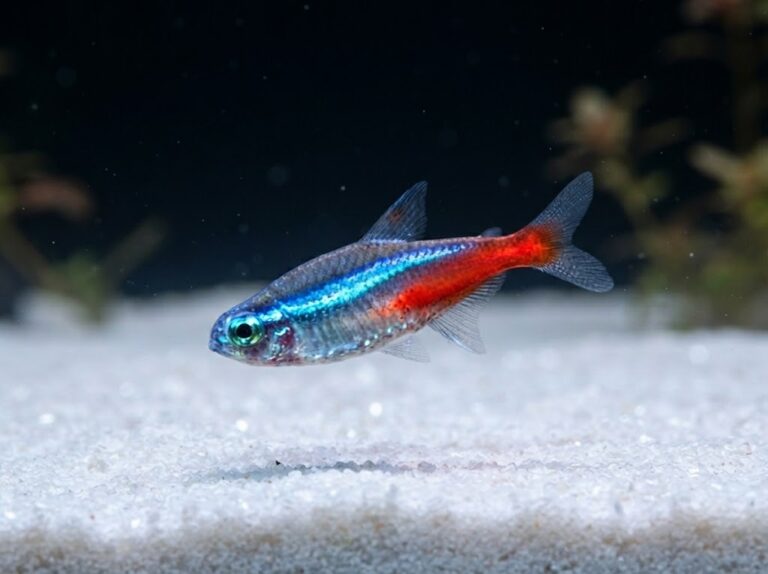
| Neon Tetra | 21 to 25°C |
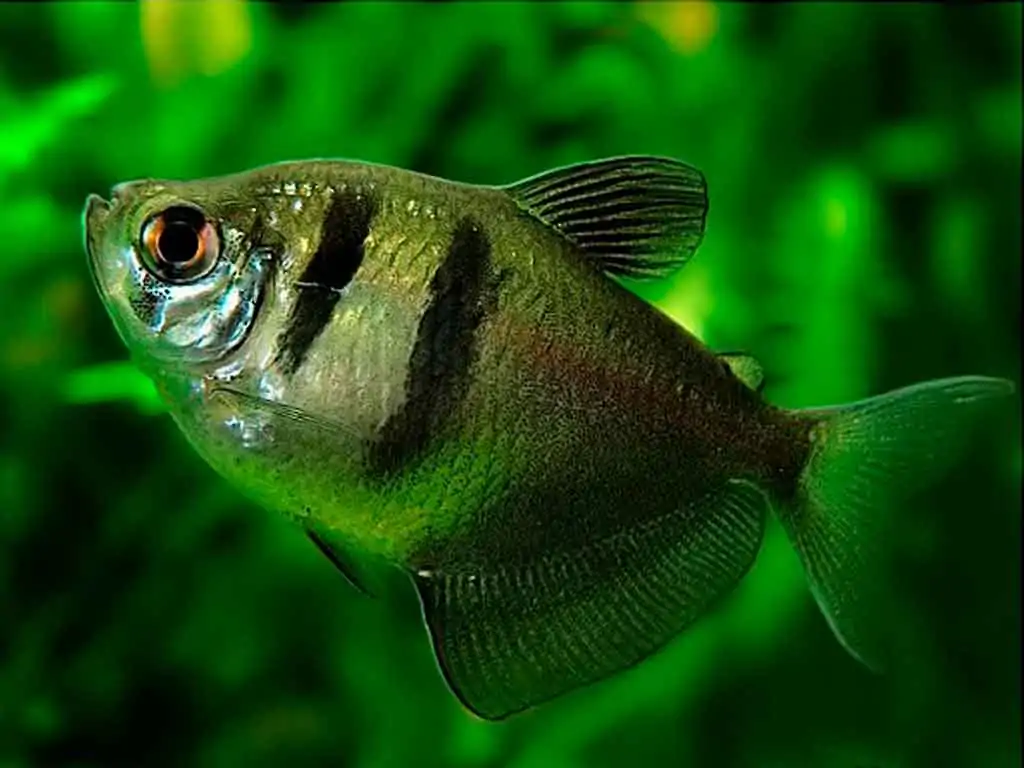
| Black Skirt Tetra | 20 to 26°C |
| Guppy | 22 to 28°C |
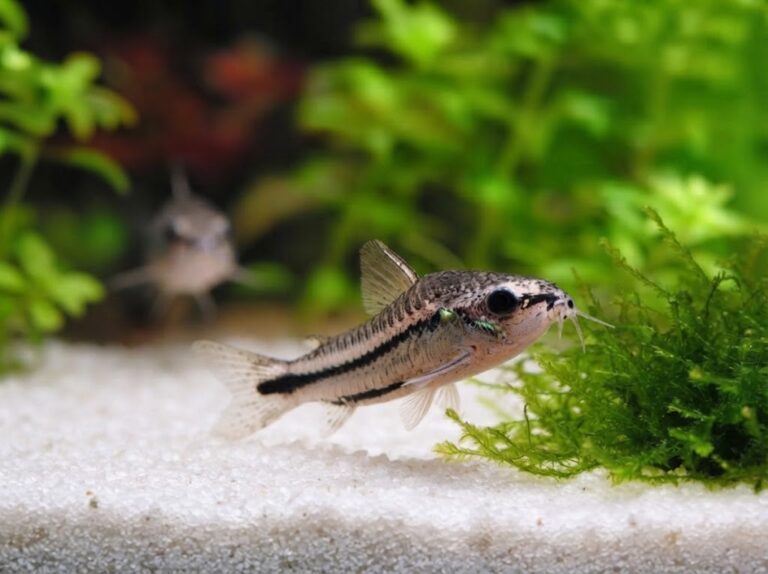
| Pygmy Corydoras | 22 to 26°C |
Neon tetras overlap at 21 to 22°C and stay in the middle layer. They bring blue and red, but they need the warmer end of the white cloud range.
Black skirt tetras handle 20 to 22°C and add a taller, darker shape. They are semi-aggressive, so keep a group of six or more.
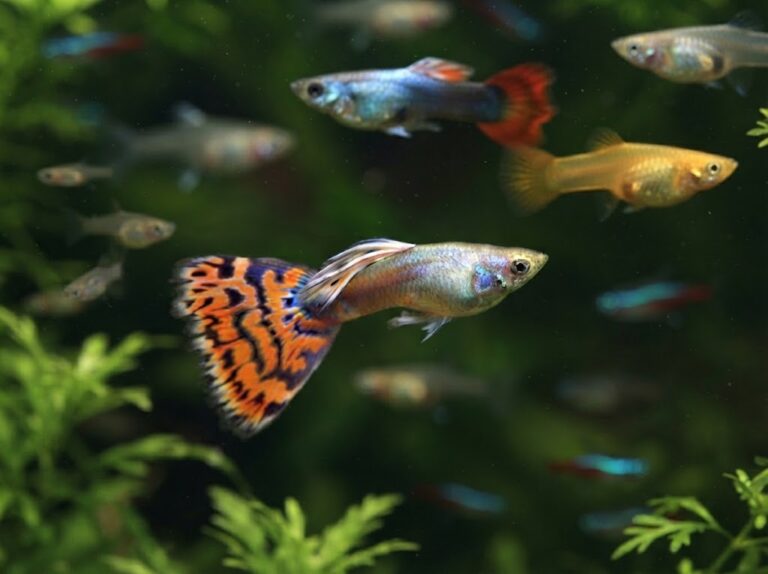
Guppies overlap at 22°C and use the upper layer. They breed freely, so plan for fry or keep one sex.
Pygmy Corydoras work the bottom and ignore the school. Six is a better number than two, and sand protects their barbels.
Avoid goldfish, large cichlids and aggressive barbs. Goldfish are often sold as white cloud companions, but they grow too large, eat too much and prefer different water. Skip long-finned bettas as well, because the white clouds may nip.
Fish to Avoid
- Goldfish, which outgrow the tank and produce heavy waste.
- Large cichlids and aggressive barbs.
- Bettas and long-finned fish that may be nipped.
- Tropical species that need a constant 26 to 28°C.
Breeding
White clouds are among the easiest egg-laying fish to breed. A well-conditioned group in a planted tank often produces fry without help. Large water changes or a small temperature drop can trigger spawning.
- Condition a group of males and females on live and frozen food for two weeks.
- Set up a 20 to 30 L (5 to 8 US gal) tank with soft, neutral water and a sponge filter.
- Add Java moss, a spawning mop or a layer of marbles so the eggs fall out of reach.
- Add two males and three or four females, and let them spawn in the morning.
- Remove the adults after two or three days, because they eat eggs.
- Expect eggs to hatch in about 48 to 60 hours at 22°C (72°F).
- Feed the fry infusoria first, then microworms and brine shrimp nauplii.
Lifespan
Most white clouds live about 3 to 5 years in a cool, stable tank. Some reach 7. Permanent warmth, poor water and inbreeding shorten the range. Buy from a breeder who culls deformed fish.
White Cloud Minnow Health
White clouds are hardy, but inbred farm stock can arrive weak. Quarantine new fish for two to four weeks, and buy from a breeder who culls deformities.
- White spots or flashing point to ich, often after a temperature swing.
- A bent spine, missing fins or a sunken belly suggest poor breeding.
- Clamped fins and isolation are early signs of stress.
- Rapid breathing can mean low oxygen or high nitrate.
Check temperature, ammonia and nitrate before you treat. A cool-water fish in a warm tank is stressed even when the water tests clean.
Common Mistakes
- Keeping them at 26 to 28°C (79 to 82°F) because the other fish like it warm.
- Buying two or three fish instead of a group of six or more.
- Using a 38 L (10 US gal) tank as permanent housing for adults.
- Adding goldfish as tank mates.
- Feeding pellets that are too large for the mouth.
- Buying a “white cloud tetra” without checking the scientific name.
Conservation Status
The IUCN Red List lists Tanichthys albonubes as Data Deficient, assessed in 2010. It is considered endangered in China and appears to have been extirpated from White Cloud Mountain itself. All aquarium fish are captive-bred, and inbreeding has left some stock weak or deformed. Buy from a breeder who selects healthy fish.
Setup Checklist
- Tank at least 60 cm (24 in) long and 54 L (14 US gal).
- Filter rated for the volume, with gentle to moderate flow.
- No heater, or a heater set to 20 to 22°C (68 to 72°F).
- Sand or fine gravel, driftwood and a few rocks.
- Plants at the back and sides, with open water in the middle.
- A lid, because active minnows can jump when startled.
- A liquid test kit for ammonia, nitrite, nitrate and pH.
- A group of six to ten fish before you add tank mates.
Frequently Asked Questions
What to Check Before You Buy
Check the tank temperature first. If the tank runs above 24°C (75°F), this is not the right fish. Then check the group size and the label: ask for Tanichthys albonubes, not a “white cloud tetra.”
Buy at least six, and ten if the tank allows. Compare the profiles in the freshwater fish library before you commit. Cool water and a proper school are the two details that keep this fish healthy.