Black Skirt Tetra Care: Tank, Diet and Tank Mates
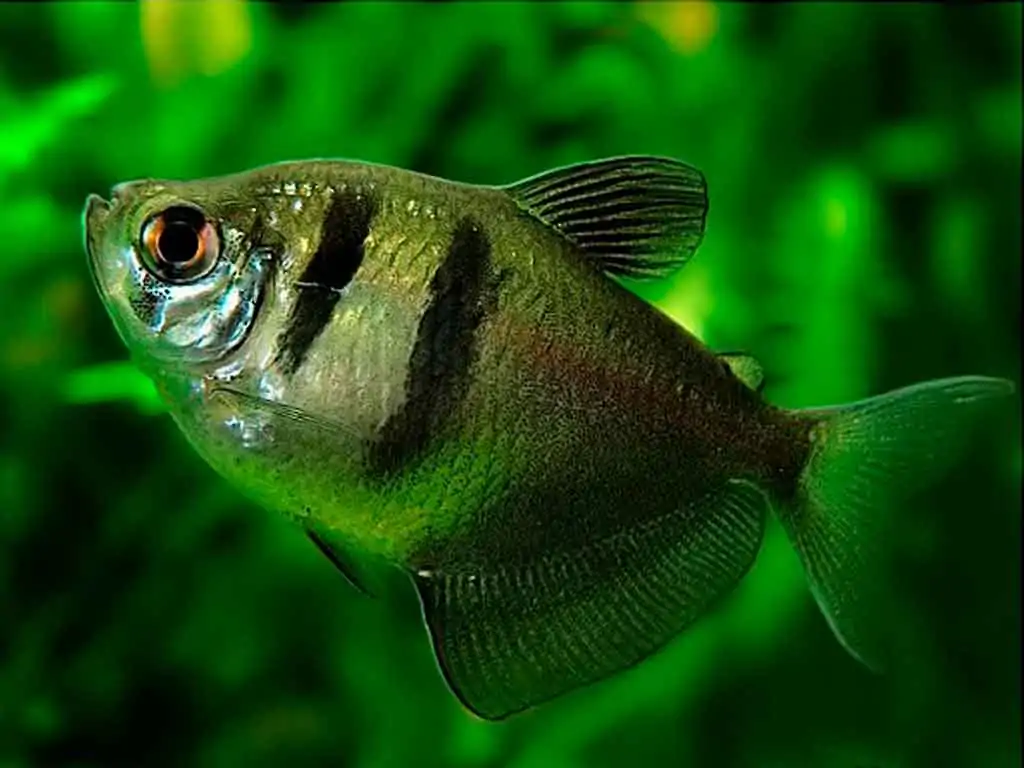
The black skirt tetra is a hardy 5-7.5 cm schooling fish for 20-26°C community tanks. It is semi-aggressive, nips long fins and needs a group of six or more. Keep the water cool and the school large, and it settles into one of the easiest tetras in the hobby.
The species is Gymnocorymbus ternetzi, also sold as the black widow tetra and black tetra. This guide covers size, male and female differences, tank size, temperature, diet, tank mates, lifespan and breeding.
Black Skirt Tetra Fish: Quick Facts
The table below gives the numbers you need before you buy. Later sections explain the exceptions.
| Fact | Detail |
|---|---|
| Scientific name | Gymnocorymbus ternetzi |
| Common names | Black skirt tetra, black widow tetra, black tetra |
| Adult size | 5 to 7.5 cm (2 to 3 in) |
| Temperature | 20 to 26°C (68 to 79°F) |
| pH | 6.0 to 8.0 |
| Minimum tank | 68 L (18 US gal), 75 cm (30 in) long |
| Group size | 6 minimum, 8 to 12 better |
| Lifespan | About 3 to 6 years |
| IUCN status | Least Concern |
Black Skirt Tetra Size
Most adults measure 5 to 6 cm (2 to 2.4 in). FishBase records a maximum of 7.5 cm (3 in) standard length, which excludes the tail fin. Females are usually deeper-bodied and visibly larger than males.
Juveniles are darker and more strongly barred than adults. The intense black fades as the fish grows, so a paler adult is normal and not automatically a sign of illness.
Black Skirt Tetra Male or Female
Mature fish are not hard to sex once you know what to look for. The table below separates the two.
| Sex | Signs |
|---|---|
| Male | Slimmer, slightly smaller, often darker, with more pointed dorsal and anal fins |
| Female | Larger, rounder and deeper-bodied, especially when carrying eggs; fins are shorter and rounder |
Black Skirt Tetra Female
A female full of eggs looks almost square from below. That fullness is the most reliable sign, and it is easier to judge than fin shape. Juveniles cannot be sexed reliably, so buy a group and let them mature.
Black Skirt Tetra Types
- Wild type: silver-gray body, two black vertical bars and a broad black rear half.
- White skirt tetra: a leucistic form with a pale body and dark eyes, not a true albino.
- Long-fin black skirt: a selectively bred fin form with the same care and temperament.
- GloFish black skirt: a transgenic line with fluorescent color, biologically the same species.
- Dyed black skirt: injected with color, stressful and short-lived; avoid these fish.
The white and long-fin forms are not separate species. They need the same water, food and group size as the wild type.
Where Do Black Skirt Tetras Come From?
The species comes from the Paraguay and Guaporé river basins in Brazil, Bolivia and Argentina. It lives in small, slow-moving creeks and tributaries with overhanging vegetation, not in the deep, fast main river.
Wild fish are not available in the trade. Every fish sold today is captive-bred, which is why the species tolerates a wide range of water chemistry. Captive-bred fish still do best in stable water, and a wild-caught claim is a red flag.
Black Skirt Tetra Tank Size
Plan by tank length and school size, not by litres alone. A long tank gives the school room to swim and spreads chasing behavior.
| Tank size | Recommendation |
|---|---|
| 38 L (10 US gal) | Too small for an adult school |
| 57 L (15 US gal) | Borderline for a small group |
| 68 to 76 L (18 to 20 US gal) | Minimum for 6 to 8 adults, preferably a long tank |
| 100 L (26 US gal) | Better for a larger school and tank mates |
A 100 L tank holds about 100 kg (220 lb) of water before rock, sand and glass. Check the floor rating before you fill a large tank. Use a filter rated for the volume, and keep the current moderate rather than violent.
Use a dark substrate if you want the black bars to stand out. Driftwood, rock and tall plants at the back give cover without blocking the open middle. Floating plants soften the light. Keep the filter output moderate, and place the heater where the school cannot crowd it.
Black Skirt Tetra Temperature and Water Parameters
This is a subtropical fish, not a warm-water tetra. The table below gives the range that keeps it comfortable.
| Parameter | Target |
|---|---|
| Temperature | 20 to 26°C (68 to 79°F) |
| pH | 6.0 to 8.0 |
| General hardness | 5 to 19 dGH |
| Ammonia and nitrite | 0 ppm |
| Nitrate | Below 40 ppm, ideally below 20 ppm |
Seriously Fish gives 20 to 26°C, pH 6.0 to 7.0 and 5 to 20 dGH. FishBase gives the same temperature range, pH 6.0 to 8.0 and 5 to 19 dGH. A steady 24°C (75°F) suits most community tanks.
Avoid keeping this fish at a constant 28°C (82°F). Warm water speeds its metabolism, shortens its life and makes oxygen levels harder to maintain. The aquarium water chemistry guide explains how temperature, pH and KH interact.
Aquarium Supplies
Tetra LED 20 Gallon Complete Fish Tank Kit for Freshwater Fish
Aquarium Kit Includes LED Light, 20 Gallon Glass Tank With Hinged Hood, Filter, Filter Cartridge, Décor, For Freshwater Fish
Shop on Amazon
Tetra TetraMin Tropical Granules
Highly digestible ingredients for use as staple food for your mid-feeding tropical fish.
Shop on Amazon
Tetra SafeStart Plus for New Freshwater Aquariums
Establishes Healthy Bacteria In New Fish Tanks, Reduces Ammonia & Nitrite, Starts Working Immediately
Shop on Amazon
Tetra AquaSafe Plus Water Conditioner & Dechlorinator For Aquarium
Treats 2X the Water as Standard AquaSafe, Makes Tap Water Safe, Reduces Fish Stress, Removes Chlorine, Use Monthly
Shop on AmazonAs an Amazon Associate, Happy Pet Zone earns from qualifying purchases, at no extra cost to you.
Diet and Feeding
These tetras are omnivores and eat almost anything of the right size. A varied diet keeps them active and improves color.
- Quality flakes or micro-granules as the staple.
- Frozen or live Daphnia, cyclops and brine shrimp two or three times a week.
- Bloodworm or mosquito larvae as an occasional protein meal.
- A plant-based prepared food once or twice a week for variety.
Feed one or two small meals a day, and only what the school finishes in a minute or two. These fish rush food, and a slower tank mate may get nothing if you overfeed the surface. No weekly fast day is required for healthy adults.
| Food | Frequency |
|---|---|
| Flakes or micro-granules | One or two small meals daily |
| Frozen or live Daphnia, cyclops, brine shrimp | Two or three times a week |
| Bloodworm or mosquito larvae | Once a week |
| Plant-based prepared food | Once or twice a week |
Behavior and Tank Mates
Black skirts are active mid-water fish that stay in a loose school. They chase, display and occasionally nip. The behavior is worse in a small group or a short tank, where the same fish gets targeted every time.
Six is the minimum group, and 8 to 12 is better. A larger school spreads the interaction among the tetras and leaves the other fish alone. Keep them with short-finned, active species of similar size, and skip slow fish with long flowing fins.
Why Do Black Skirt Tetras Nip Fins?
The behavior is social, not predatory. A small group turns its attention outward, and long, slow fins are easy targets. Eight to 12 keeps the hierarchy inside the school.
Feeding time can trigger chasing. Offer food across the surface rather than in one spot, and keep the tank long enough for a chased fish to break line of sight.
Black Skirt Tetra Tank Mates
The four species below all have profiles in our freshwater fish library, and all four overlap with the black skirt at 23 to 26°C. They are active enough to ignore the tetras and short-finned enough to avoid becoming targets.
| Species | Temperature overlap |
|---|---|
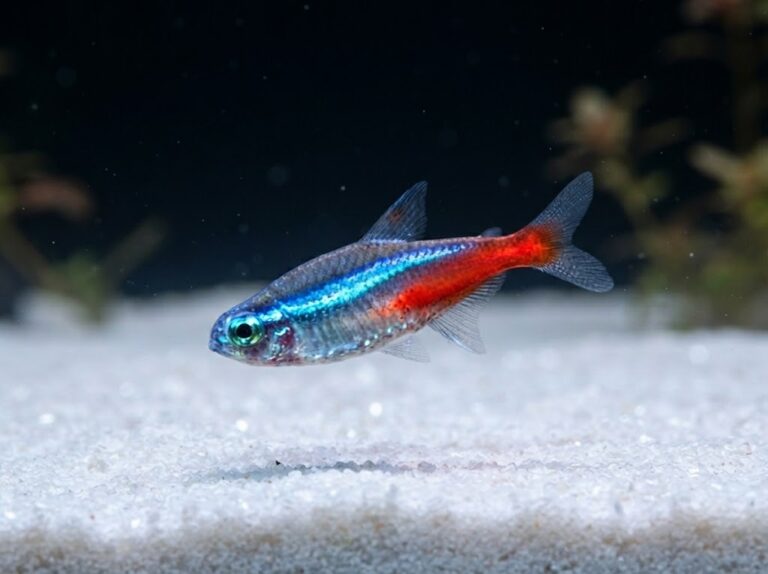
| Neon Tetra | 21 to 25°C |
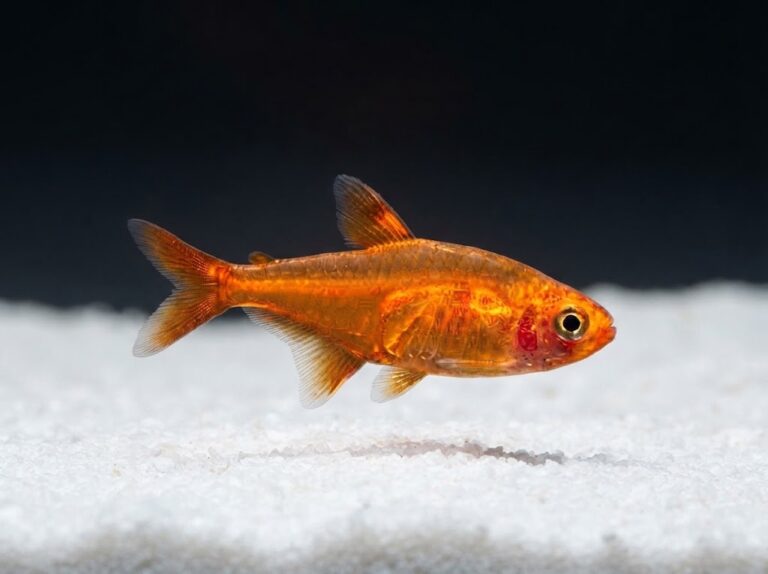
| Ember Tetra | 23 to 28°C |
| Cherry Barb | 23 to 26°C |
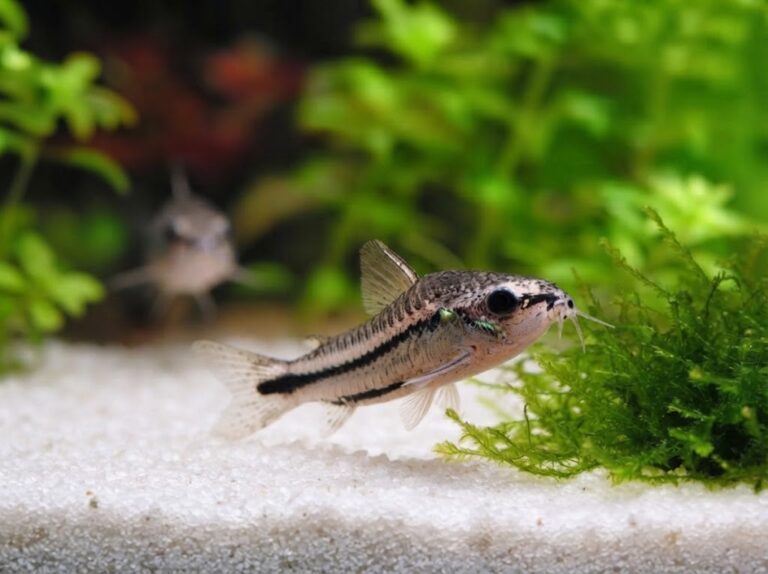
| Pygmy Corydoras | 22 to 26°C |
Neon tetras stay in the middle layer and bring blue and red to the tank. They overlap at the cool end of the black skirt range, around 23 to 25°C.
Ember tetras are small, peaceful and happy at 24 to 26°C. Their orange body contrasts with the black skirt, and they do not compete for the same space.
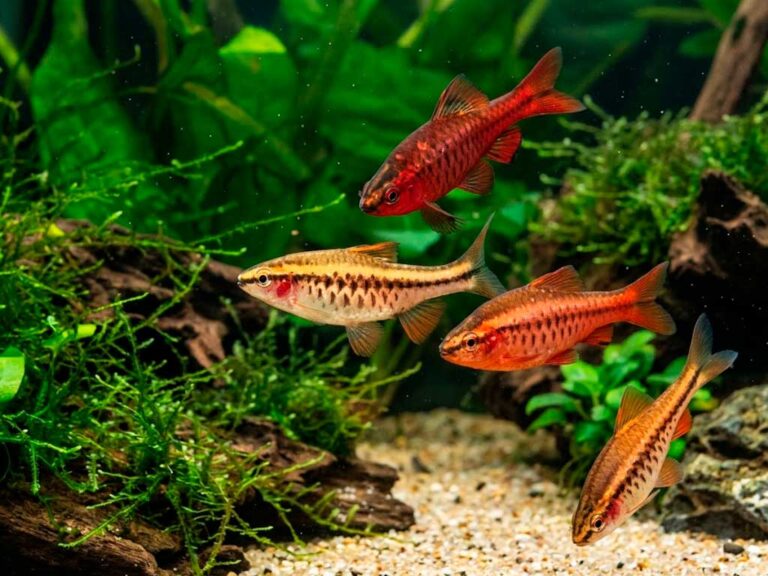
Cherry barbs are robust enough to handle the tetra’s activity and short-finned enough to avoid nipping. Keep a group of six or more.
Pygmy Corydoras work the bottom and ignore the mid-water school. Six is a better number than two, and a sand or fine gravel substrate protects their barbels.
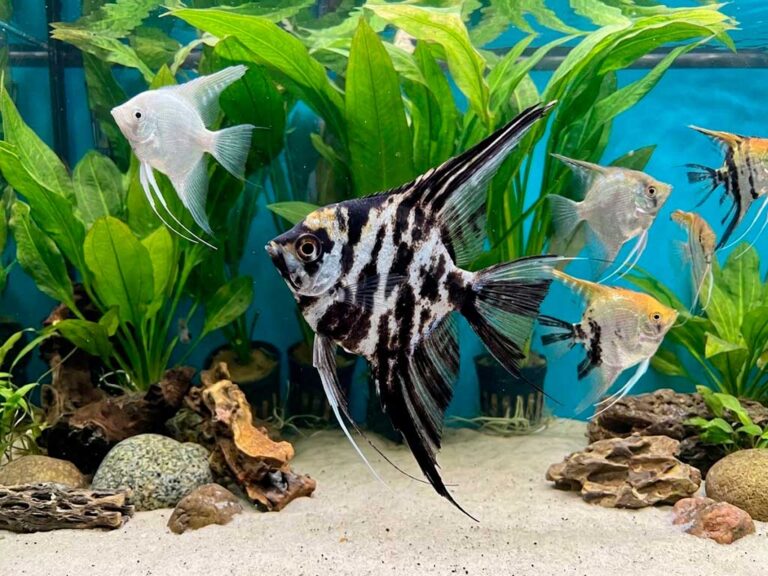
Avoid bettas, fancy guppies and long-finned angelfish. Their fins are exactly what a black skirt cannot resist. Also skip very shy fish that will be outcompeted at feeding time.
Fish to Avoid
- Bettas and fancy guppies, because their long fins invite nipping.
- Angelfish, which are slow and long-finned in the same water range.
- Large or aggressive cichlids that can bully the school.
- Very small shrimp, because shrimplets are food.
Black Skirt Tetra Lifespan
Most live about 3 to 6 years in captivity, and a well-kept fish can reach 7. Cool, stable water and a varied diet matter more than any single number. Warm water and chronic stress shorten the range.
Breeding and Fry
This is an egg scatterer with no parental care. Adults eat eggs, so a separate breeding tank gives the best results.
Condition the pair on live and frozen food for two weeks before spawning. A female full of eggs is visibly rounder, and the male will display with fins flared. If the pair does not spawn within a week, separate them, feed heavily for a few days and try again.
- Set up a 20 to 30 L (5 to 8 US gal) breeding tank at about 24°C (75°F).
- Add Java moss, a spawning mop or marbles so the eggs fall out of reach.
- Introduce a pair or a small group, and let them spawn in the morning light.
- Remove the adults as soon as eggs appear.
- Expect 150 to 200 eggs, hatching in about 20 to 24 hours at 24°C (75°F).
- Feed the fry infusoria first, then newly hatched brine shrimp once they are free-swimming.
The fry become free-swimming about three to four days after hatching. Keep the light dim and the flow gentle for the first week. A sponge filter protects the smallest fry.
Eggs and Hatching
The eggs are adhesive and about 1 mm across. At 24°C (75°F) they hatch in about 20 to 24 hours, and cooler water slows development. The larvae absorb the yolk for three to four days before they swim freely.
Feed infusoria or a commercial microfood first, then brine shrimp nauplii. Keep the light dim, because early eggs and fry are sensitive to bright light.
Common Mistakes
- Keeping a group of two or three and wondering why one fish is bullied.
- Using a 38 L (10 US gal) tank as permanent housing for adults.
- Running the tank at 28°C (82°F) because other community fish like it warm.
- Adding bettas, fancy guppies or long-finned angelfish.
- Buying dyed fish instead of a natural or selectively bred form.
- Breeding in the community tank and losing every egg.
Black Skirt Tetra Health
Black skirts are hardy, but they still get ich, fin rot and bacterial infections when water quality slips. The first response is a water test, not a medication.
- White spots, flashing or clamped fins point to ich or poor water.
- Ragged fins can be social damage or fin rot; watch the group before treating.
- Loss of appetite and isolation are early signs of stress.
- A fish that hides while the school feeds is usually being bullied.
Quarantine new fish for two to four weeks. Keep ammonia and nitrite at zero, change 25 to 30 percent of the water weekly, and avoid temperature swings. A bullied fish may show fin damage that looks like fin rot, so check behavior before you treat.
Setup Checklist
- Tank at least 75 cm (30 in) long and 68 L (18 US gal).
- Filter rated for the volume, with moderate flow.
- Adjustable heater set to 24°C (75°F) and a separate thermometer.
- Sand or fine gravel, plus driftwood or rock for cover.
- Tall plants at the back and floating plants to soften the light.
- Open swimming space across the middle of the tank.
- Liquid test kit for ammonia, nitrite, nitrate and pH.
- A tight lid, because active tetras can jump when startled.
Conservation Status
The IUCN Red List lists Gymnocorymbus ternetzi as Least Concern, assessed in 2021. It is widespread across the Paraguay and Guaporé basins, and the aquarium trade relies on captive-bred stock. Never release aquarium fish into the wild.
Frequently Asked Questions
What to Check Before You Buy
Measure the tank length first. A 60 cm (24 in) tank is too short for an adult school; aim for 75 cm (30 in) or more. Set the heater to 24°C (75°F) and check that it holds steady before the fish arrive.
Then buy a group of at least six, and avoid any tank with long-finned fish already in it. Compare the profiles in the freshwater fish library before you commit. A cool, stable tank and a proper school are the two details that decide whether this fish thrives.