Tetra EasyStrips & Aquarium Water Testing Guide
Clear water lies. A tank can look perfectly fine and still be carrying an ammonia spike that’s actively damaging your fish’s gills.
Testing is the only way to actually know what’s in the water, and it’s the single habit that separates aquarists who catch problems early from the ones who only find out something’s wrong once a fish is already sick.
This guide covers water testing in general, strips versus liquid kits, what to test and how often, and then narrows in on where Tetra EasyStrips fits into that routine. For the deeper chemistry behind these numbers, see our aquarium water chemistry guide.
What You’re Actually Testing For
Every tank, freshwater or saltwater, should have four parameters checked as a baseline: ammonia, nitrite, nitrate, and pH. Ammonia and nitrite should both read zero in a healthy, cycled tank; anything above that is a direct threat to fish health, not a minor inconvenience.
General hardness (GH) and carbonate hardness (KH) matter more for specific setups: planted tanks, African cichlids, and reef systems all lean on stable hardness more than a basic community tank does. Saltwater adds salinity and, for reef tanks, calcium and alkalinity on top of everything freshwater already needs.
Test Strips vs. Liquid Reagent Kits
Every fishkeeper eventually asks whether to use strips or a liquid kit, and the honest answer is that it depends on what you’re testing for and how often.
| Test Strips | Liquid Reagent Kits | |
|---|---|---|
| Speed | Seconds, dip and read | Several minutes per parameter |
| Accuracy | Good enough for routine checks | More precise, better for diagnosing issues |
| Cost per test | Lower upfront, less per test | Higher upfront, cheaper long-run per test |
| Best for | Weekly monitoring, quick checks | Cycling a new tank, troubleshooting a problem |
In practice, plenty of experienced keepers use both: strips for the routine weekly glance, and a liquid kit when something looks off and they need a number they can actually trust.
Where Tetra EasyStrips Fits
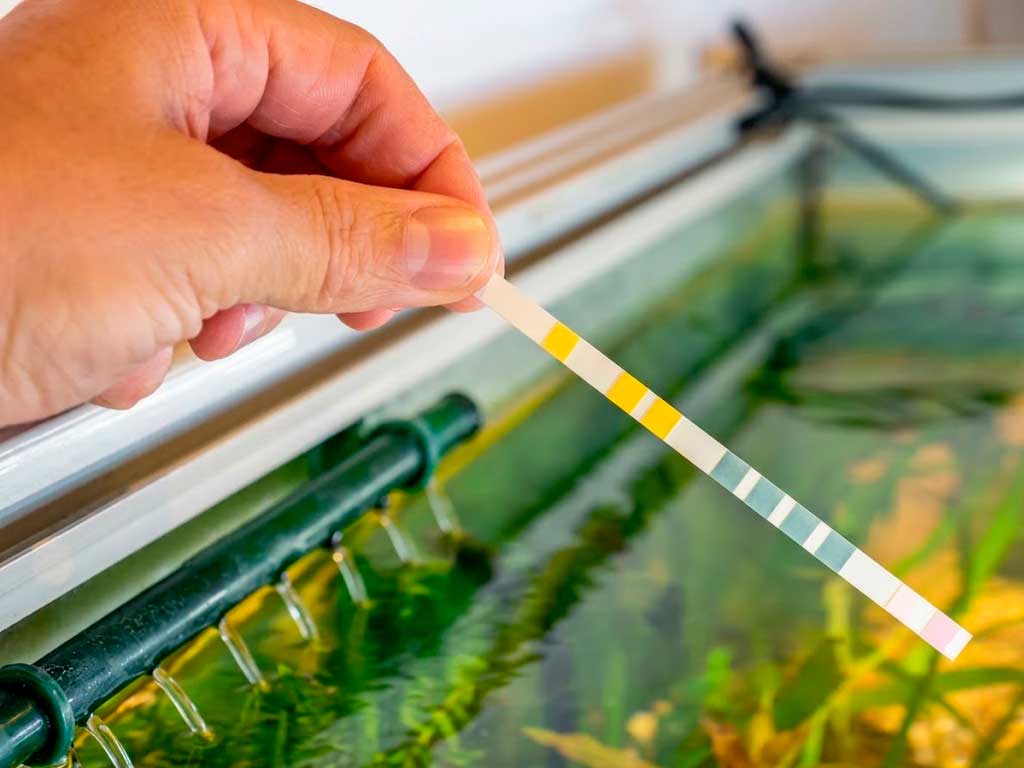
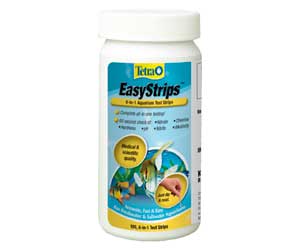
Tetra EasyStrips cover six parameters in one dip: pH, ammonia, nitrite, nitrate, and two more depending on the exact kit version, usually GH and KH or chlorine and alkalinity. Dip the strip, wait the stated time, and match the pads against the color chart on the bottle. No vials, no drops to count, no timer split across four different reagents.
FROM AMAZON.COM
Tetra EasyStrips 6-in-1 Test Strips
Six parameters in one dip, the fastest way to keep tabs on a tank without setting up a full reagent kit.
Buy on Amazon.comHappy Pet Zone may earn a commission when you click through to Amazon.com, at no extra cost to you. As an Amazon Associate, we earn from qualifying purchases.
Where EasyStrips falls short is precision at the low end. Distinguishing 0.25 ppm ammonia from 0.5 ppm by eye against a color pad is genuinely hard, and that distinction matters during the first weeks of a cycle. That’s the situation where I’d reach for a liquid kit instead, even if strips handle every other week just fine.
How Often to Test
A cycling tank needs daily or every-other-day testing until ammonia and nitrite both hold at zero. Once established, weekly testing is the standard baseline, and it’s worth testing right before a water change too, since that’s when you’ll know if you’re falling behind on nitrate.
Test more often than usual after adding new fish, after any filter maintenance that disturbs the bacterial colony, or if fish start showing stress signs you can’t otherwise explain. If your readings keep coming back stuck rather than dropping, our guide to a tank that won’t cycle walks through what to check next, and our Tetra water conditioners guide covers the products that actually fix what the strips reveal.
Testing doesn’t fix anything by itself, it just tells you what needs fixing before your fish tell you the hard way. Keep it routine, keep the strips fresh, and reach for a liquid kit when the numbers matter more than the convenience. For the rest of the water care lineup, see the full Tetra products guide.